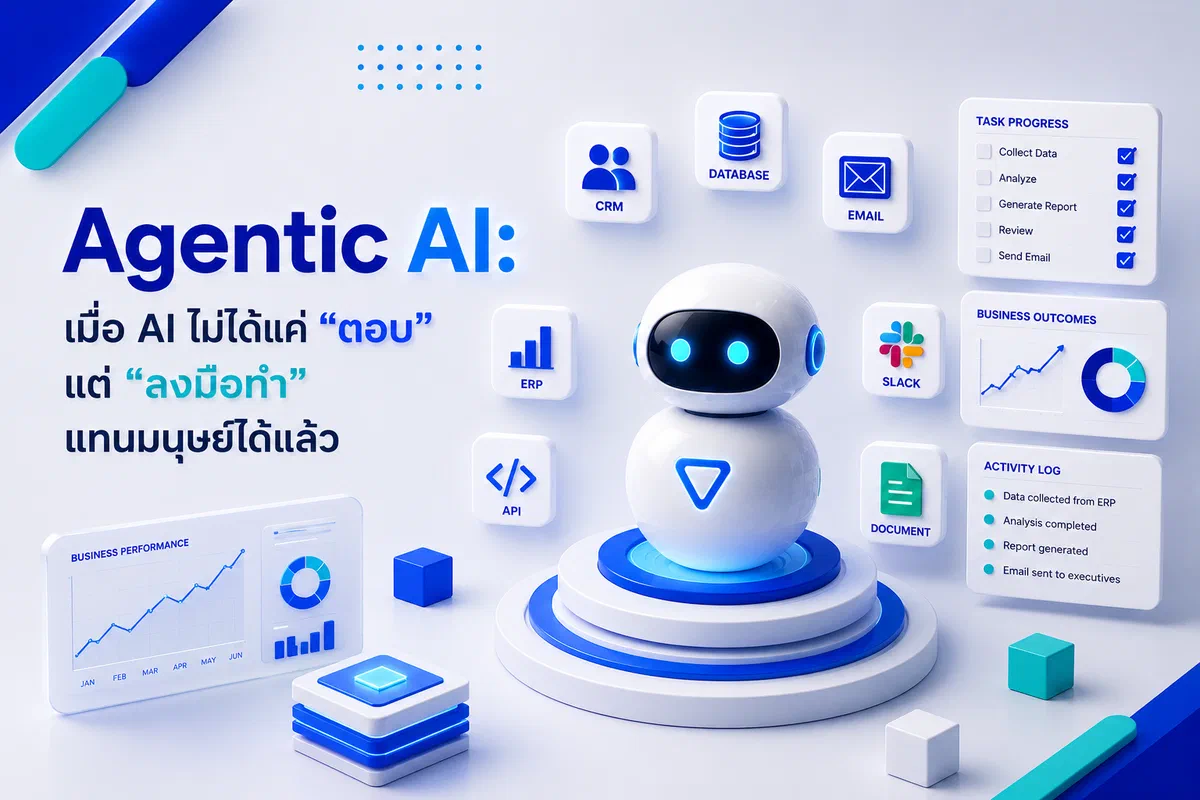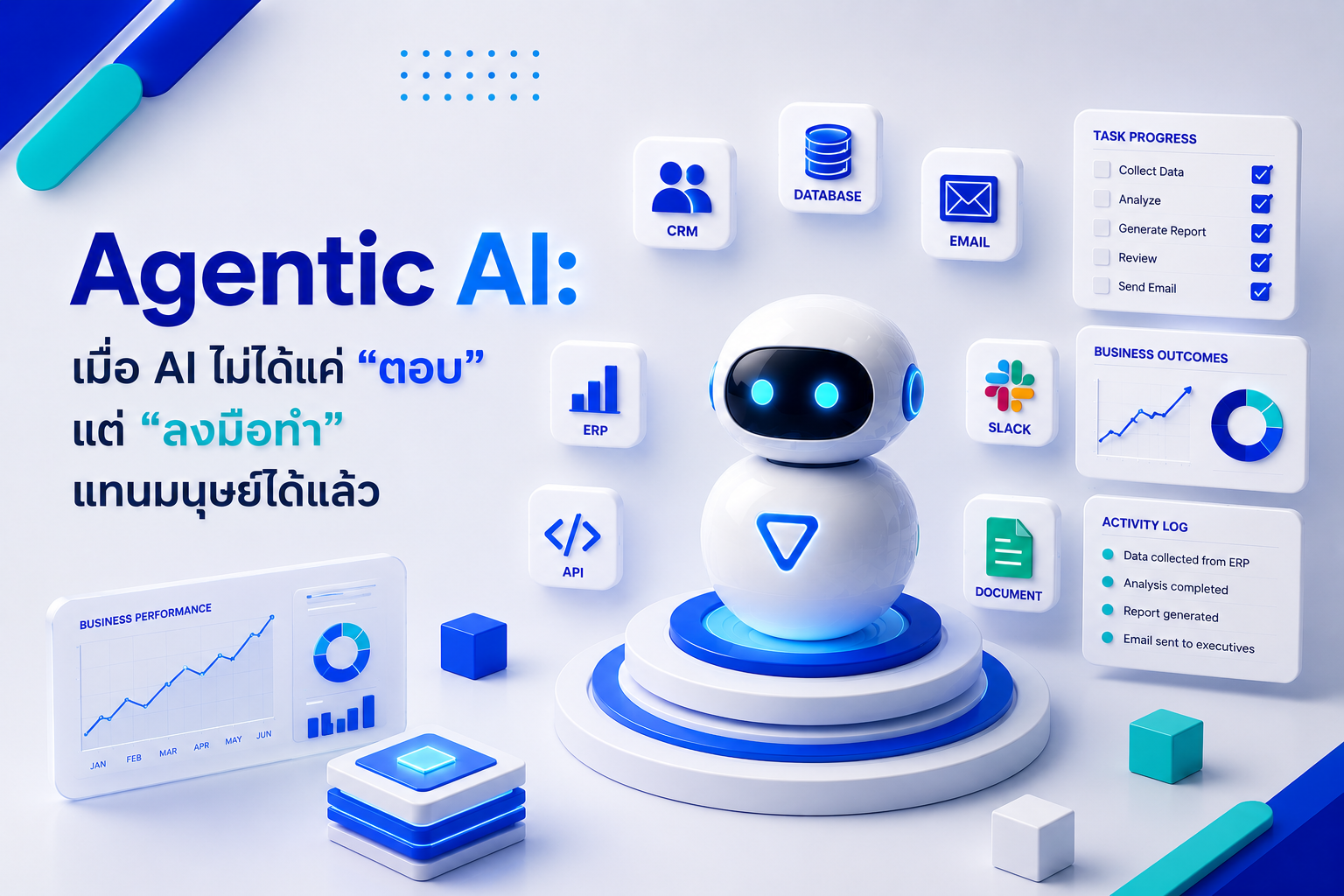
Many organizations have started using AI to create content, summarize reports, or write code — and consider themselves ahead of the curve. But what’s happening today goes far beyond making AI “better at answering.”
We’re entering an era where AI can genuinely think, plan, and execute tasks on behalf of humans.
This technology is called Agentic AI, and it’s shifting AI’s role from a “tool” to an “operator.”
Signs that this shift is no longer a future scenario: companies like Salesforce, Microsoft, and Google all announced products built on Agentic Architecture over the past year. At the enterprise level, operations, finance, and IT teams are increasingly being asked by leadership: “Which process should we deploy an AI Agent on first?” This article is meant to give a clearer picture before answering that question.
From Answer Engine to Action Layer
Looking back, the Generative AI we’re familiar with today operates in a fairly straightforward pattern: human inputs a command → AI generates a response → process ends.
Whether it’s writing an email, summarizing a report, or generating an image, AI responds to what the user requests — and does nothing further.
Agentic AI is fundamentally different.
Instead of receiving step-by-step instructions, the system receives a “goal” and is responsible for finding a way to achieve it.
In the world of Generative AI, you might give commands like:
- Pull the sales data
- Analyze the data
- Generate a report
- Write a summary email
But in the world of Agentic AI, you might simply define:
“Summarize the weekly performance and send it to executives every Monday at 8 AM.”
The AI then manages every step on its own — pulling data from multiple systems, analyzing trends, generating the report, checking accuracy, and sending the email to the relevant recipients.
This is the critical shift: from a system that produces answers to a system that produces real business outcomes.
What makes this shift possible today isn’t just smarter AI — it’s the supporting infrastructure finally being ready. Large Language Models now have sufficient Reasoning capability to handle complex, multi-step problems. Agent frameworks have become accessible enough for organizations to adopt without deep ML expertise. And API and Integration Layers can connect AI seamlessly to an organization’s real operational systems. All of these converged at the same time, making Agentic AI no longer just a concept.
How Agentic AI Works Like an Employee
What sets Agentic AI apart from earlier generations isn’t just language capability — it’s the integration of multiple capabilities working together.
Perception — Contextual Awareness AI can understand information from multiple sources simultaneously: documents, emails, databases, or internal organizational systems.
Reasoning & Planning AI can break large problems into subtasks, prioritize them, and determine an appropriate plan of action.
Tool Usage Agentic AI doesn’t just operate within a chat window. It can connect to external tools — CRM, ERP, Slack, Outlook, various APIs — to take real actions.
Memory AI can remember context from previous work, learn from past results, and improve its own working methods over time.
When these four components combine — Perception, Reasoning, Tool Usage, and Memory — AI starts to resemble a “digital employee” more than a conventional chatbot.
Consider an AI Agent managing an organization’s procurement function. When a product’s stock falls below a defined threshold, the system Perceives the signal from the ERP, Plans which supplier to order from at the best current price, uses a Tool to submit the purchase order automatically, and Remembers whether that supplier has had delivery delays in the past — factoring that into the next decision. All of this happens without a human manually monitoring every step.
Many organizations wonder how Agentic AI differs from RPA (Robotic Process Automation) they’ve already been running for years. The key distinction: RPA follows a pre-written script. If the process changes, the bot breaks or needs to be rewritten from scratch. Agentic AI can read the situation, interpret shifting context, and adjust its plan in Real-time. RPA suits repetitive, rule-bound tasks with fixed conditions. Agentic AI suits tasks that require Judgment and decision-making under uncertainty — which describes most real business work.
The 5 Levels of Agentic AI
Level 1: Prompt & Response AI receives commands and provides answers. Humans remain in control of every step. This is equivalent to using ChatGPT or Claude to answer questions, draft copy, or summarize documents — the starting point most organizations already know well.
Level 2: Guided Decision AI can choose certain paths or functions within a framework defined by humans. For example, a chatbot that routes tickets to the correct department on its own, or a recommendation engine that adapts its Persona based on user behavior.
Level 3: Tool-Using Agent AI can independently select the right tools to solve problems on its own — searching the web, calling external APIs, writing and running code to process data — choosing the appropriate tool based on the situation at hand.
Level 4: Multi-Agent Systems Multiple AI agents work together, with some acting as managers and others handling specialized tasks. An Orchestrator Agent breaks a project into subtasks, delegates each to a Specialist Agent, then aggregates the outputs and surfaces them for human review.
Level 5: Automated Workforce AI can think, plan, execute, review results, and resolve issues end-to-end on its own, with minimal human intervention at each step. Humans retain roles in setting goals, defining Guardrails, and making high-level strategic decisions.
Most organizations today sit between Level 2 and Level 3, while a handful of leading technology companies are actively testing Level 4. Level 5 remains largely in the research and development phase — but the direction is clear: systems are moving there faster than most organizations anticipate.
When AI Replaces “Processes” — Not Just “Jobs”
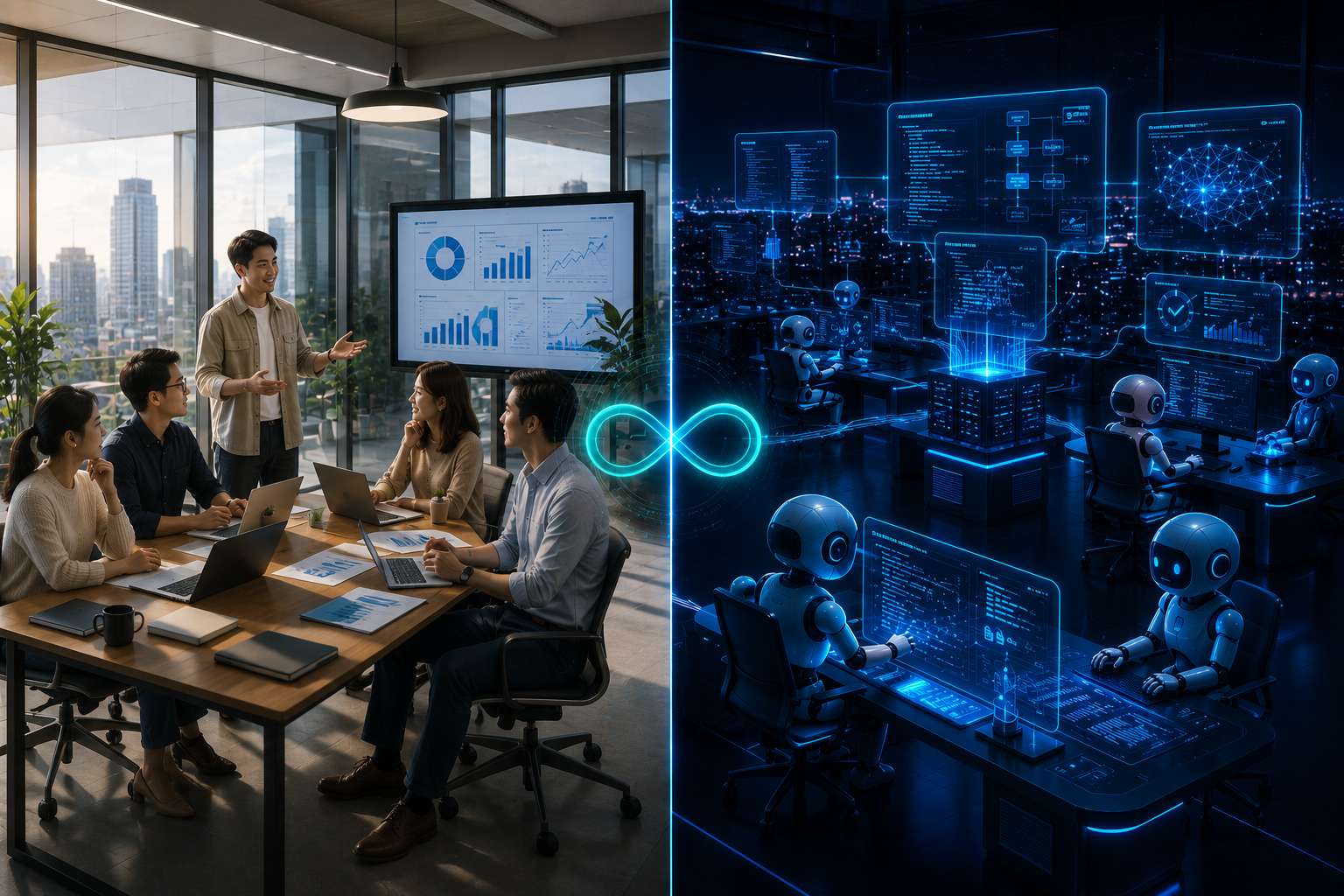
One of the most common misconceptions is that AI will directly replace specific occupations. In reality, what Agentic AI is replacing is “Workflows” — entire work processes.
Take executive report preparation as an example. In the past, this process might involve multiple people:
- One person pulls the data
- One person analyzes it
- One person builds the slides
- One person reviews before sending
Agentic AI can take responsibility for the entire process within a single system.
This thinking is expanding across industries — customer service, marketing, finance, HR, and software development.
What’s worth noting is that this shift isn’t happening simply because “AI is finally smart enough” — it’s happening because organizational processes are now digitized enough for AI to connect into and act on. Organizations with clean data, integrated systems, and clearly defined workflows will capture value from Agentic AI faster than those still running on spreadsheets and email chains.
The important question is no longer whether AI will replace humans, but how organizations will redesign their work processes when a Digital Workforce becomes part of the team.
Clear examples already visible today: E-Commerce businesses using AI Agents to manage the entire After-Sales process — from receiving complaints, assessing return eligibility, coordinating with Logistics teams, to providing Real-time status updates to customers. Or in financial services, where AI Agents can analyze a client’s portfolio, compare it against current market conditions, and recommend rebalancing strategies — all pending a final approval from a human supervisor. Processes that once took days now complete in minutes.
The 24-Hour Operating Model Is Already Here
One of the most compelling examples is the software industry. Many organizations are experimenting with a concept called the 24-Hour Sprint.
During the day, human teams define goals, review results, and make business decisions. When the day ends, AI Agents take over:
- Writing code
- Creating test cases
- Quality assurance
- Architecture analysis
- Documentation
- Preparing deliverables for the next morning’s review
The result: development cycles can advance continuously for 24 hours.
This isn’t just an efficiency improvement — it’s a complete transformation of how organizations operate.
This model isn’t limited to the software industry. In retail, AI Agents can analyze hourly sales data, adjust product pricing based on market demand, and update inventory systems automatically overnight. In logistics, AI can plan delivery routes, track shipments in Real-time, and alert teams the moment anomalies appear — all without any overnight staff. The ability to operate across time zones without relying on night-shift teams becomes a genuine Competitive Advantage for organizations ready to invest in this infrastructure.
New Risks When AI Starts Acting on Its Own
In the era of Generative AI, the primary risk was Hallucination — AI providing incorrect information. But when AI can connect to real systems and take real actions, the risks shift as well.
Imagine an AI that:
- Sends an email to the wrong customer
- Approves a refund outside policy
- Modifies critical data in a system
- Initiates a transaction without authorization
These errors don’t stay on screen — they immediately impact real business outcomes, and they happen at a speed that humans may not detect until the damage is already done.
This is what many organizations are starting to call “Unaccountable Action”: actions where responsibility cannot be clearly attributed. And when it happens, answering “who is accountable?” becomes harder than ever — AI has no legal identity, no Line Manager, and no Performance Review system to trace back through.
When one AI Agent can coordinate with several others simultaneously, errors can propagate far faster than a human team can detect. Real-time Monitoring that catches anomalous behavior as it happens is no longer an optional add-on — it’s a foundational requirement for any organization that wants to deploy Agentic AI responsibly.
Human-in-the-Loop May No Longer Be Enough
Many organizations believe that having humans review final outputs is the answer. But in reality, having someone click an approval button doesn’t guarantee safety. If the approver doesn’t understand the full process, doesn’t have time to verify, or lacks the authority to stop the system — Human-in-the-Loop can become little more than a ritual that doesn’t actually reduce risk.
What organizations need more than approval checkpoints is a system with full auditability, clearly defined authority boundaries, and accountable ownership for every decision made.
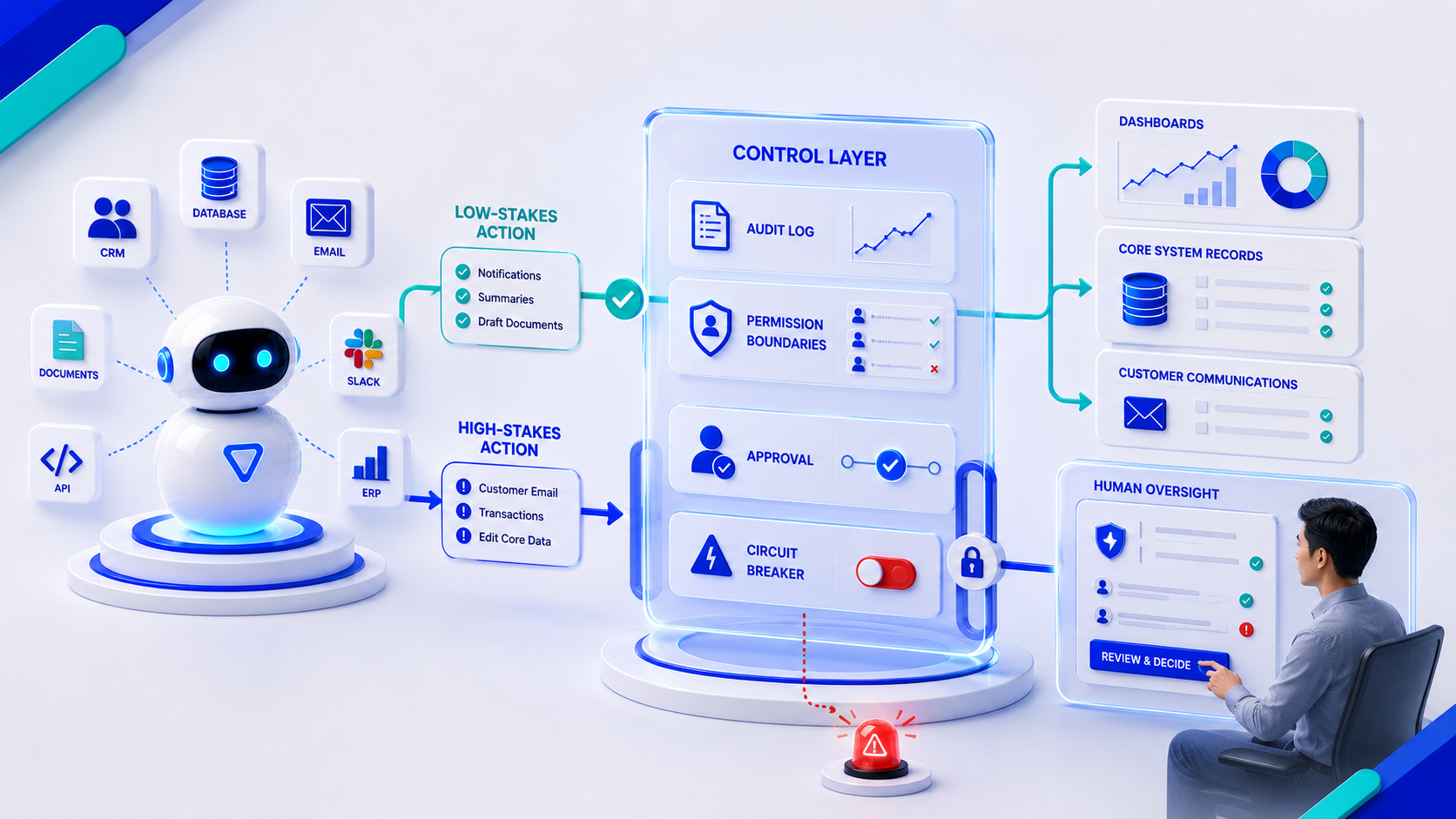
A practical approach is dividing AI actions into two tiers: Low-Stakes Actions the AI can execute autonomously — sending notifications, summarizing data, drafting documents — and High-Stakes Actions that always require human confirmation before proceeding, such as sending emails to customers, executing transactions, or modifying records in a core system. This clear separation keeps Human-in-the-Loop genuinely meaningful, not just ceremonial.
The approach leading organizations are taking is designing a “Control Layer” that sits between AI Agents and live operational systems. This layer logs every action, verifies that each operation stays within defined boundaries, and can halt the system immediately when anomalies are detected — not unlike a Circuit Breaker in an electrical system, designed to contain damage before a problem can cascade.
Accountable Automation Is What Organizations Must Start Thinking About Now
In the future, the organizations that succeed with Agentic AI may not be the ones that give AI the most freedom — but the ones that design the best governance systems.
Every AI Agent should have:
- An Audit Trail that can be reviewed after the fact
- Clearly defined authority limits
- Process owners who can be held accountable
- Mechanisms to halt operations when anomalies occur
Because when AI gains the power to act in the real world, Governance becomes just as important as model capability. No model, however accurate, substitutes for a well-designed governance system.
In practice, organizations that successfully adopt Agentic AI tend to start with small, well-scoped use cases where the impact of any error is limited — such as task routing within teams, pre-meeting document summaries, or first-tier customer query responses. They expand scope only after the system proves reliable. This Incremental approach isn’t a limitation; it’s the strategy that helps organizations build lasting Trust in AI-driven processes.
Conclusion
Agentic AI is transforming AI from a tool that helps produce outputs into an operator that can produce outputs on its own.
In the past, organizations competed on headcount. Then on software and data. But in the future, the ability to design and manage a Digital Workforce may become the defining factor of competitive advantage.
The question isn’t whether organizations should adopt Agentic AI. It’s whether organizations are ready to manage a team made up of both humans and AI — together.
For organizations considering where to start, the first step isn’t rushing to buy technology or rushing to test the latest model. It’s auditing internal workflows clearly: which processes have well-defined conditions, sufficient data, and measurable outcomes? Those are the best entry points for Agentic AI. Starting from the right place helps organizations build confidence faster and avoids investing in systems that don’t match real operational needs.
Readiness doesn’t require a large AI engineering team or a massive budget. It requires a clear understanding of what Agentic AI can and cannot do — and governance structures capable of supporting it responsibly. Organizations that build this foundation well from the start will hold a more durable advantage than those who rush to deploy technology without a plan to manage it.
Because ultimately, “No autonomy without accountability.” There can be no delegating power to AI without clear accountability. And that may be the most important principle of the Agentic AI era.