Deep insights from top executives analyzing the current AI landscape — is it a new bubble crisis, or a once-in-a-generation opportunity for Thai Startups? Plus the “100-person team performing at 500-person capacity” strategy to outmaneuver large corporations that are too slow to adapt.
In recent years, no technology has captured more attention than Artificial Intelligence. Executives, investors, business owners, and professionals across every industry are asking the same question:
- “How will AI transform the business world?”
And for Startup founders, the question goes deeper:
- “Can AI genuinely help small businesses outgrow large organizations?”
Looking back at history, the world went through an internet boom in the late 1990s that ended in the Dot-com Bubble — bankrupting countless companies almost overnight.
The question arises again: is the current AI wave repeating that same pattern? Or is this a truly transformative shift that will reshape the global economy?
Is Today’s AI a “Bubble” Like the Dot-com Era?
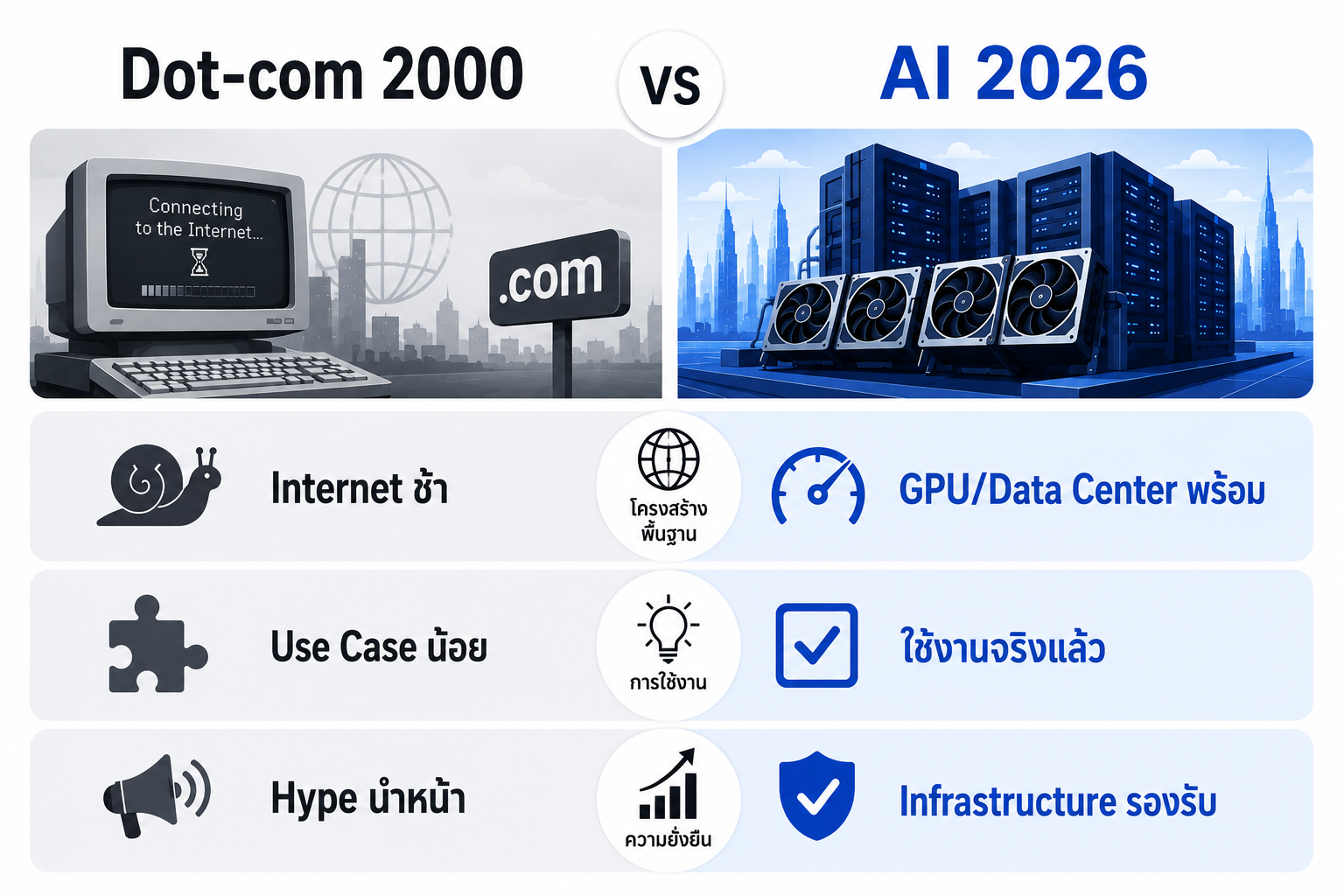
Looking back at the year 2000, many businesses were born from enormous expectations about the internet. Many investors believed that simply having a website or appending “.com” to a company name was enough to create massive business value.
The result: companies received enormous funding despite having no revenue, no business model, and no clear customer base. When expectations outpaced reality, the bubble inevitably burst.
However, comparing the Dot-com era to today’s AI era reveals two critical differences.
1. Infrastructure Is Actually Ready
During the Dot-com era, many dreams couldn’t be realized. Streaming video online, large-scale e-commerce — all were constrained by internet speed, network limitations, and processing power.
Today, the world has massive infrastructure supporting AI. Global technology companies are investing hundreds of billions of dollars in building Data Centers, Cloud systems, and next-generation AI chips continuously.
The difference: today’s technology isn’t “waiting to be ready” — it’s ready now.
2. AI Is Delivering Real Business Results
In the past, many companies sold visions of the future. But today’s AI is generating results in actual business operations. Organizations worldwide are deploying AI for customer service, data analysis, software development, content creation, and internal process management.
While some Startups are still overvalued, AI has broadly proven its economic value and is on track to become critical infrastructure for the future business world.
So AI may have some bubble characteristics — but that doesn’t mean the technology will disappear like a passing trend.
Which Startups Are at Risk of Not Surviving the AI Era?
While AI creates enormous opportunity, it doesn’t mean every business with “AI” in its name will succeed. One category attracting the most discussion today is what’s called “AI Wrappers”.
What Is an AI Wrapper?
An AI Wrapper is a business that takes existing AI models already in the market — such as GPT, Claude, or Gemini — and builds specialized services on top of them. Examples include:
- AI for writing product descriptions
- AI for analyzing legal documents
- AI for basic health consultations
- AI for automatic meeting summaries
While these seem like interesting products, the key risk is that these businesses don’t own the core technology.
Why Are AI Wrappers High-Risk?
No proprietary technology — When everyone can access the same AI models, differentiation becomes extremely difficult. Competitors can build the same type of product in a short time, making competitive moats nearly impossible to build.
Risk of being replaced by model owners — If OpenAI, Google, or Anthropic add the same capability that a Startup built, that business could lose its market value instantly.
So What Kind of Startup Will Survive?
In a world where AI is becoming a commodity, the advantage will no longer come from having access to AI. It will come from what others don’t have:
- Proprietary Data: Specialized data that competitors cannot easily access
- Complex Workflows: Deeply designed processes genuinely integrated with real business operations
- Domain Expertise: Industry-specific knowledge that general AI cannot replace
The winners of the AI era won’t be those who adopt AI first — they’ll be those with business assets that AI can amplify the most.
Muze Innovation’s AI Strategy: 100 People Performing at 500-Person Capacity
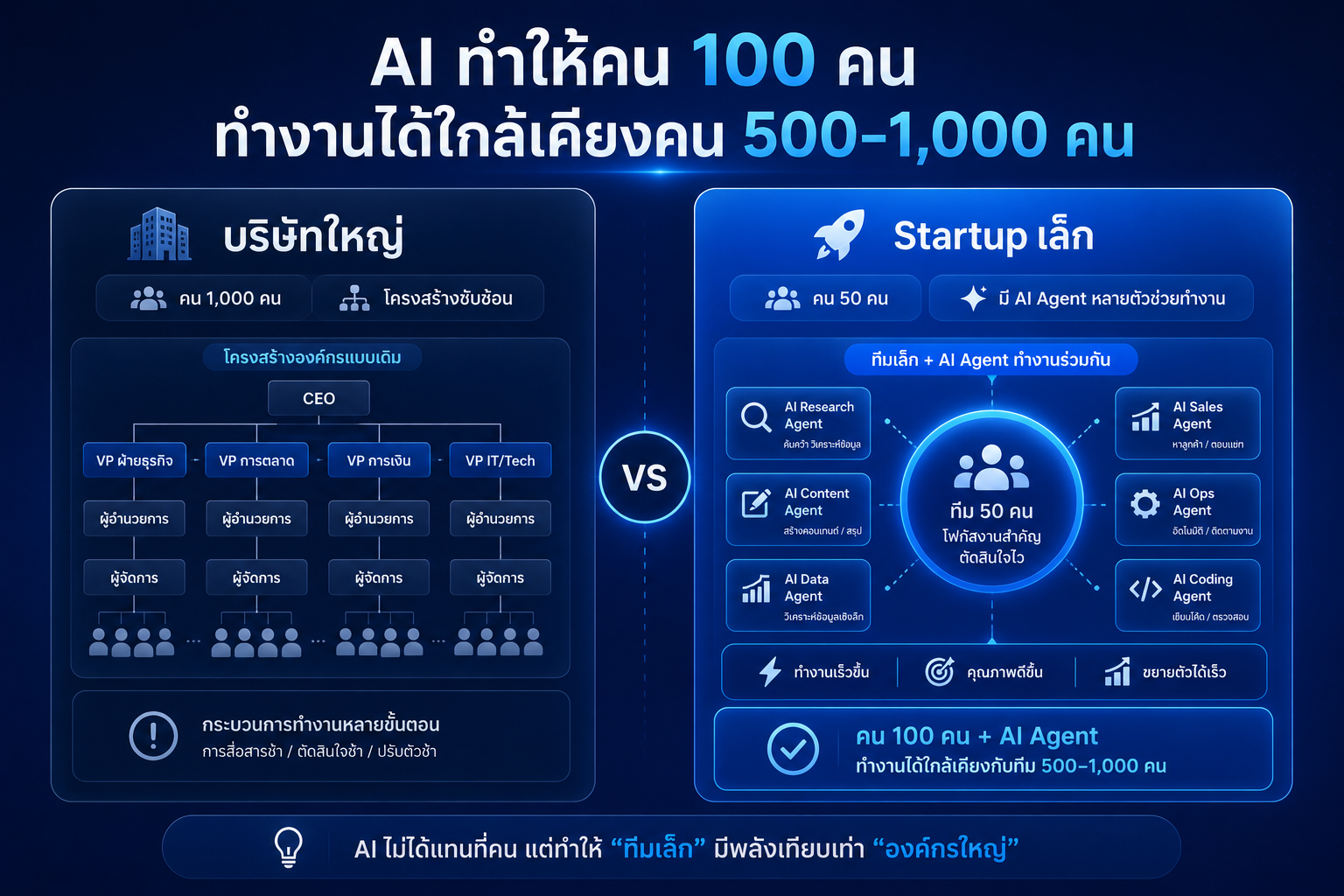
At Muze Innovation, we don’t see AI as a tool to replace people — we see it as a tool to amplify human potential.
Our goal isn’t to reduce headcount. It’s to increase our team’s capacity to deliver results many times over.
The key question is: “How can a 100-person team produce outcomes comparable to an organization with 500 to 1,000 people?”
Eliminating Routine Work
AI can help reduce time spent on repetitive tasks such as: writing boilerplate code, generating documentation, running tests, summarizing reports, and preparing data.
When time spent on routine work decreases, people can focus on work that creates significantly more value.
Elevating Human Skills
What AI still cannot replace includes: strategic thinking, solving complex problems, understanding business context, high-impact decision-making, and systemic creativity.
When AI handles foundational work, people can move up to higher-level work. This is exactly where mid-sized organizations can compete meaningfully with large corporations.
Advice for Thai Startups: Start with Pain Points, Not Technology
One of the most common mistakes among AI-era entrepreneurs is starting with the question: “What should I build with AI?” when the right question is really: “What problems haven’t been solved well enough yet?”
Because ultimately, customers don’t buy AI — they buy outcomes, convenience, time savings, and solutions to their problems.
The right approach should be:
1. Find the Real Problem — Start by deeply understanding customer pain. What problems are creating cost, time, or friction for them?
2. Assess Market Size — Is the problem large enough to build a business around? Are there enough customers? Are people genuinely willing to pay?
3. Use AI as an Accelerator — Once the problem is deeply understood, bring AI in to improve efficiency — whether reducing cost, increasing speed, or creating better experiences.
AI should be a tool, not the starting point of a business.
A Historic Opportunity for the Underdog
Looking at the next 2-3 years, this may be the most interesting moment in history for Thai Startups.
Large companies still have more capital, more people, and more resources. But at the same time, they often face constraints in agility — slower decision-making, complex organizational structures, and change that requires enormous momentum to initiate.
Meanwhile, Startups can experiment, adapt, and pivot faster. For those that can design their organizations as AI-Native from day one, embed AI into their operating processes, and build a culture of continuous learning and adaptation — small businesses today could become major players far sooner than most expect.
Summary
AI is not magic that will make every business succeed, nor is it a bubble that will vanish tomorrow.
What’s happening is a fundamental transformation in how we work, how we build businesses, and how we compete in the modern world.
The winners of the AI era won’t be those with the most AI — they’ll be those who understand customer problems best, hold data of real value, and can use AI to amplify their team’s capabilities effectively.
For Thai Startups, this may be the most significant opportunity in decades — the chance for the “underdog” to deliver results at the level of large organizations, with fewer resources but greater agility.
And that may be the true beginning of a new form of competition in the AI era.