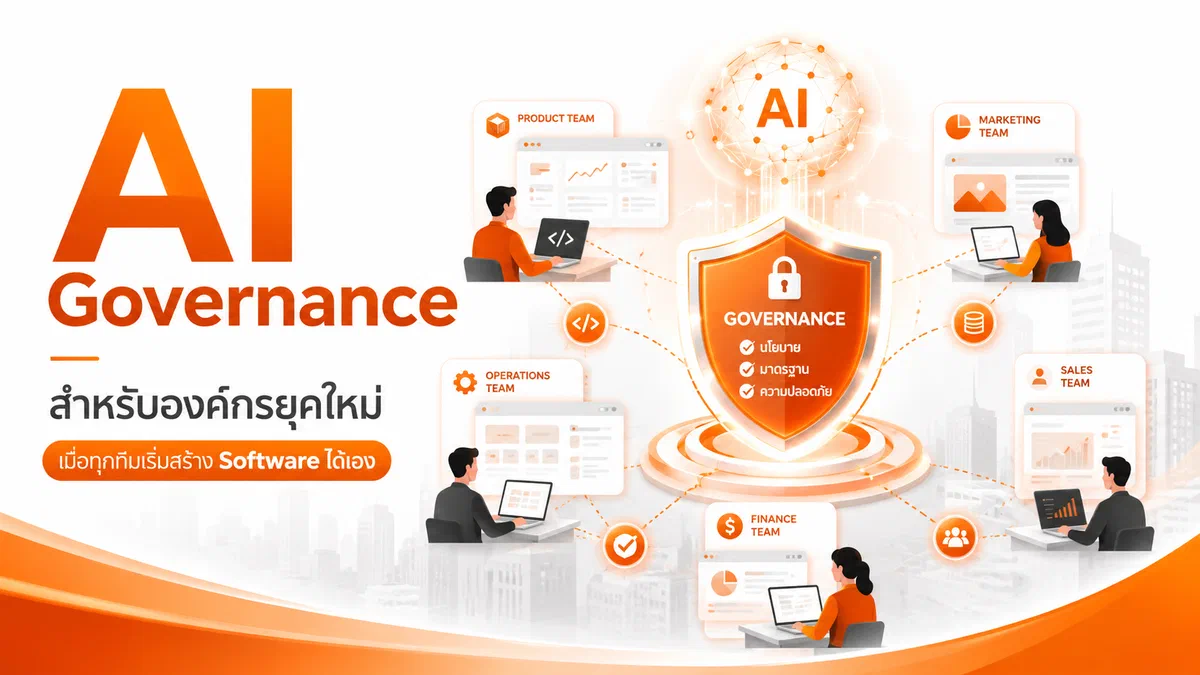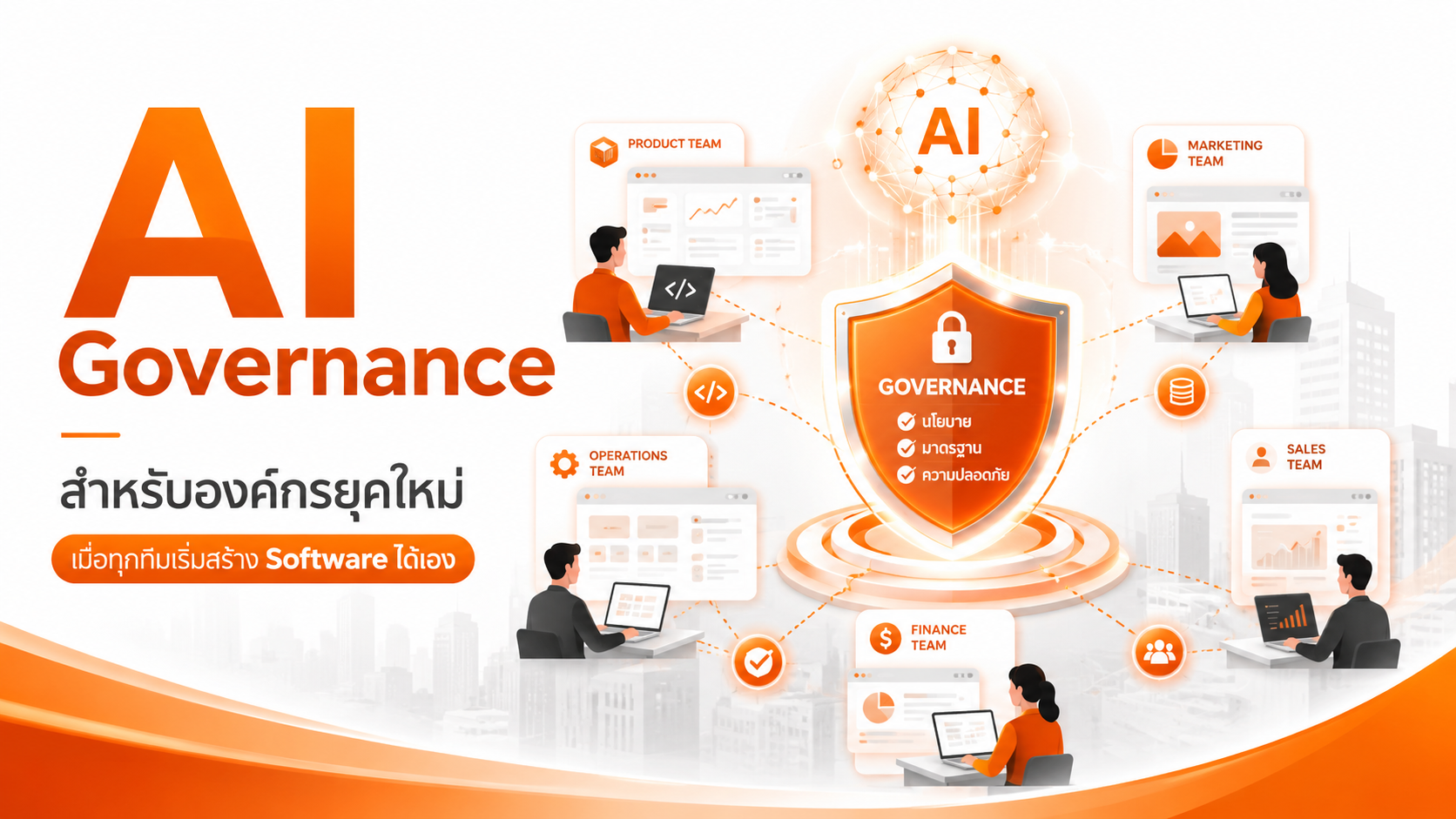
AI is enabling people across every functional team to build tools and custom software on their own. But when software creation is no longer limited to IT, organizations need governance that enables safe experimentation, upholds standards, and bridges the gap to real production use.
The Day Software Stopped Belonging Only to IT
In the past, any team that needed software or an internal tool followed a familiar path: write up requirements, hand them to IT for feasibility assessment, wait in the prioritization queue, wait for a development sprint, then test and deploy. This process had real merit for quality control — but it also meant many useful ideas were never built, because they were too small, not urgent enough, or there was simply no capacity.
“Today, AI is visibly changing this equation.”
Finance teams can use AI to build scripts for handling repetitive data work. Sales teams can try building dashboards to track their pipeline. HR can create workflows to manage job applications. Operations teams can build small tools to assist with daily data checks — without launching a full-scale software project every time.
What’s happening isn’t just developers working faster. It’s that the ability to build software is spreading to a much wider population of people within the organization. The people who best understand the problem at hand now have tools that help them turn pain points into prototypes much faster.
This is a massive opportunity for organizations. Many problems affecting productivity aren’t enterprise-level system problems — they’re function-specific, team-specific, or workflow-specific friction that happens every day. If those teams can use AI to build their own tools to solve these problems, organizations can unlock efficiency gains from many small places in ways they never could before.
But this opportunity comes with an important question: if every team starts building software on their own, how does the organization maintain standards, security, and manage risk?
AI-Driven Development Is Creating a New Generation of Citizen Developers
The concept of citizen developers isn’t new. Many organizations have already encouraged non-technical staff to use no-code or low-code platforms to build internal workflows and applications. But AI is accelerating and broadening this concept considerably.
Previously, citizen developers still had to learn specific platforms, understand the tool’s logic, and operate within the constraints of a no-code framework. With AI, workers can start by describing a problem in natural language, then let AI suggest data structures, build a flow, write initial code, and even debug errors immediately.
The result is that non-developers can increasingly build prototypes that look and feel genuinely functional — in far less time than before.
From an organizational perspective, this is exciting new capability. Innovation no longer has to originate solely from the technology team. Business teams closest to the problem can experiment with solutions first, then selectively bring the things that have real value to IT or an external partner for further development.
However, as citizen developers proliferate, so do the risks. Without a clear framework, organizations can accumulate a growing body of software with inconsistent standards, no documentation, no clear system owner, and no review process before it goes into actual use.
This is where AI governance becomes essential — not to stop the creativity, but to ensure that creativity happens safely and can actually scale.
The Risks When AI Tools Proliferate Without Structure
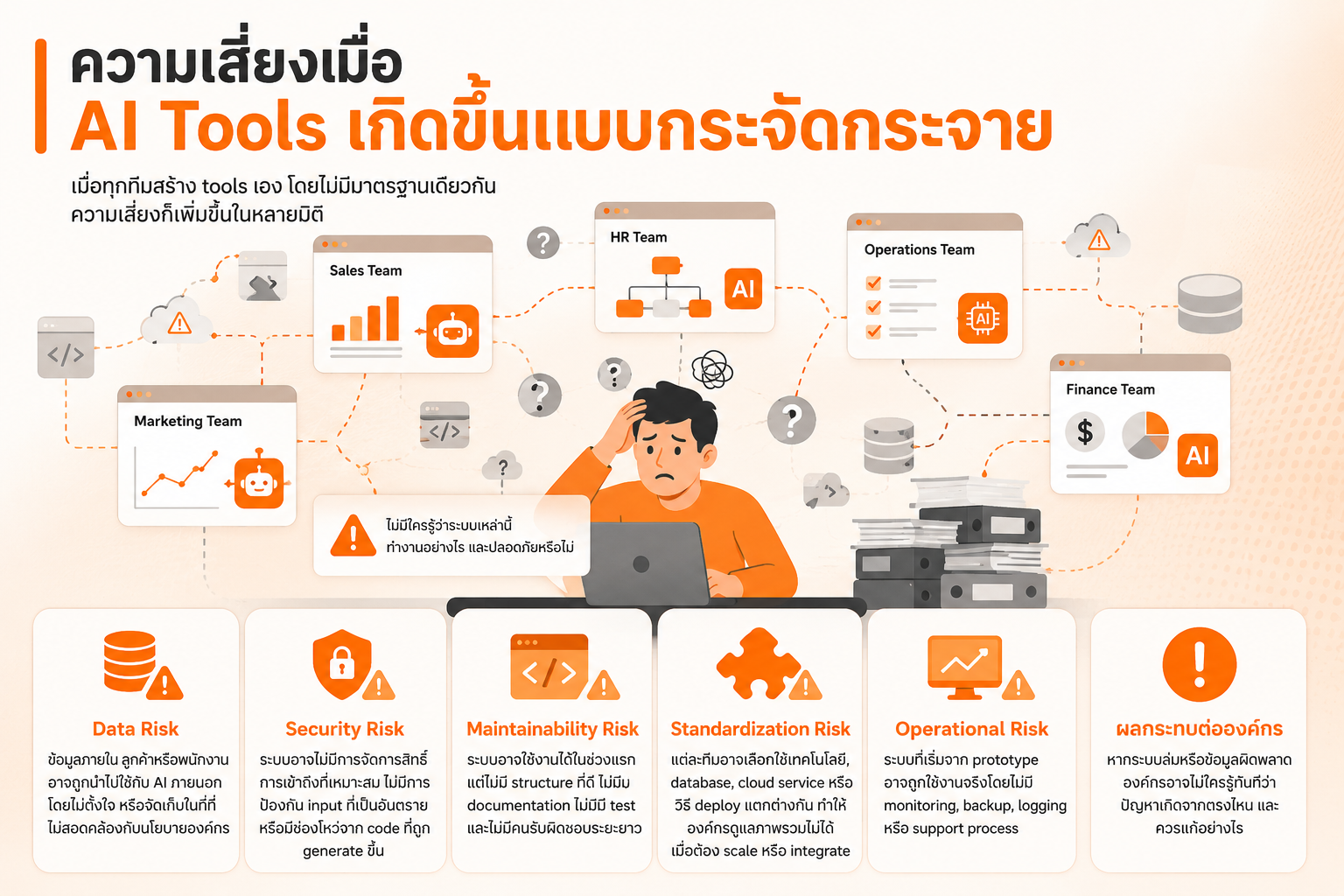
As teams start building tools on their own, what organizations need to watch for is the emergence of fragmented systems — a new form of what has traditionally been called shadow IT.
In the past, shadow IT typically meant business teams using external software or cloud services without IT approval. In the AI era, shadow IT may not just appear as off-the-shelf software. It can appear as scripts, mini apps, automations, dashboards, or internal tools that employees build with AI and start using in real work — with no one knowing how those systems actually function.
The risks that follow can manifest across several dimensions:
Data Risk — The system may inadvertently feed internal data, customer data, or employee data into external AI tools, or store information in ways that don’t align with organizational policy.
Security Risk — The system may lack proper access controls, may not protect against malicious input, or may contain vulnerabilities arising from code that was rapidly generated without review.
Maintainability Risk — The system may work initially but lack good structure, documentation, tests, or a long-term owner. When a bug occurs or a workflow changes, there may be no clear path to fix it.
Standardization Risk — Different teams may choose different technologies, databases, cloud services, or deployment approaches, leaving the organization unable to manage the overall picture. When the time comes to scale or integrate these systems, costs escalate dramatically.
Operational Risk — Systems that started as prototypes may go into real use without monitoring, backup, logging, or a support process. If the system breaks or data becomes incorrect, no one may immediately know where the problem originated or how to fix it.
These risks don’t mean organizations should ban the use of AI for building software. They mean organizations need a more structured approach to managing AI-driven development.
Good Governance Must Not Stifle Innovation
When governance comes up, many people picture complex approval processes, mountains of documentation, and workflows that slow everything down. But for AI-driven development, traditional governance may be insufficient — because if governance is designed to be too burdensome, people in the organization will simply go back to experimenting informally, and the risks will increasingly escape control.
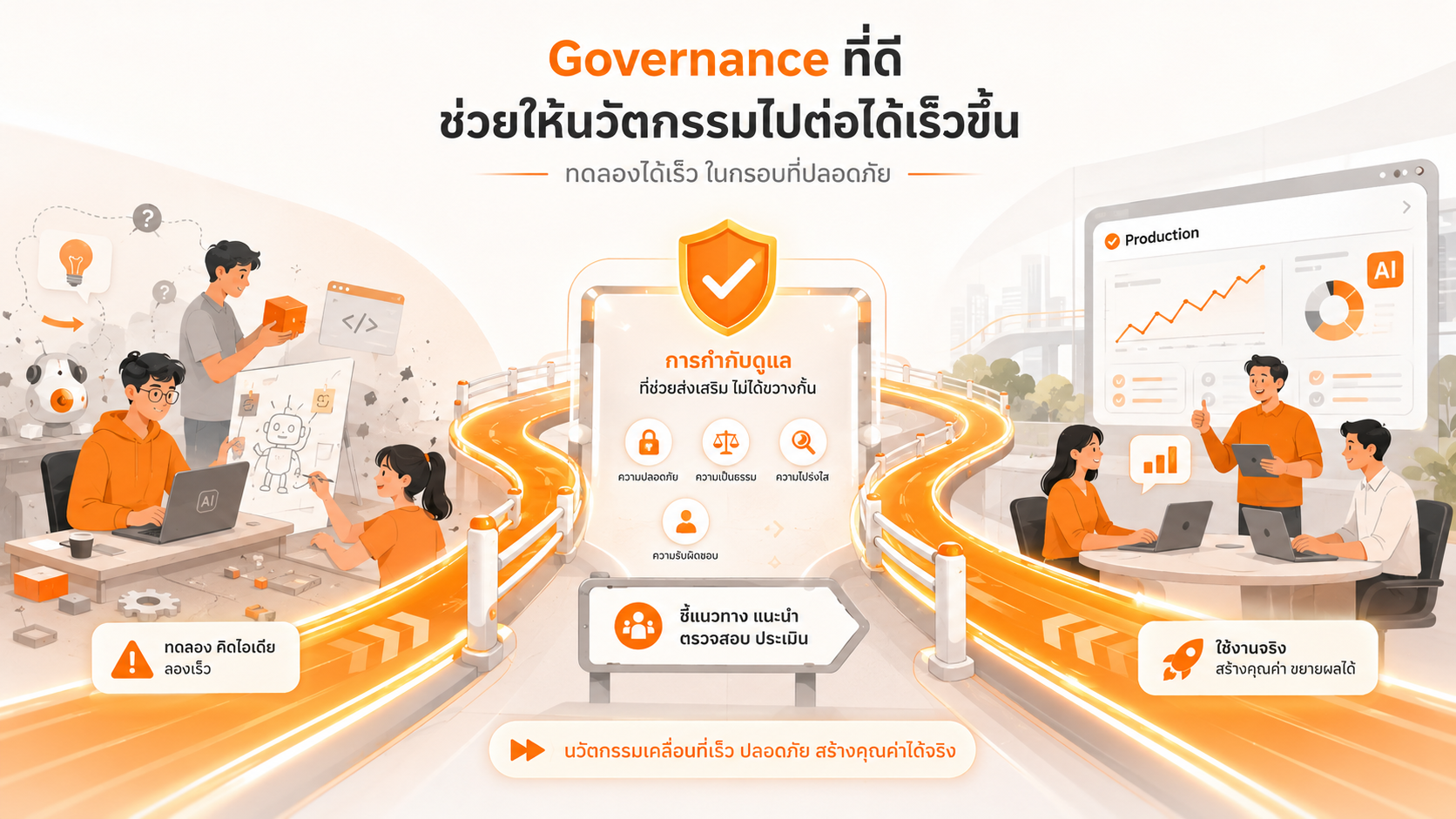
Good AI governance shouldn’t be a wall. It should be a guiding track.
The role of governance isn’t to say “you can’t build this” — it’s to say “if you’re going to build it, here’s how to do it safely” and “once the system starts affecting real work, here are the steps to go through before expanding its use.”
Organizations should create space for people to experiment, but there must be a clear distinction between personal experimentation, team-level use, and deploying a system to production — because each level carries different risk and shouldn’t require the same heavy process.
For example, a prototype using mock data and tested only by the person who built it may require little more than basic guidelines. A tool that starts using real team data may need to go through a data review and access control check. A system with users across multiple teams, or involving important organizational data, should enter a production readiness review before going live.
The key principle is that governance should help innovation move forward faster within a safe framework — not slow every idea down until people stop wanting to try.
The Components of AI Governance for Modern Organizations
If an organization wants to seriously support AI-driven tool and software creation, good governance should span multiple dimensions: from the human level, to process, to technical standards.
1. Usage Guidelines — Define the boundaries of AI use clearly
Organizations should have guidelines that explain in plain terms: what employees can use AI to help build, what types of data must not be fed into external AI tools, when approval is required, and when the IT or governance team should be notified before going live.
2. AI Development Enablement — Train people to build the right way
Teaching people to use AI shouldn’t stop at prompt engineering. It should include production-readiness mindset: thinking about data, security, clear requirements, maintainable code, and the limitations of AI-generated output.
3. Standardized Tech Stack — Reduce fragmentation at the source
If every team is left to choose technology entirely on their own, the organization may end up with systems that are hard to maintain in the future. Having a recommended stack, templates, components, or deployment patterns to point people toward helps ensure AI-built tools stay within a framework that’s actually maintainable.
4. Production Readiness Review — Assess before going live
Systems that are likely to be used in production should be evaluated across key dimensions: security, data governance, architecture, code quality, and operational readiness — so the organization knows what issues need to be addressed before deployment.
5. Remediation Support — Have a team that fixes, not just finds
If the organization only has a checklist but no capacity to remediate, many systems will get stuck mid-process. Having a team that can help fix findings — adjusting architecture, resolving security issues, adding logging, improving code maintainability — is what allows prototypes with real value to actually move forward.
6. Continuous Care — Maintain after go-live
Systems that reach production need clear owners and a support model: bug fixes, dependency patches, minor adjustments, and stability checks. Software that isn’t maintained will degrade over time.
Transforming IT from Bottleneck to Enabler
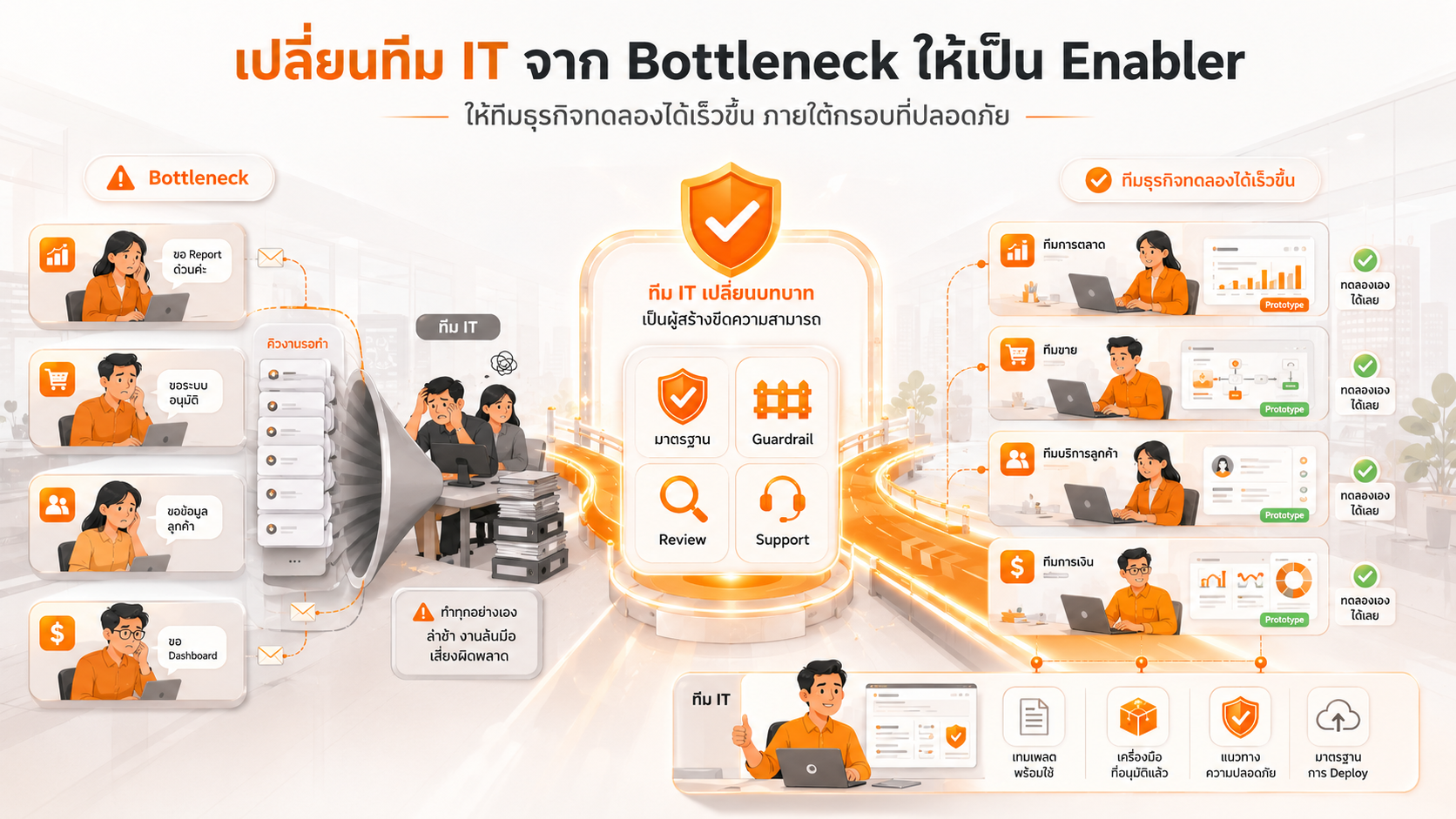
One of the key pain points in mid-to-large organizations is that IT teams have limited capacity while the demand for software from the business side keeps growing. When AI empowers business teams to build their own prototypes, the demand for review and deployment support will grow alongside it.
Without a new operating model, IT may become an even heavier bottleneck — expected to inspect large numbers of systems that weren’t built to any particular standard from the start.
But if the organization designs governance and enablement well, the IT team’s role shifts from the person who has to build everything, to the person who sets standards and helps bring solutions with genuine value into real use.
IT can focus on setting guardrails: security policy, data policy, architecture patterns, approved tools, and deployment standards. Meanwhile, business teams can experiment and build faster within a clear framework.
This approach lets both sides work better together. Business teams don’t have to wait for IT on everything. IT doesn’t have to carry every idea from inception — but still maintains control over the risk of what enters production.
Where to Start: Building AI-Safe Software in Your Organization
Organizations entering the AI-driven development era don’t need to build a large governance structure on day one. The right starting point is laying a foundational structure that improves visibility and risk management.
Step one: Survey the current state — who in the organization is already using AI to build tools, automations, or prototypes, what work are they applying it to, and are any systems already in real use without having gone through a review process.
Step two: Define risk levels for different system types — personal experiments, team tools, department tools, and production systems — so each level gets governance that’s appropriately weighted, not too heavy and not too light.
Step three: Create plain-language guidelines for employees — not a dense policy document, but practical guidance people can actually use: what kinds of data can or can’t go into AI tools, who to notify when a tool starts gaining more users, and what to prepare before requesting a production review.
Step four: Create clear review and remediation pathways, so people who’ve built a prototype with real value know how to take it further — rather than letting useful things stall at the demo stage or go into real use without standards.
Step five: Treat governance as something that evolves. As the number of AI-generated tools grows, the organization should adapt its framework to fit the actual context — not apply a fixed set of rules uniformly to every situation.
Conclusion: AI Governance Is What Makes Organizations Experiment Faster, Not Slower
AI is giving every team in the organization more capability to build software than ever before. This is a meaningful opportunity — organizations can turn frontline workers’ pain points into tools and custom software that genuinely improve how work gets done, faster.
But as software creation spreads, risk must also be managed systematically. Without governance, organizations can end up with many fragmented systems that aren’t secure, are difficult to maintain, and aren’t ready for production.
Good AI governance in the AI era shouldn’t be a tool for prohibition. It should be a structure that lets people in the organization experiment with confidence — knowing the safe boundaries, and having a clear path to bring prototypes with real value into actual use.
Organizations that get this right won’t have to choose between speed and control. They can build an environment where people experiment faster, while systems entering production remain held to standards the organization can rely on.
How Muze Helps Organizations Build AI Governance
Muze believes AI-driven development will be one of the defining approaches to building custom software in modern organizations. But using AI to create real impact requires more than the ability to generate code or build a prototype.
Organizations need a framework that helps people across many functional roles build tools the right way, with a production-readiness mindset from the start, and a clear process for reviewing, remediating, deploying, and maintaining systems after go-live.
Muze can help organizations design their AI Governance & Enablement approach — from establishing tech stack standards and compliance-by-design practices, to assessing the production readiness of systems being built, through to helping remediate findings and providing ongoing application care after launch.
For organizations beginning to see teams across the business building internal tools with AI — or looking to open up custom software creation without adding excessive risk to the IT team — Muze is ready to serve as a partner that helps set the guardrails and systematically brings valuable ideas all the way to production.
Contact the Muze team → muze.co.th/contact/