Generative AI and AI coding agents are changing how software gets built, fast.
Today, many organizations can use AI to build a prototype of a website, an application, or an internal system within a matter of hours — work that used to take weeks or months. A team that has never written a line of code before can now sit down with an AI, describe what they need, and walk away by the afternoon with something working on screen. Just a few years ago, that would have been nearly impossible.
As “building” gets easier, more people are starting to ask:
“If AI can develop software on its own, what challenges do organizations still face?”
Even though AI can dramatically cut development time, many organizations are finding that having a prototype doesn’t mean the system is ready for real use. The real challenge was never “building” — it’s making the system ready at an organizational scale, ready for real data, real users, and the standards an organization has to be accountable for over the long term.
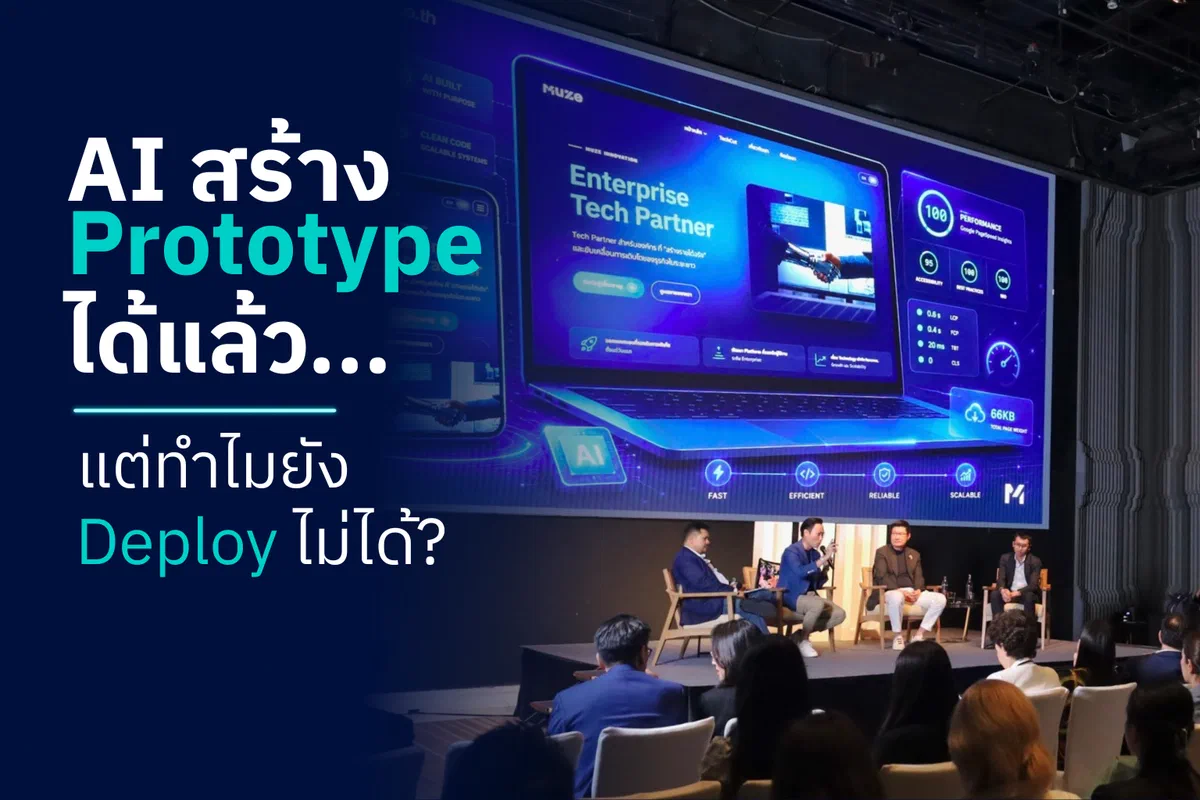
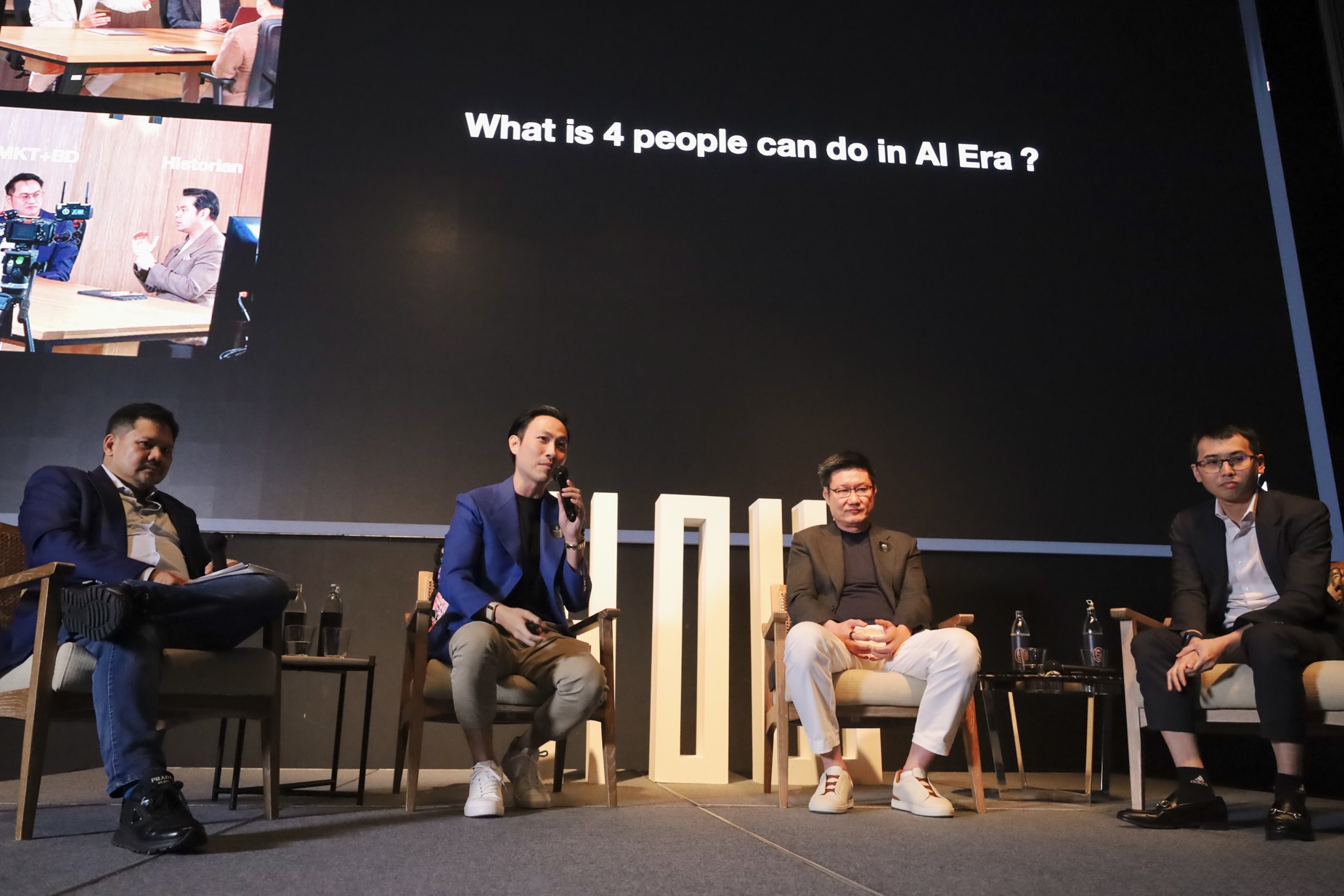
This was one of the topics Peeranat Thoonsaengngam, CEO of Muze Innovation, shared on stage at HOW – Burning Platform: Corporate Survival Guide in the Age of AI, framing what AI can do today as merely the “starting point” of software development — not the finish line. Organizations that mistake the starting point for the finish line are usually the ones that get hurt the most in the long run.
The session’s name — “Burning Platform” — wasn’t picked at random. It captures a situation many organizations are genuinely facing right now: pressure to transform with AI as fast as possible, out of fear of being left behind. But rushing to build without getting the foundation right can end up accelerating new risk for the organization, instead of the business advantage it set out to create.
AI Prototype to Production
AI has made it easier to build a website or application — but being able to build a prototype doesn’t mean an organization can put that system into real use right away. Between “can build it” and “can actually use it” lies a gap that’s invisible to the naked eye, and that gap is exactly where a large number of projects get stuck.
From working with a large number of organizations, Muze has found that the real challenge isn’t “building” — it’s closing three critical gaps that most organizations run into when putting AI to work in practice. All three gaps show up in sequence, from the day building starts to the day the system is genuinely used across the whole organization, and each one demands a completely different set of skills, processes, and owners.
The 3 Gaps Organizations Must Close to Get Real Results from AI
1. Building Gap: AI Helps You Build — But It’s Not Yet a Production-Ready System
The first gap is the Building Gap — the ability to build a website, mobile application, or piece of software.
Today, AI can already help with:
- Building prototypes
- Generating source code
- Designing the user interface (UI)
- Basic API integration
- Building automated workflows
All of this happens far faster than before, so getting started on software development is no longer the obstacle it once was. Where a dedicated developer used to be required before a single line of code could be written, today, anyone in any function with a clear idea can try building a working prototype themselves — without waiting in line for the IT team.
But the important question is: is the system that was built actually ready for real use? For many organizations, the answer is “not yet” — because the Building Gap is only the first of three gaps. Closing it quickly doesn’t mean the other two close just as easily. Often, the prototype that looks most polished to the person who built it turns out to be the starting point of an entirely new set of problems the moment it needs to go into real use.
There’s a hidden risk here: the faster and easier the Building Gap closes, the more people across the organization want to try building their own tools. Without a shared standard in place from the start, an organization can end up with prototypes scattered across every department, with no one holding a full picture of how many tools actually exist or what risks each one is quietly carrying.
2. Production Gap
Many organizations succeed in building a prototype, only to get stuck in the transition to real-world use.
The core reason: a prototype and a production system are two different things.
A prototype’s job is to prove “this idea works.” A production-ready system has to support a lot more, including:
- Reliability and system stability
- Security and data protection
- Scalability to support large numbers of users
- Legacy system integration
- Monitoring and logging
- CI/CD
- Quality assurance
- Data governance
This is the Production Gap — the reason many projects, even when successfully built with AI, still can’t be put into real use within the organization. Picture a prototype that performs beautifully in a demo for leadership in a conference room, but the moment it’s pointed at real data for tens of thousands of customers, or opened up to the whole organization at once, all the questions that were never answered while building the prototype surface immediately: how many concurrent users can it support, where is the data the AI processes actually stored, who has access to which parts of that data, and if the system goes down at 2 a.m., who is responsible for fixing it.
This is why the Security, DevOps, and Compliance teams need to be involved from early on — not brought in to review a system only after it’s already been built. Fixing security or architecture problems after a system is already in real use costs many times more than getting the foundation right from the start.
Many organizations have tried to close the Production Gap simply by banning employees from building tools with AI, to reduce risk. That usually misses the point — the employees facing the real pain point still have the same need, and often end up building the tool unofficially anyway. What an organization actually needs isn’t a ban; it’s a standard that lets people build safely in the first place.
3. Adoption Gap
Even after a system clears the production stage, success doesn’t happen automatically — because the final challenge is changing how users actually behave.
When an organization changes a workflow, brings AI into a process, or replaces an existing system, what typically happens is:
- Users lack confidence in the new system
- Teams resist the change
- People fall back to the old way of doing things
- Adoption falls short of expectations
This is the Adoption Gap — a gap many organizations tend to overlook. Once a system passes technical testing and gets deployed into production, many teams assume the work is done, when in reality the hardest part has just begun. Changing human behavior is the hardest of the three gaps to control, because no amount of code or configuration can directly resolve a user’s lack of confidence.
Organizations that close the Adoption Gap well tend to share a few things in common: they communicate clearly why the change is happening, they run onboarding that walks users through the new system step by step instead of leaving them to figure it out alone, and they keep a feedback channel open to keep improving the system after launch — rather than flipping the switch and walking away.
Another thing that helps close the Adoption Gap is finding a champion on each team — someone who genuinely believes in the new system and is willing to be living proof to their teammates that it actually works, rather than relying on a memo from leadership alone. Behavior change usually comes from seeing a tangible example, not just hearing a reason.
In the end, no matter how much an organization invests in building a new system, if it isn’t actually used, it can’t create business value.
Looking at all three gaps together, it’s clear that AI genuinely cuts software development time — but it doesn’t reduce the complexity of bringing a system into an organization. The speed AI provides only applies at the tail end of the Building Gap. The complexity of the Production Gap and the Adoption Gap still demands the same experience, process, and people who understand both technology and business as it always did.
The transition, then, isn’t just about finishing the code. It’s about designing the entire process — from building the prototype, to taking the system into production, to making sure people can actually use the new system. Organizations that see all three stages as one continuous picture from day one tend to plan far more accurately than those that focus on just one stage at a time.
In practice, an organization doesn’t have to wait for all three gaps to turn into real problems before fixing them one at a time. What it can do today is ask, for every prototype currently being built inside the organization: if this had to go into real use across the whole company tomorrow, would it pass a security standard, does it have a clear long-term owner, and are the actual users ready to change their behavior to adopt it? Asking these questions early is always easier than solving them after the system is already in use.
Ultimately, the organizations that succeed aren’t competing on “who can code faster with AI.”
They’re competing on “who can turn a prototype into a system that creates business value, faster.”
So the question leadership should be asking their teams isn’t just “how fast can we build a prototype.” It should be “do we have a process that covers everything from the day an idea gets built to the day the whole organization can actually use it.” The answer to that question is what actually determines whether an organization is ready for an era where AI can build software on its own.
Turning AI Prototypes into Production Is What Muze Helps Organizations Do
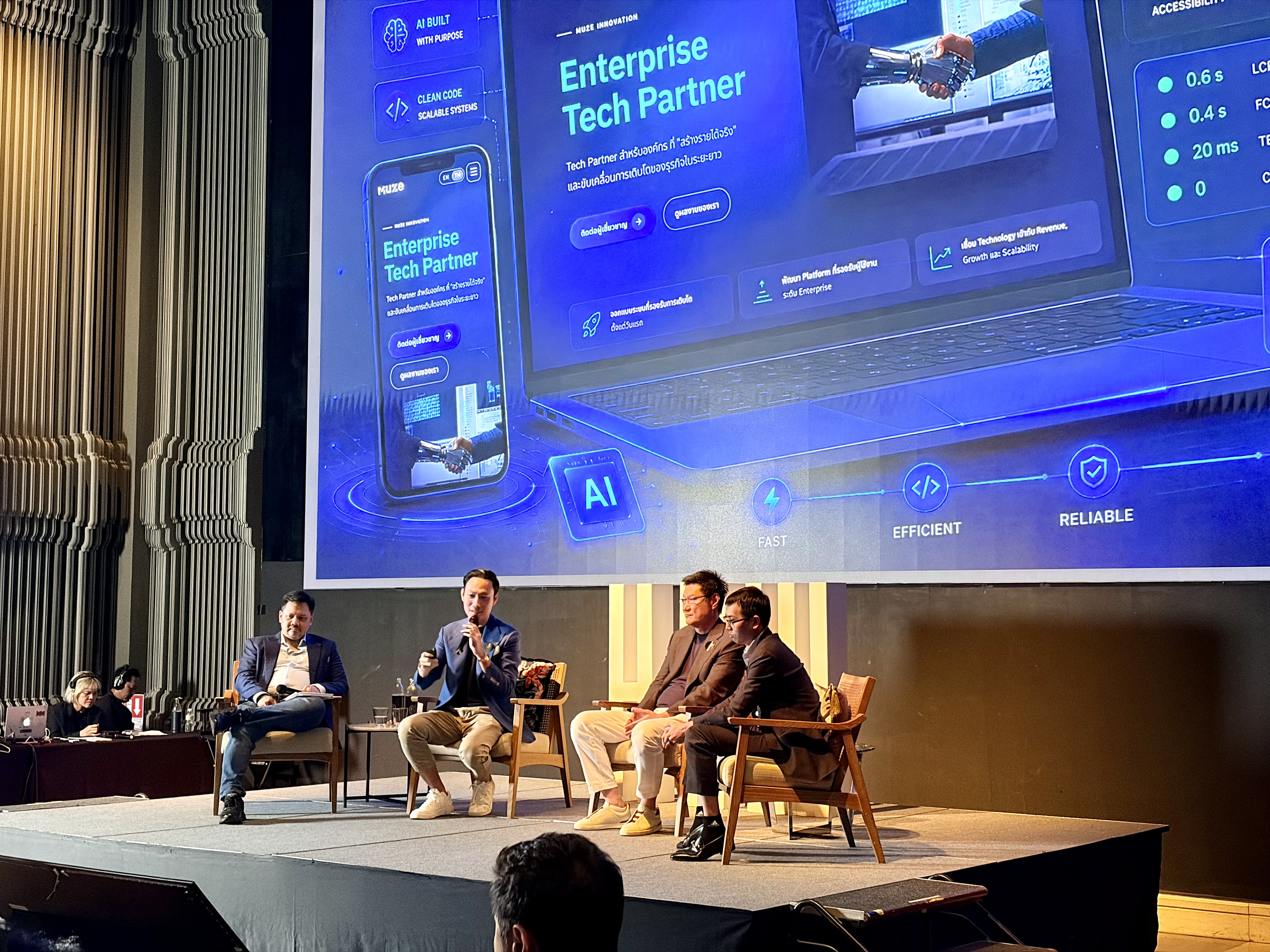
These three gaps aren’t just theoretical concepts — they’re the challenges Muze has seen firsthand working with organizations across industries, from organizations just starting to experiment with AI to large enterprises with complex legacy systems and strict governance requirements.
That’s why Muze Innovation built the AI Prototype to Production approach: to help organizations turn AI-built prototypes into systems that are genuinely ready for real use. This approach is designed to close all three gaps at once, rather than patching each one after the problem has already surfaced.
This approach is designed to cover every step, from training to deploy, with each part connecting directly to the next:
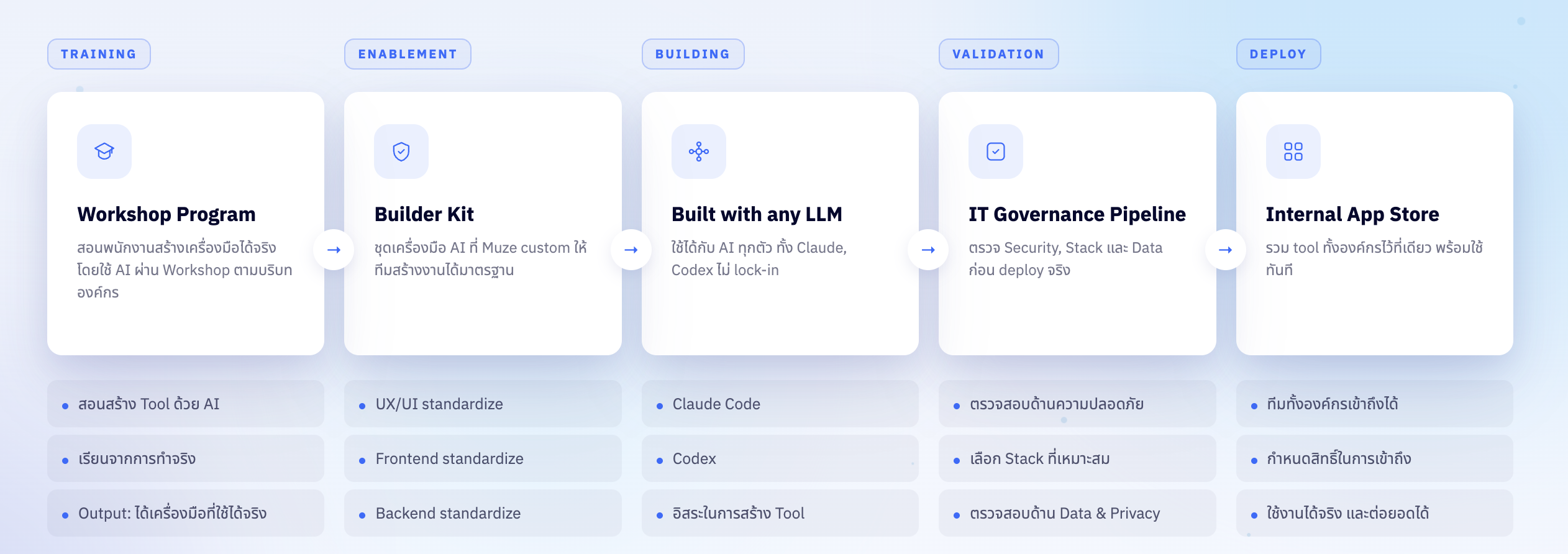
- Workshop Program — hands-on workshops that get employees building real tools with AI, tailored to your organization’s context. Teams learn by doing, and the output is a tool that actually works — not just theory.
- Builder Kit — custom AI tooling built by Muze, covering UX/UI, frontend, and backend, each standardized to your organization’s requirements. No matter who builds what, the quality stays consistent — and it isn’t locked into any single LLM, working with Claude Code, Codex, or whatever tool your team prefers.
- IT Governance Pipeline — a security review, the right stack for the job, and data & privacy compliance checks before anything ships. This is the gate that turns a prototype into a system the organization can trust.
- Internal App Store — a central hub Muze sets up that brings every tool in the organization into one place, with access management built in, giving the whole organization immediate access and room to keep extending it long-term.
The result: your organization ends up with tools built by employees using AI — fully standards-approved and ready to use across the entire organization through an Internal App Store.
The goal isn’t just to “build a system” — it’s to make sure AI actually delivers business results, because the most technically impressive system in the world is no different from one that was never built at all if no one actually uses it.
What sets this approach apart from hiring a typical development team is that Muze doesn’t come in to build the system for the organization — it comes in to build the organization’s own capability to build. From the first day of the Workshop to the day the first tool goes live through the Internal App Store, the knowledge and standards put in place stay with the internal team; they don’t disappear once the project wraps up. That’s the difference between buying a one-off packaged system and building a capability the organization can keep extending on its own for years to come.
Muze uses this same approach internally. Teams across Muze regularly use AI to build tools for their own work, from tools that support content workflows to small systems that cut manual work in operations. Before any of those tools go into real use internally, they go through the same standards Muze designs for clients. That’s part of why Muze trusts this approach — it’s something the company has used to solve its own problems first, before bringing it to other organizations.
Looked at through a build-vs-buy lens, this approach opens up a third option. Instead of choosing between hiring a dev team to build everything from scratch or buying off-the-shelf software that may not fit every need, an organization can combine the people who understand the problem best — its own employees — with what AI can now do, to build tools that match its actual workflow. The cost is lower than a traditional large-scale build, and the result fits the organization better than packaged software that forces the organization to adapt to the tool instead of the other way around.
And over the long term, these tools shouldn’t belong to any one employee — they should become an asset of the company. Keeping every tool in the Internal App Store, with clear standards and documentation, means the organization never has to risk a critical tool “walking out the door” with the employee who built it if they leave or move teams. The knowledge and the tool itself get recorded as a shared company asset, not knowledge that lives in one person’s head alone.
Ready to Turn Your AI Prototype into a Production-Ready System?
If your organization is starting to experiment with AI and wants to move from a prototype to a production-ready system, learn more about Muze Innovation’s AI Prototype to Production service at muze.co.th/aegis