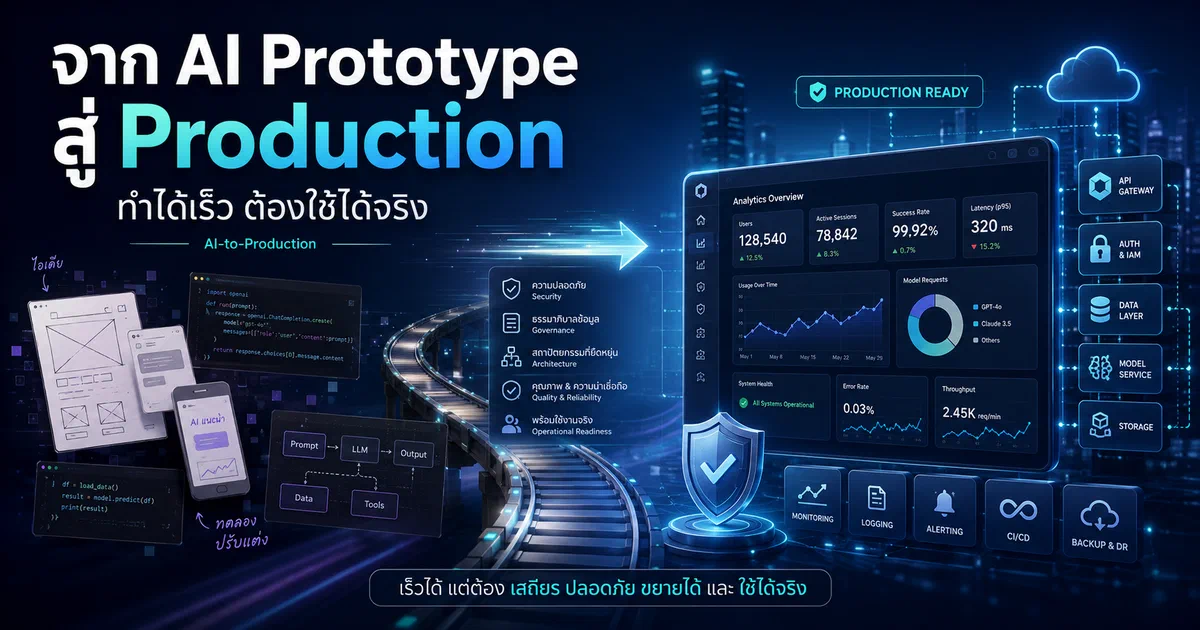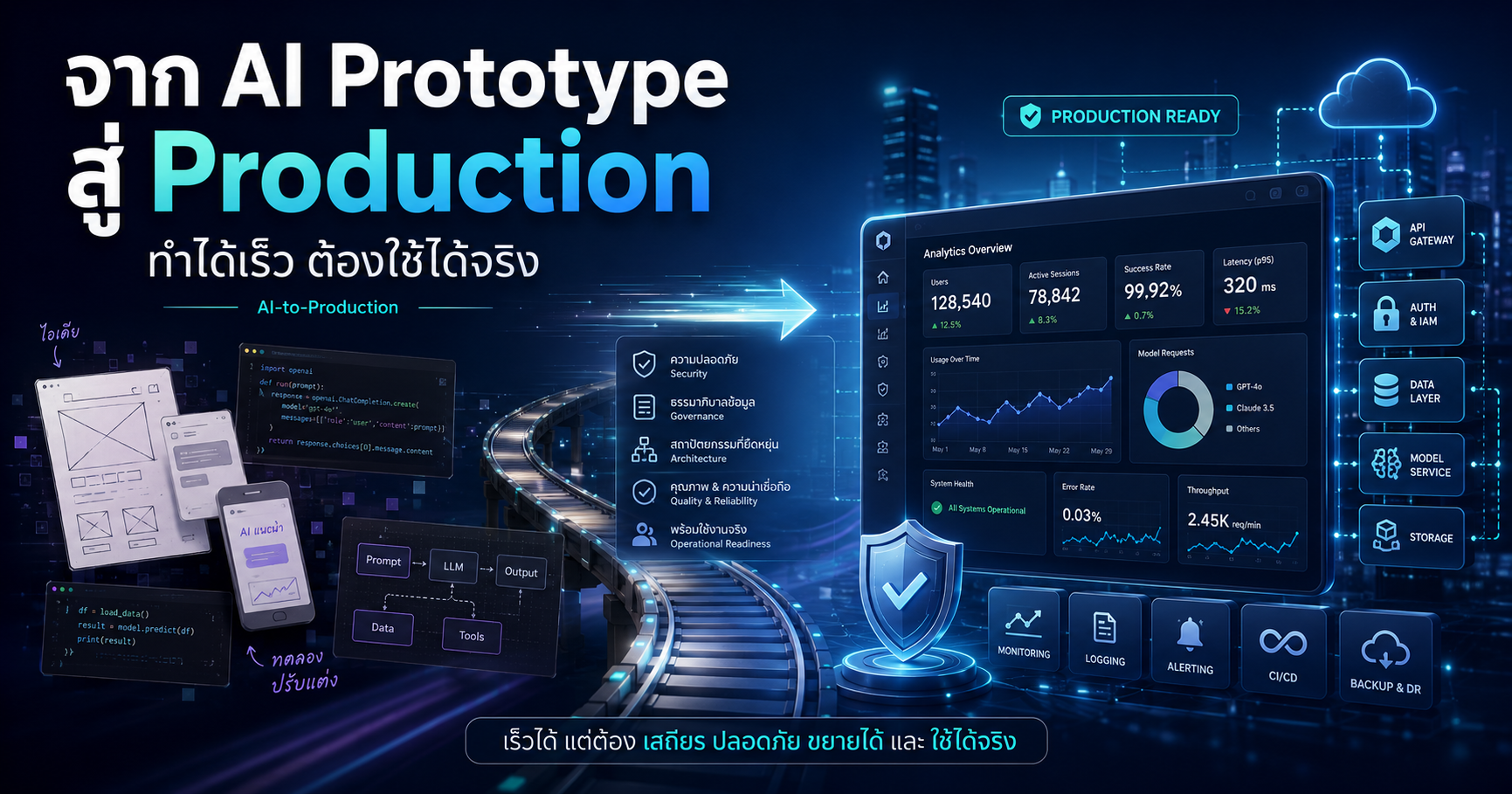
AI lets every team in an organization build tools and custom software faster than ever before. But the real challenge isn’t finishing a prototype as quickly as possible — it’s making those systems secure, standards-compliant, ready for real-world use, and maintainable over the long term.
When AI Made Software Development Everyone’s Job, Not Just IT’s
Over the past few years, AI has fundamentally changed how organizations think about building software. What once required writing detailed requirements, handing them off to IT for scope assessment, waiting in the development queue, testing, and deploying on a lengthy release cycle — today, employees across many functional teams can use AI to build small tools that directly solve their own pain points.
Finance teams might use AI to build a basic data reconciliation tool. Sales teams might build a dashboard for tracking leads and opportunities. HR might experiment with an application screening workflow. Operations might build a small system to automate daily data checks. These were once tasks that required a dedicated developer or software team — but now, the people who best understand the problem at hand are increasingly empowered to build solutions themselves.
This is a profound shift. AI isn’t just making developers write code faster — it’s distributing the ability to build software across a much wider population of people within organizations. Software, once the exclusive output of technology teams, is becoming a tool every team can use to improve their own work.
But as prototyping becomes easier, a question many organizations are now facing is: how do these systems actually get put into real use? Because having a working-looking prototype doesn’t always mean that system is ready for production.
AI Reduces the Barriers to Building — But Not the Need for Standards

One of AI’s greatest strengths is reducing the friction of starting something new. In the past, if a business team had an idea for an internal system, it might take weeks to explain the requirements to IT, wait for technical feasibility assessment, compete with other projects in the backlog — and many ideas were never built at all because they weren’t a top organizational priority.
AI has clearly changed this dynamic. Business team members can now experiment with mockups, workflows, database structures, scripts, and even basic web applications on their own. Ideas that once lived in presentations or spreadsheets can become tangible prototypes in a matter of hours.
This gives organizations enormous opportunity. Many organizational pain points aren’t large-scale enterprise system problems — they’re small, recurring daily friction points: consolidating data from multiple files, detecting anomalies, generating automated reports, tracking task status, routing approvals, or turning manual repetitive workflows into something more manageable.
However, speed of creation doesn’t automatically mean the system is ready for real-world use. An AI-assisted prototype may demo well, help visualize workflow, and excite stakeholders — but when deployed against real data, real users, and real processes, a different set of risks immediately surfaces:
- Is the system designed to handle data securely enough?
- Is customer, employee, or internal organizational data stored and transmitted correctly?
- Can the architecture handle concurrent usage from multiple users?
- Is the generated code actually maintainable?
- Is there logging, monitoring, backup, and a recovery plan?
- If the system breaks, who is responsible?
- If features need to be extended, can they be built on top of the existing code?
This is the gap between “making something visible” and “making something that actually works” — and it’s the point where many organizations are discovering that AI makes it fast to start, but making those systems stable, secure, and maintainable still requires process, standards, and software delivery experience.
Prototype Economy: When Organizations Have More Experimental Systems Than Ever
Historically, organizations had relatively few formally created software projects — each one required significant budget, time, and resources. In the AI era, prototypes can emerge from multiple teams simultaneously: developers, business analysts, operations managers, marketing teams, finance teams, and even executives who want to quickly test a new idea.
This gives rise to what might be called a Prototype Economy within the organization — an environment where ideas can be turned into prototypes more easily, experimentation increases, and small systems emerge from the genuine needs of workers.
From one angle, this is excellent. Organizations that can experiment more tend to learn faster. Teams that previously had to wait on technology roadmaps can now test approaches themselves before deciding what’s worth scaling.
But from another angle, without structural support, a Prototype Economy can become a new organizational problem:
- Many experimental systems may go into real use without proper review
- Multiple teams may build overlapping, duplicative tools
- Data may end up scattered across many locations without standards
- Use of external AI tools may inadvertently cause internal data to leak
- IT teams may face overwhelming review workloads without sufficient capacity
When any of these systems moves into actual use without a clear technical owner, the organization can become stuck with software nobody dares to change, nobody maintains, and nobody knows where the risks are.
The important organizational trend for the next phase isn’t just encouraging more people to use AI to build tools — it’s creating the structure that guides those experiments toward safer, more standardized paths, and enables a clear distinction between prototypes that should stop, those that should improve, and those that should enter real production.
From “AI-assisted Development” to “AI-to-Production”
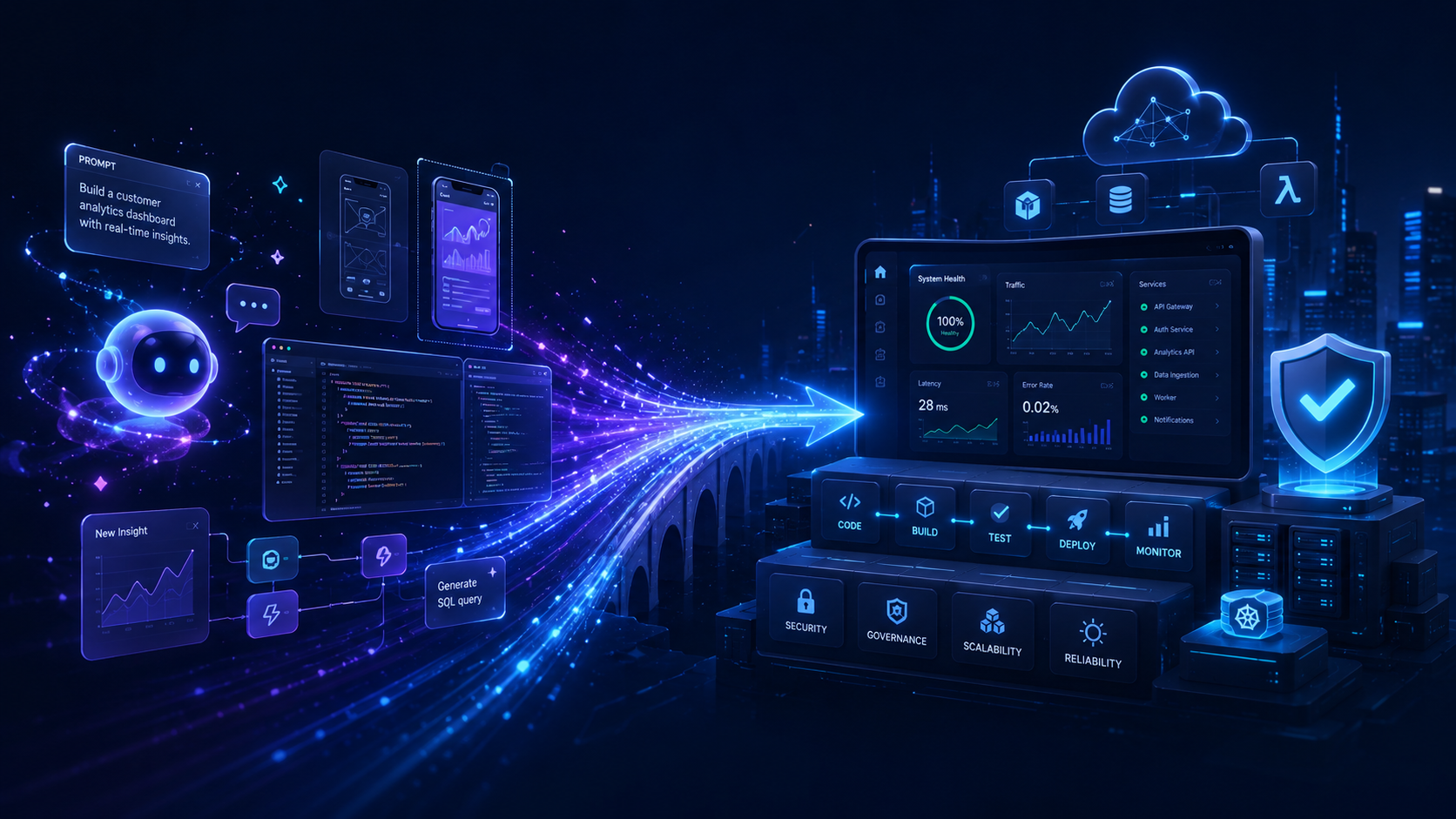
Many organizations start by asking “how can we use AI to help write code?” But after using it for a while, the more important question becomes: “how do we get what AI built into production?”
This is the difference between AI-assisted Development and AI-to-Production.
AI-assisted Development focuses on using AI within the creation phase — helping generate code, write tests, refactor, create documentation, or convert requirements into faster prototypes. Its benefit is speed and productivity.
AI-to-Production takes a broader view. It doesn’t care only about finishing the build — it cares about the entire system lifecycle: from ensuring people in the organization understand how to use AI correctly, to designing systems from the start to align with organizational standards, reviewing readiness before going to production, remediating any findings, deploying safely, and providing ongoing care after go-live.
Put more clearly: AI-to-Production shifts the question from “what can AI do for us?” to “how do we operationalize what AI helped build into actual business value?”
Software built quickly but impossible to use in practice may generate temporary excitement, but doesn’t create long-term organizational impact. By contrast, software built from real pain points, reviewed appropriately, and maintained continuously can become a tool that genuinely reduces costs, increases speed, and improves how teams work.
What Makes a System Production-Ready Is Not Just Running Code
One of the most common misconceptions is: if the system runs, it’s ready for real use. But for enterprise software, the ability to run is only the starting point. A production-ready system should be reviewed across multiple dimensions:
1. Security
The system must not expose vulnerabilities that allow sensitive data to be accessed without authorization. It requires appropriate handling of authentication, authorization, secret management, and input validation — especially for systems touching customer data, employee data, or business information.
2. Data Governance
The organization needs to know where data is stored, what it’s used for, who can access it, and whether it’s transmitted to external services. Systems built quickly with AI may inadvertently use inappropriate data storage approaches, or connect to APIs without sufficient data compliance standards.
3. Architecture & Tech Stack
The system should use structures and technology the organization can actually maintain — not whatever library or framework AI happened to generate without consideration. If the tech stack becomes too fragmented, the organization faces increasing maintenance costs over time.
4. Code Quality & Maintainability
Code that works today can become a problem tomorrow if it lacks good structure, separation of concerns, tests, or adequate documentation. Systems without maintainability make bug fixes and future feature additions progressively harder.
5. Operational Readiness
Production systems need operational components: logging, monitoring, alerts, backup, deployment process, rollback plan, and a support model. When the system has problems, someone needs to know where to look and how to fix it.
Why So Many Organizations Get Stuck at “Great Demo, Can’t Deploy”
A common situation in the AI era: a team builds a demo that looks excellent in a short period of time. Everyone can see how this system could genuinely help. Leadership agrees. Users are excited. But when the time comes to actually deploy it, the system runs into multiple issues:
- Some systems can’t use real data, because access permissions were never designed
- Some systems can’t connect to internal data, because the architecture doesn’t align with the organizational environment
- Some systems can’t be deployed, because there’s no pipeline or clear dependencies
- Some systems need extensive code changes, because AI built logic that worked for the demo but doesn’t handle real-world edge cases
- Some systems have no one to maintain them, because the person who built them isn’t on the development team, and IT doesn’t have the capacity to take them on immediately
These problems don’t mean AI doesn’t work. They mean the organization is missing a bridge between experimentation and production. Without this bridge, organizations will have more prototypes, but business impact may not increase proportionally — because many things stop at the experiment phase, never get actually used, or get used in unsafe ways.
IT’s New Role: From Builder of Everything to Governance Leader and Production Accelerator
AI doesn’t make IT teams irrelevant. On the contrary, it makes the IT team’s role more important — just in a different way.
IT teams were traditionally expected to build almost all systems. But in a world where people across the organization can use AI to build tools themselves, IT no longer needs to be the bottleneck for every idea. The more important role becomes setting standards, assessing risk, and helping things with genuine value reach production safely. This is the shift from “centralized builder” to “governance and enablement partner.”
This approach solves two problems simultaneously. On one side, the organization can unlock more innovation from frontline workers, because not every idea has to wait in the traditional development queue. On the other side, IT doesn’t have to carry the full burden of building every small system — they can spend their time governing standards, building platforms, and maintaining the systems that truly matter to the organization.
The balance point is governance that doesn’t create too much friction, and enablement that doesn’t create too much risk.
Good AI Governance Shouldn’t Be a Handbrake — It Should Be a Railway Track

When governance gets mentioned, many people think of restrictions, documentation, approvals, and bureaucracy that slows things down. But in the context of AI-driven development, good governance shouldn’t function like a handbrake that stops everything.
Good governance should function like a railway track. A railway track doesn’t stop the train — it helps the train move faster in a safer direction. Similarly, good AI governance should help people in the organization understand: if you’re going to build a tool with AI, where do you start? What’s allowed? What should you avoid? What type of data must not be used with external tools? What systems need to go through a review before deployment? And when a prototype starts having real users, how do you elevate the standards?
If governance is designed practically enough, it reduces organizational fear around AI — because everyone can see a clear path forward. They’re no longer forced to choose between “let experiments run freely until they become risky” and “prohibit use entirely and miss the opportunity.”
The organizations with an advantage in this era are not those with no risk. They’re the ones who can manage AI risks well enough to experiment faster, learn faster, and put things of genuine value into real use faster than their competition.
Conclusion: The Advantage Isn’t Who Builds Prototypes Fastest — It’s Who Gets Prototypes to Production Best
AI is democratizing software creation. People who understand business problems can now turn ideas into prototypes many times faster than before. This is a massive organizational opportunity — many small pain points that were previously overlooked can now be addressed with tools and custom software built from the genuine needs of workers.
But in the organizational world, speed alone isn’t enough. A good system isn’t just one that’s built quickly — it must be secure, truly usable, extensible, maintainable, and held to standards the organization can rely on.
The critical enterprise AI trend for the next phase, therefore, won’t be simply having more AI tools — it will be having the capability to systematically transform AI-generated prototypes into production-ready software. Organizations that achieve this won’t have to choose between innovation and governance — they can have both: experimenting faster without letting risks escape control, and turning ideas from people across the organization into real impact.
How Muze Helps Organizations Take AI Prototypes to Production
Muze believes AI will allow organizations to build tools and custom software at dramatically accelerated speed — but building fast is only the first half of the challenge. What matters just as much is making those systems actually work in an organizational context.
We’ve designed our AI-to-Production Enablement approach to help organizations bridge the gap between experimentation and real deployment: from training teams to understand how to build systems with AI correctly, to helping develop prototypes or custom software from business ideas, to assessing production readiness across critical dimensions — security, data governance, architecture, code quality, and operational readiness — through to remediating findings before deployment and providing ongoing support after go-live.
For organizations beginning to see multiple teams building internal tools with AI, or looking for ways to scale custom software development without overloading IT capacity, Muze can serve as a partner that helps establish standards, increases review capacity, and safely moves software with potential into production.
Contact the Muze team → muze.co.th/contact/