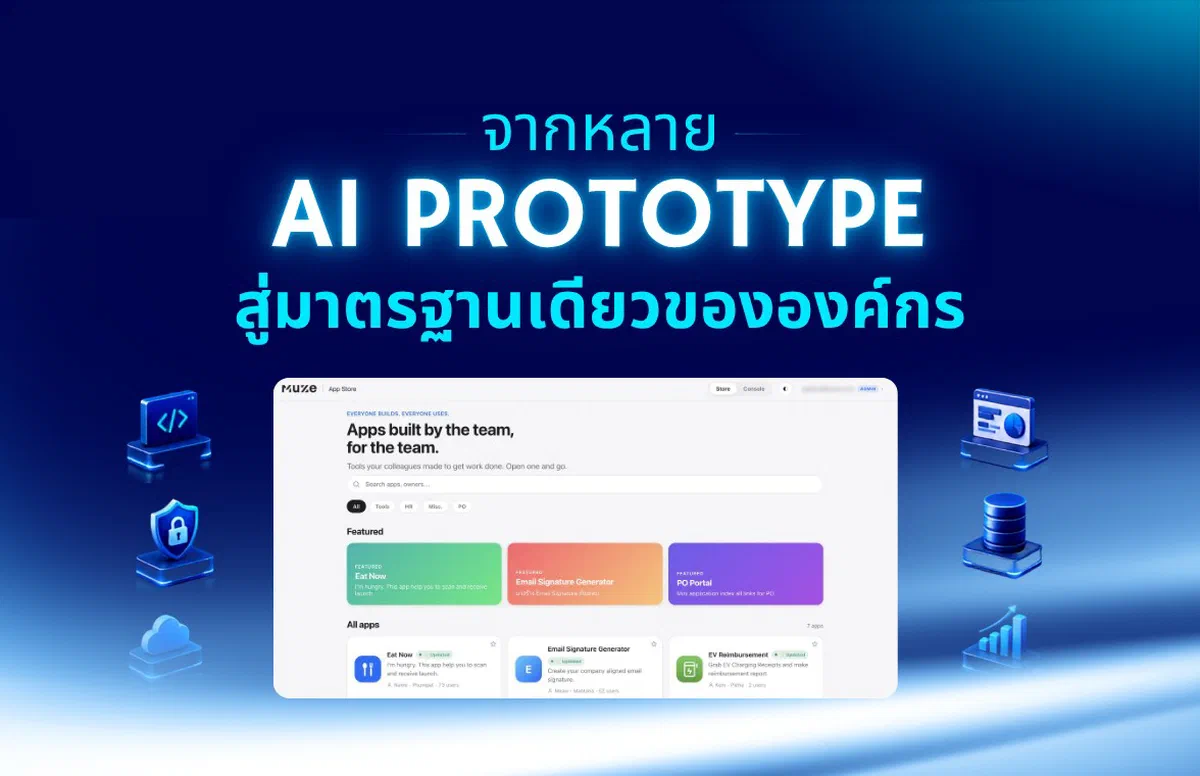
In the early stage of bringing AI into an organization, what we usually see starts with small experiments. One team tries using AI to help write code. Someone builds a prototype to solve an immediate problem. Another team tries building an internal tool to cut out some step in an existing workflow.
At this stage, the number of tools is still small. Everyone roughly knows who built which tool and where it lives, and if something needs fixing, people can just walk over and ask the owner directly. But as people across the organization get more comfortable with AI, what happens next is that AI stops belonging to any single team.
The Operations team might have a tool for managing documents. Sales might build a system that helps summarize customer data. Marketing might have a tool that pulls together data from multiple sources, while other teams start building their own workflows or applications. Some are used only within a team. Some get shared with other teams. And some start becoming part of the daily working process, with the number of users quietly growing all the time.
At this point, the organization’s real challenge starts to shift. Building a tool fast isn’t the hard part anymore — maintaining those tools so they’re genuinely usable, safe, and inside a system the organization can keep controlling becomes something that needs serious thought.
Because once AI tools start spreading across many teams, what the organization needs to know isn’t just “who can build what.” It also needs visibility into which tools are actually in use, who owns them, who should have access, what data each one connects to, and whether it has been through the review process the organization requires before going into real use.
As Building an AI Tool Gets Easier, the Number of Tools in the Organization Grows With It
Tools for building software with AI have visibly lowered the barrier to starting a new application. Where building a single internal tool used to mean starting from writing a requirement, finding resources, planning an architecture, and going through a full development process, today people on a team can test far more ideas, much faster.
AI coding tools can help build a prototype, write code, or put together a basic interface in a fraction of the time it used to take. From an innovation standpoint, this is a good thing — a team no longer has to wait until everything is ready before it can start experimenting. Someone who runs into a problem in their workflow can try building something to fix it right away, then find out afterward whether the idea is genuinely useful.
The trouble starts once a prototype that was built to test an idea starts being used for real. Say a team builds a tool to help manage internal documents during an experimentation phase. After using it for a while, the team finds it genuinely cuts down the work involved, so more people on the team start using it — and before long, another team wants in too.
From a user’s point of view, the tool might look ready enough, since it opens, runs, and produces the results people need. But from the organization’s point of view, “it works” still isn’t the same thing as “ready for production.” Once a tool goes into real use, the things that need managing multiply immediately — from the environment it runs on, to user management, to access permissions, to exactly what data the tool is allowed to touch.
Something that works well for 5 users may need an entirely different structure once there are 50 or several hundred. A tool that used sample data during testing may start connecting to the organization’s real data, and code that was written quickly just to prove an idea may not yet meet the same standard as everything else the organization already runs.
From “It Can Be Built” to “The Organization Can Maintain It”
Something that happens often once building AI tools spreads across an organization is that every team ends up with its own way of managing things. One team might deploy an application into one kind of environment. Another team uses a completely different approach to authentication. Meanwhile another team might just share a link and let users access it directly.
While the number of tools is still small, none of this necessarily creates an obvious problem. But once a tool becomes a real part of the workflow, the organization has to start answering more and more questions about that system’s lifecycle.
- Who owns this tool?
- If the original owner moves to another team, who takes over?
- Who is allowed to access the application?
- What kind of data does this tool use?
- If the system needs a fix or an update, who has the right to deploy a new version?
- Does the application use a framework or technology that’s within the organization’s standards?
And if one day the organization no longer wants to use this tool, how does it handle the application, its access, and the data tied to it?
None of these questions are unique to AI — they’re the same questions an organization has to answer for every piece of software it puts into real use. What’s different is that AI lets the number of pieces of software being created inside an organization grow far faster than before.
Once every team can build something new more easily, the old way of managing software — designed around a handful of development teams — may no longer be able to keep up with the growing number of use cases. That creates a new question: how does an organization let people build and experiment quickly, while still holding onto the standards production genuinely requires?
A Good Prototype Still Needs Infrastructure That Can Support It
A prototype has one important job: to answer whether an idea actually works. At this stage, speed matters enormously. A team should be able to experiment, adjust, and drop ideas that don’t work without investing in a full-blown system from day one. But the infrastructure that suits experimentation isn’t necessarily the infrastructure that suits real use.
Once an application starts picking up more users, the system has to support a whole set of things that follow — the right environment, configuration management, connections to internal services, and ongoing deployment care. If every team has to design all of this on their own from scratch, the result is both duplicated effort and inconsistency between systems.
A team with a strong technical background might be able to lay out a solid structure. Another team might just pick whatever solution is most convenient at the time. The result is that the organization ends up with a collection of tools that each solve a real business problem well, but each needs to be maintained in a completely different way — and as the number of systems grows, so does the cost of maintaining them.
So scaling AI inside an organization was never about letting people build the largest possible number of applications. It’s about making sure the tools that genuinely prove their value can enter a structure the organization is actually equipped to maintain.
Security and Data Start to Matter the Moment a Tool Touches Real Work
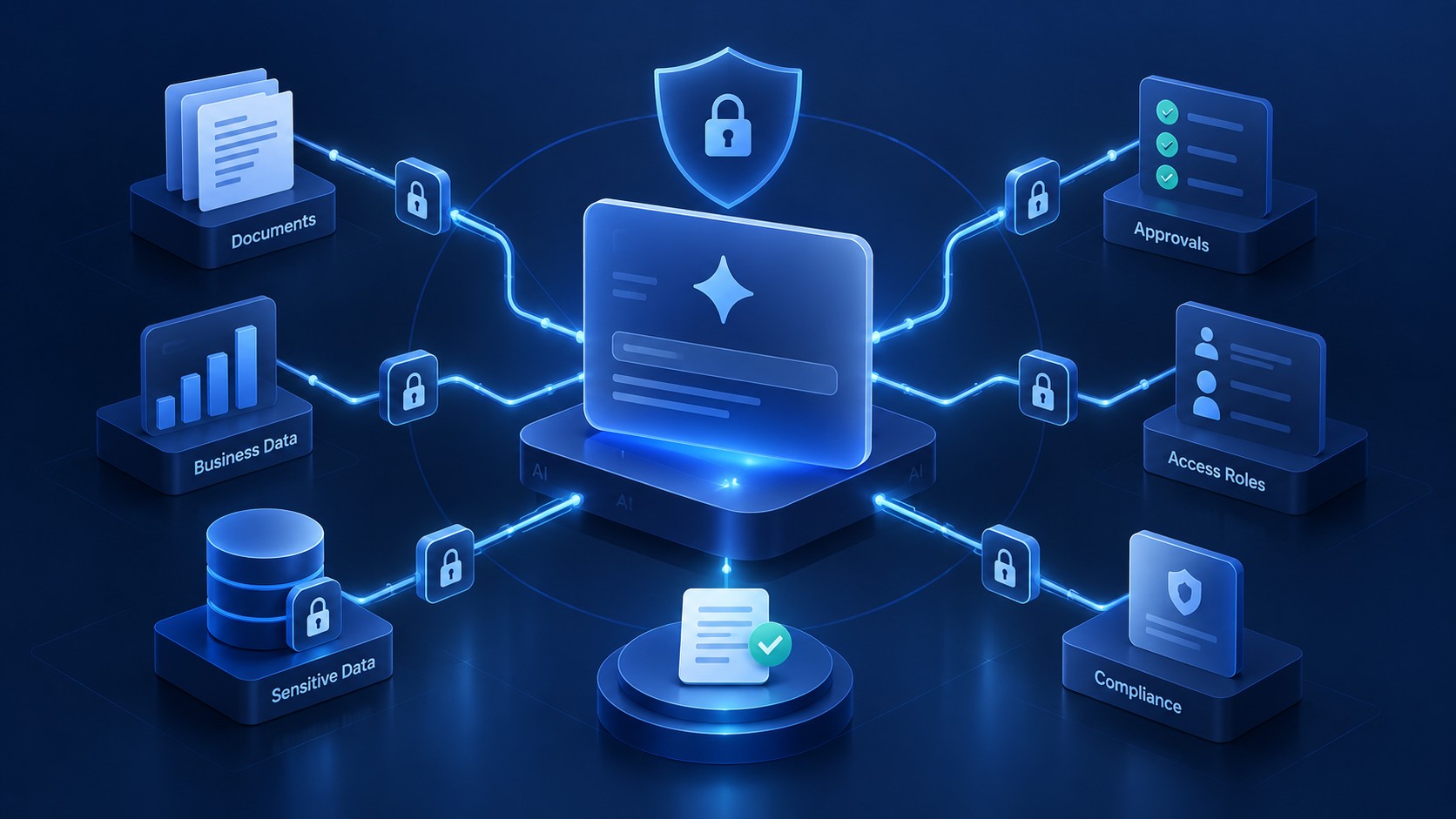
During experimentation, plenty of use cases start out with mock data or data that isn’t especially sensitive. But once a tool goes into real use, the situation changes. An application may need to connect to internal systems, pull customer data, or process internal documents. What used to be a small tool running only on its creator’s own machine now has security and data privacy squarely in the picture.
An organization needs to be able to define exactly which application has permission to access which kind of data, and which users are allowed to use which function. Defining access shouldn’t be something that happens after a tool has already been shared around — it should be built into the path before deployment even begins, because the more a tool spreads to more users, the more complicated it becomes to go back and sort out permissions afterward.
At the same time, a security review shouldn’t be treated as a step that only happens at the very end of a project. If security standards are built into the development structure from the start, a team can know from day one which kind of application is fit to go live, and what still needs adjusting before it reaches production.
This approach helps avoid the situation where a team spends all the time it takes to finish building a tool, only to discover afterward that its architecture or the way it handles data can’t pass the organization’s requirements.
Too Much Variety in Tech Stack Piles Up Long-Term Maintenance Costs

Another thing whose impact usually doesn’t show up right away is the tech stack. When AI makes writing code easy for anyone, choosing a framework, a library, or a technology gets easier too. A developer can have AI build an application using a huge range of technologies, even if the person building it has never actually worked with that technology before.
During the prototype stage, this helps experimentation happen fast. But for production, too much variety in tech stack creates a long-term burden.
Every technology carries its own versions, dependencies, security updates, and way of being maintained. If every application picks its technology based on whatever was convenient for whoever built it, the organization may end up having to maintain a large number of systems running on entirely different stacks in the future.
Having a standard stack was never meant to limit the thinking of the people building tools — it’s meant to set a frame for which technologies a system that’s going into production should use, so the IT team can maintain it effectively.
Use cases that genuinely need a technology outside the standard can still happen, but they should go through a clear review and decision process.
Governance Starts to Matter Once an AI Tool Has More Than One Owning Team
When there are only a handful of AI applications, remembering who built what isn’t especially hard. But once an organization has dozens of tools built across many teams, relying on memory or chasing people down individually stops being enough. An organization should be able to see the full picture of the applications currently in use.
- Which tools are still in the experimentation stage?
- Which ones have already passed review?
- Which ones have been deployed and have real users?
- Who owns each one?
- Which systems are currently having a new version developed?
Having this information isn’t useful only to IT. The business side can also know what solutions already exist in the organization before building yet another tool that does the same job. Once everyone can see the applications that already exist more clearly, the knowledge and solutions built in one team have a much better chance of being carried over and built on in another.
A good tool doesn’t need to stay confined to the team that built it. At the same time, governance helps make the status of every application clear. A prototype can still be a prototype without having to go through every step of the same process as production — but the moment a tool is about to be opened up for real use by other people, there’s a clear path for what it has to go through first.
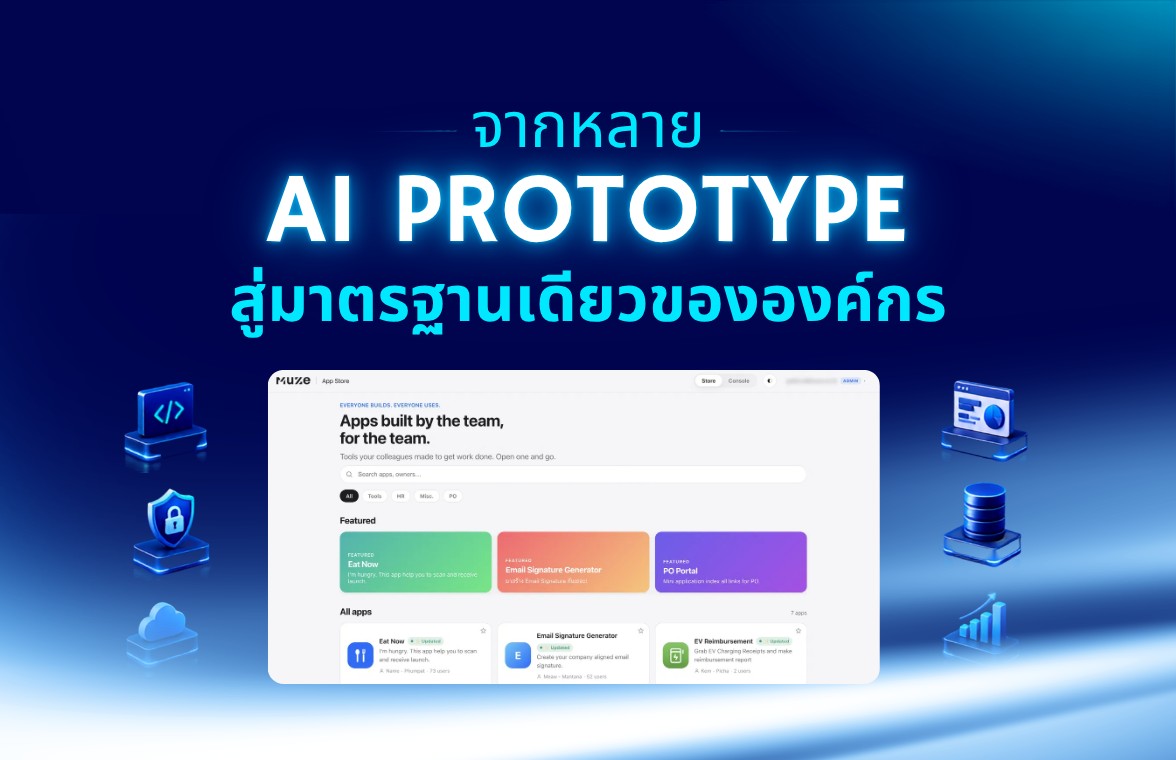
An Internal App Store Keeps Every Ready-to-Use AI Tool in One Place
Once applications are being built by many teams, spreading tools around through links, chat messages, or scattered documents starts becoming hard to manage, both for users and for the team responsible for maintaining the systems.
An internal app store acts as the shared space for applications that have already been through the organization’s process. Users can reach the tools they need from one place, while the organization can set permissions by role and clearly separate tools that are ready for use from prototypes still in the experimentation stage.
As the number of applications grows, having a shared space like this makes it much easier for the organization to see what tools exist, who can use them, and which applications are still under active maintenance.
AEGIS Maps Out the Path From Building a Tool to Production
AEGIS is designed to give AI tools coming out of every team a clear path into production, without having to design a new development and deployment process every single time. A team can use whatever AI coding tool the organization has chosen to build an application around its own use case, with a Builder Kit that keeps the development structure aligned with the standards the organization has set.
Once an application is ready for real use, it goes through the IT Governance Pipeline, which checks security, tech stack, and data & privacy before it’s deployed into the internal app store, with access permissions set according to each user’s role.
AI Coding Tool → Builder Kit → IT Governance Pipeline → Internal App Store
Prototypes can still happen just as fast as before, but once a tool proves its value, there’s already a path to bring it into production without having to design the whole system again from scratch.
Builder Kit and the Governance Pipeline Cut Down on Work That Would Otherwise Come Back Later
The Builder Kit brings the organization’s standards into the development stage from the start, so each team doesn’t have to design its own foundational building blocks every time, and applications coming out of different teams end up with a much more consistent structure.
From there, the IT Governance Pipeline acts as a checkpoint before production, checking security, the technology being used, and how data & privacy are handled.
A team therefore knows from the outset exactly what an application has to pass before deployment, while IT can manage the whole process through a single flow, instead of having to individually check tools coming out of every different team.
From Prototype to Software the Organization Can Actually Maintain
AI lets people inside an organization turn a problem they run into at work into a prototype faster than before, and opens the door to new use cases coming out of many different teams. But once a tool starts being used in a real workflow, speed of building alone isn’t enough. The system still has to support infrastructure, security, data, ownership, access, and long-term upkeep. Having a shared structure in place early, while the number of applications is still small, lets an organization keep scaling its use of AI without having to come back and clean everything up later once tools are already scattered across the whole organization.
AEGIS exists to map out that path — from build, to govern, to deploy — so AI tools coming out of every team can grow from prototype to production under the same standard, while staying inside a system the organization can see, control, and keep maintaining.
For an organization that’s starting to see AI tools spread across multiple teams, or that wants to put a system in place to support building internal applications with AI, the Muze team is available to talk through an approach suited to your organization’s infrastructure, governance, and workflow.