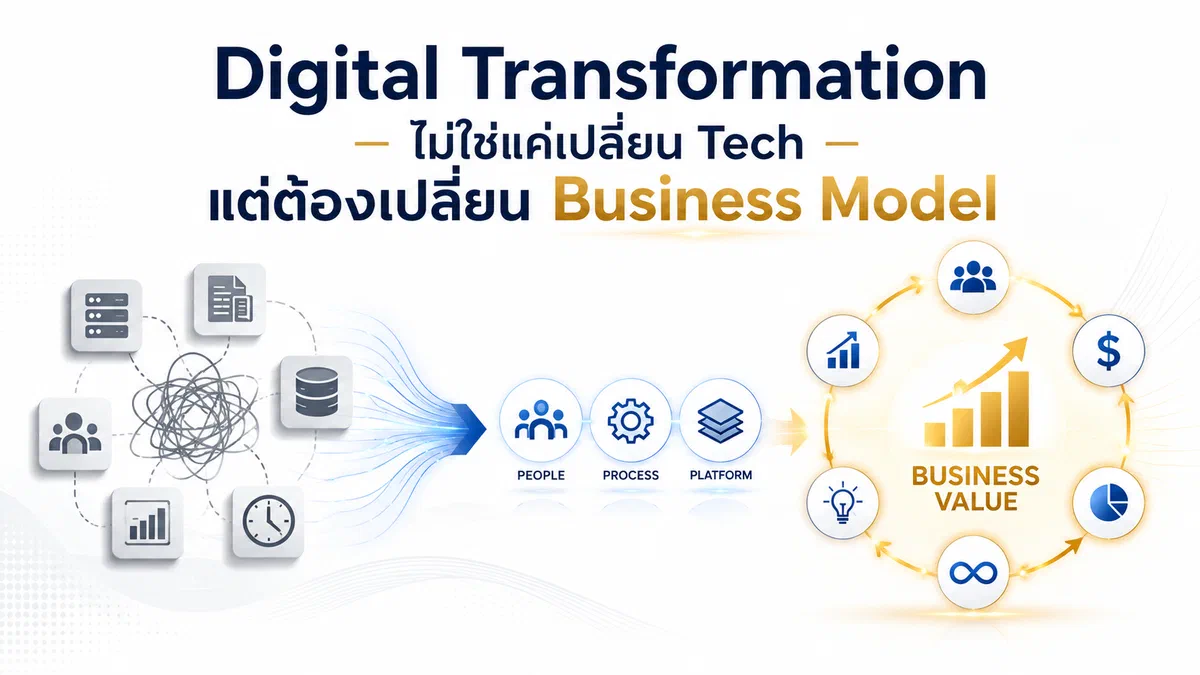
Many organizations invest in new systems, buy new software, or start adopting AI — and call it Digital Transformation.
But in reality, digital change doesn’t happen just because an organization has newer technology. If the way people think, the way they work, and the business model remain the same, the result is often just new technology layered on top of the same old processes.
The problem isn’t a lack of intention — it’s treating Technology as the destination rather than the tool. When an organization invests in a new ERP or Cloud Migration without changing how the business makes decisions or generates revenue, the result is the same process in new clothes.
Research from McKinsey shows that over 70% of Digital Transformation projects fail to achieve their stated goals — not because they chose the wrong technology, but because there was no clarity on how the Transformation would actually change the business. That makes the investment a cost without measurable business value.
True Digital Transformation isn’t about changing your tech stack. It’s about changing how your organization creates value, delivers services, and competes in the market.
Starting in the Wrong Place Leads to the Wrong Outcome

One of the most common misconceptions is treating Technology as the starting point for change. Many organizations begin by asking “which system should we use?”, “should we invest in AI?”, or “which platform should we migrate first?”
But the more important question is: “What does the organization need to change about its business?”
Consider an organization that invests tens of millions in a new CRM system, but the Sales team still records customer information in Excel and enters it into the system later. The problem isn’t the system — it’s that no one asked upfront: “Why doesn’t the sales team want to use the new system?” and “What does the actual sales process look like in the field?” Ask those questions first, and the answer might be that the old system was too hard to fill in, or didn’t match how the team actually worked on the ground — a problem solvable from the start, not after the money is already spent.
Because ultimately, Technology is just a tool — one that helps organizations execute strategy faster, more efficiently, and at greater scale. Without clear business goals, technology investment can easily become a cost that delivers far less business value than expected.
Why Most Organizations Get Stuck Just Changing Their Tools
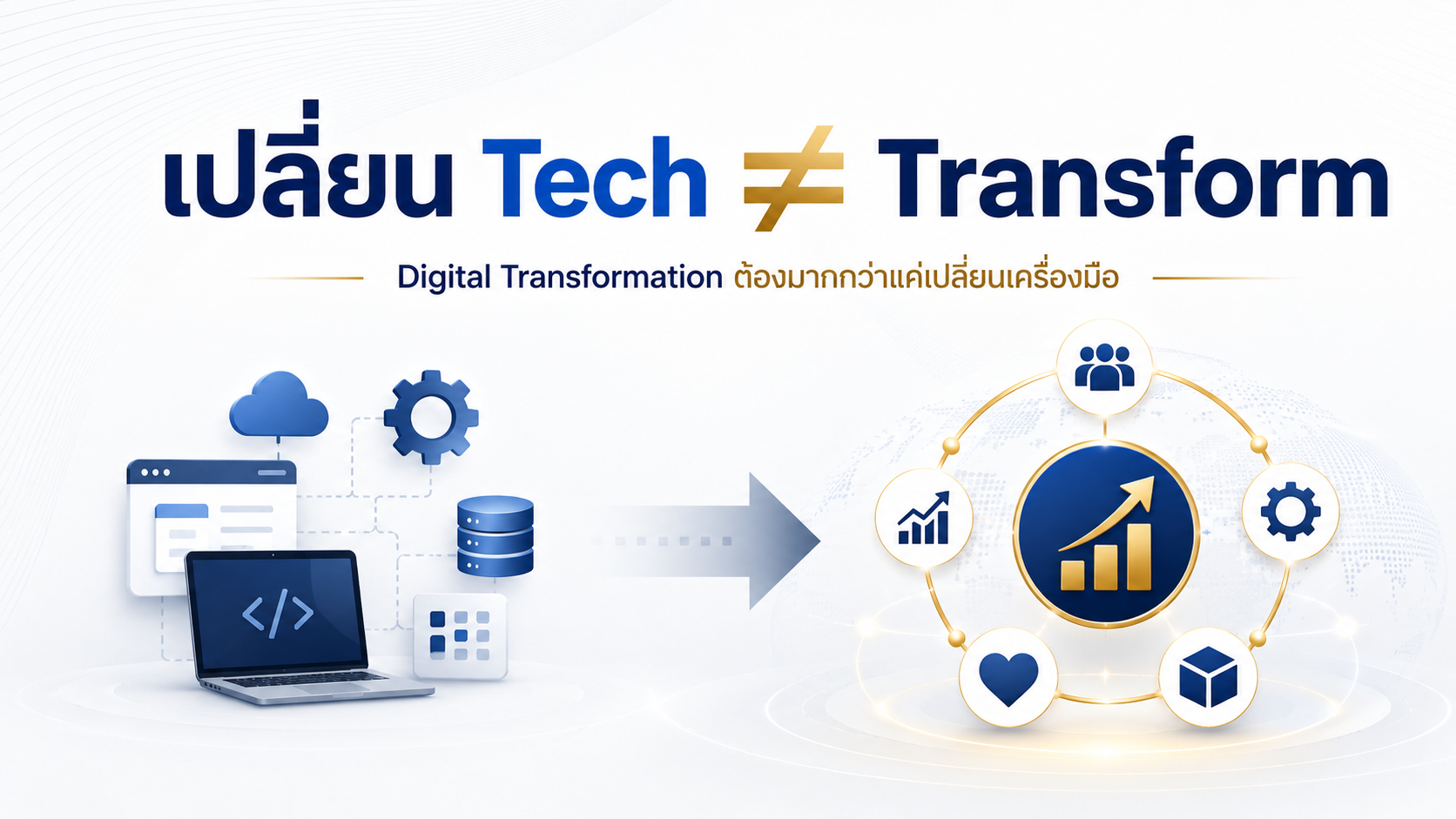
The assumption that “changing Tech = changing the business” runs deeper than expected. Part of it comes from how large organizations structure their budgets — with a clearly separate “IT Budget” line item that means digital investment gets framed as an IT Project from the start, rather than a Business Initiative that happens to have a Technology component.
Another reason is a culture of short-term performance measurement. Executives reporting to boards every quarter face pressure to show tangible results quickly — like “the new system is deployed” rather than “user behavior has durably changed,” which takes longer but is the real indicator of Transformation.
Fixing this has to start at the executive and board level, with a new set of questions and success metrics for digital projects — not just a new team responsible for them.
Viewing Digital Transformation End-to-End

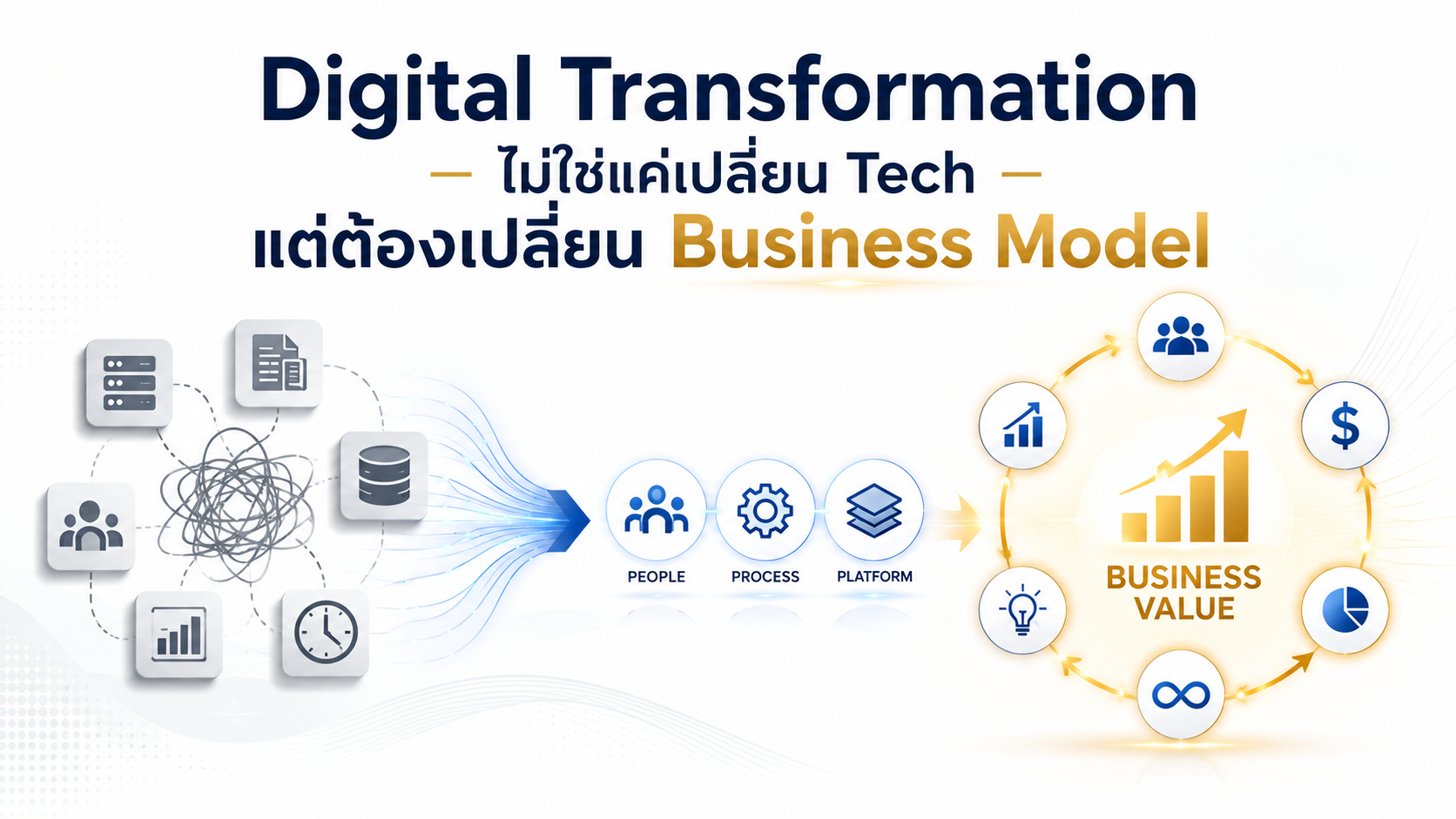
Successful organizations rarely start from Technology. They start from a holistic view of the entire organization. The framework most commonly used for planning Digital Transformation breaks down into 3 core components:
1. People
Change won’t happen if people in the organization are still working the same way. Many Transformation projects fail — not because they chose the wrong technology — but because employees didn’t understand the purpose of the change, or lacked the skills required for the new way of working.
The resistance often isn’t because employees don’t want to grow. It’s because there’s no clear answer to “how does this change affect my job?” The best system in the world won’t deliver value if the people who need to use it don’t believe it makes their working lives better.
Building Digital Mindset isn’t about telling people to use more Technology — it’s about creating a way of thinking where data and digital tools are a natural part of every day’s decisions. Organizations that succeed typically start with small, visible Quick Wins that let employees see real results in their day-to-day work, before scaling to bigger changes.
Organizations must invest in developing the new skills required, managing change effectively (Change Management), and creating a culture that’s comfortable experimenting and learning. Because ultimately, Technology creates value only when there are people who can apply it to produce real business outcomes.
2. Process
Before automating anything, organizations should first ask whether their existing processes are efficient enough to be worth automating. Many times, organizations bring in new systems only to end up making inefficient processes run faster — without fixing the underlying inefficiency.
A common example: a document approval process that passes through 4 levels of management. When the organization goes digital, those steps remain — they just changed from physical paper to clicking Approve on a screen. Time-to-Decision doesn’t decrease at all.
Digital Transformation isn’t just about digitizing existing processes. It’s about redesigning how work gets done to fit a digital world — moving from Manual tasks to automated Workflows, eliminating unnecessary approval steps, connecting data across teams, and using data to support Real-time decision-making. When Processes are redesigned properly, organizations can reduce costs, increase speed, and elevate the customer experience simultaneously.
3. Platform
Once People and Process are ready, Technology becomes the accelerator for growth. Platform in the context of Digital Transformation doesn’t just mean Software or Application — it means the foundational infrastructure that enables an organization to continuously build, improve, and scale its services.
A good Platform also needs an ecosystem of tools and services that connect easily — whether Payment Gateways, Analytics, Notification systems, or the Third-party APIs a business will need in the future. Being locked in to a single Vendor with no clear exit path can become a hard-to-escape constraint later.
Organizations should evaluate Platforms from a business perspective: Can the system support future growth? Can it integrate easily with other services? Does it reduce dependencies and give the Product team the Agility to test new ideas quickly, instead of waiting months on Technical Dependencies? Choosing the right Platform isn’t purely a technical decision — it’s a long-term strategic business decision.
Case Study: CH3PLUS — When a TV Channel Had to Become a National Streaming Platform

Channel 3 is one of Thailand’s most recognized television stations. But in an era where viewer behavior has fundamentally shifted, having strong content alone is no longer enough.
The real challenge for CH3PLUS wasn’t simply to “add an online channel” — it was deciding whether their existing Platform could support the direction of the business in the Streaming era, and how to build a new Business Model that would make online viewers genuinely valuable to the business. Because TV viewers and OTT Platform users have fundamentally different behaviors and expectations.
From TV Channel to a Truly Scalable OTT Platform
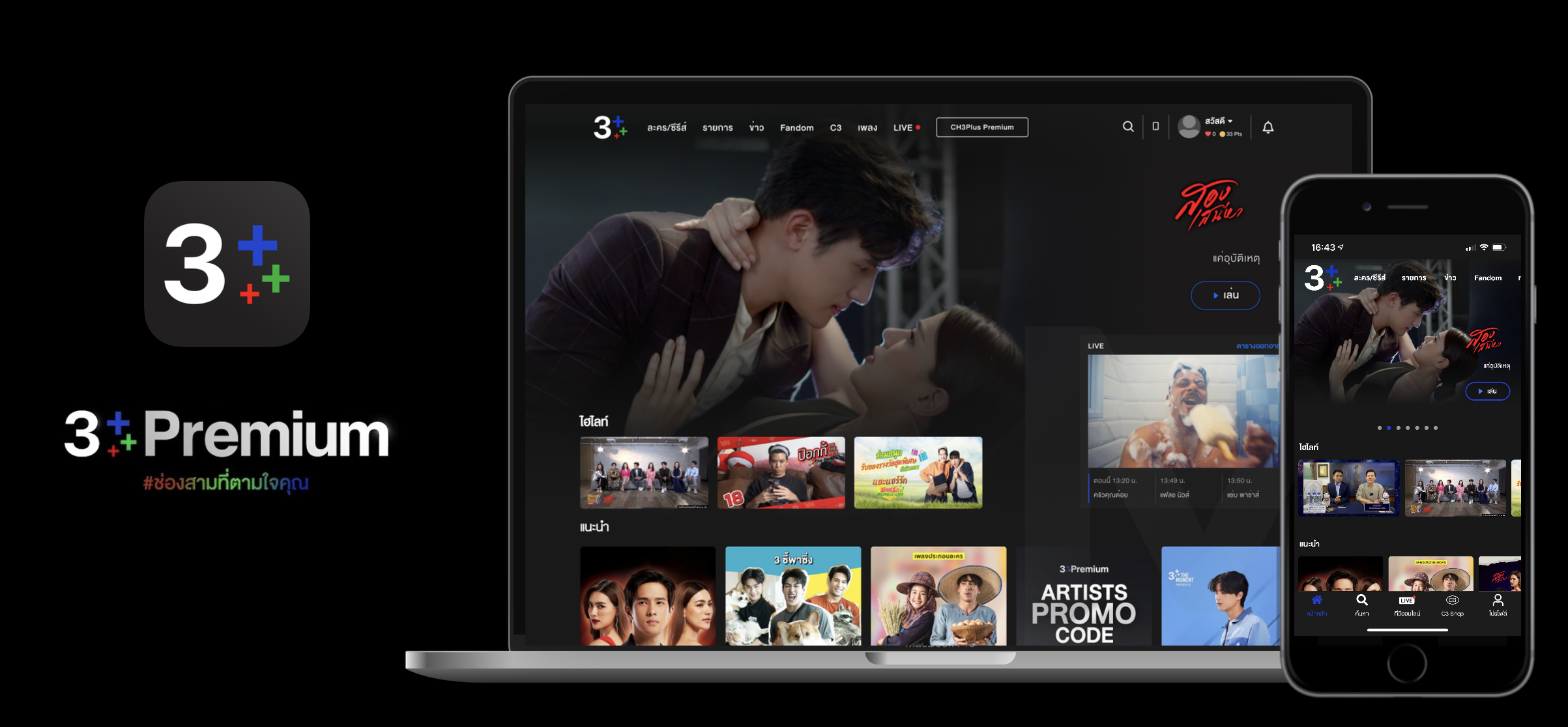
CH3PLUS’s challenge wasn’t a lack of content. It was that the existing system wasn’t designed to handle massive concurrent viewers. When a hit drama went on air, traffic spiked sharply — and an unprepared system meant a broken experience immediately. In the Streaming world, there are no second chances: users switch platforms within seconds.
Muze came in as a Technology Partner — and didn’t start by writing Requirements or choosing a Tech Stack. The starting point was identifying what Asset CH3PLUS already had that no competitor in the industry could replicate.
The answer was its talent roster. Channel 3 has one of Thailand’s largest stables of well-known celebrities, each with a large and highly loyal Fan Base. That’s an Asset that Netflix or Disney+ simply cannot replicate in the short term — and a point of differentiation that sets CH3PLUS clearly apart from every other OTT player in the market.
So the concept wasn’t just building a Platform where people can watch content like any other Streaming service. It was designing Features that connect directly to the celebrities themselves — turning the existing Fan Base into Engaged Users on the Platform who can Interact with their favourite stars in ways unavailable anywhere else, and opening up multiple Transaction opportunities: from supporting artists, to accessing Exclusive Content and Virtual Experiences.
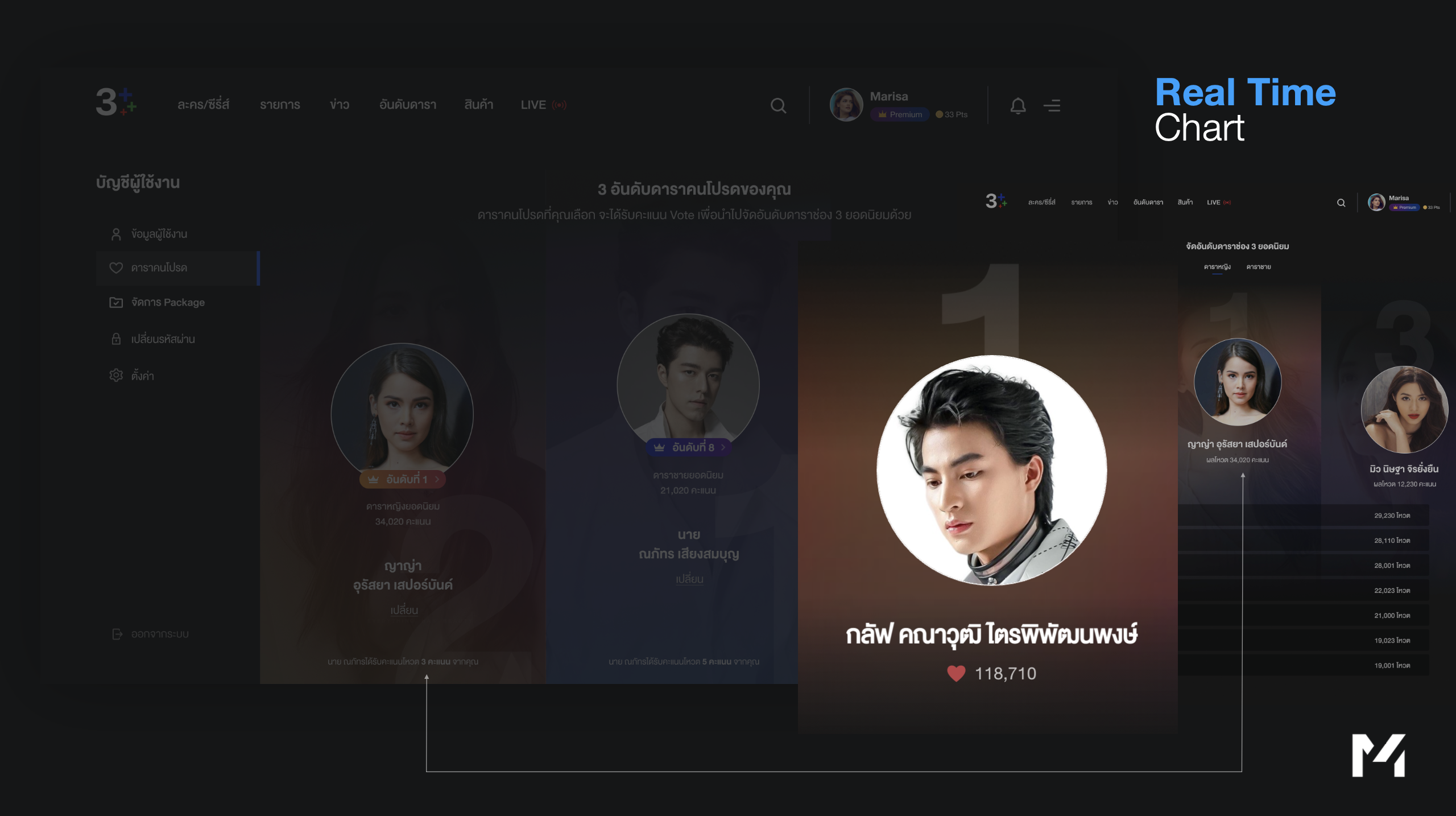
Muze then designed an Architecture that could handle high Concurrent User loads stably, developed a Streaming system that supports a wide range of devices — from mobile and Tablet to Smart TV — and built the Infrastructure to support Fan Features that demand high Real-time capability and can handle Traffic Spikes whenever a celebrity appears at an event or runs an activity.
The result was an OTT Platform supporting over 12 million users per month, with peak simultaneous viewers of 500,000 — stable, without system failures even during Prime Time when demand was at its highest.
What CH3PLUS achieved wasn’t simply “adding an app” on top of the existing business. It was identifying a Unique Asset that was already there, and building a Platform that lets that Asset generate value in the digital world at its full potential. From a TV channel dependent on broadcast airtime revenue, to a Digital Platform where its talent is the engine that drives Engagement and Revenue around the clock.
From Digital Transformation to Business Transformation
What happened with CH3PLUS is a clear example of the difference between Digitizing an existing business and truly Transforming how an organization creates value and grows revenue over the long term.
The question executives need to ask isn’t “are we digital yet?” — it’s “how has the way we generate revenue and deliver value to customers actually changed because of Digital?” Because the real measure of Transformation isn’t the number of Features shipped, it’s the business metrics that have moved in the right direction.
This difference shows up clearly across every industry. A bank that just adds Mobile Banking on top of its existing Core Banking is Digitizing. A bank that designs new Financial Products that only exist in the digital world and reach entirely new customer segments is Transforming. A retailer that adds an online ordering channel is Digitizing. A retailer that uses combined online and offline customer data to design Loyalty Programs that change repurchase behavior is Transforming.
What leading organizations are doing across every industry isn’t simply changing their working tools — it’s redesigning the way they operate to be competitive in a digital world. That’s why Digital Transformation shouldn’t be seen as an IT project. It should be seen as a business project, with Technology as one of the key drivers.
Signs That Your Transformation Is Heading in the Right Direction
One of the challenges of Digital Transformation is measuring success along the way — because real outcomes often take 12–24 months to become clear. But there are early signals that show whether a project is on track.
The first is that organizational decisions are increasingly data-driven. When teams start bringing Data into presentations and debates rather than relying on personal opinion alone, that’s a good sign.
The second is that Feature delivery speed is increasing, not decreasing. Many failed projects make teams feel the new system is more complicated than the old one, because the Architecture wasn’t designed for how the team actually works.
The third is that Business and Technology teams start speaking the same language. The real challenge of Digital Transformation is narrowing the gap between these two sides. When Business understands Technical Constraints and Technology understands Business Context, every decision gets faster and more accurate.
And the fourth, equally important sign, is customers giving increasingly positive Feedback. Because true Transformation must affect the experience users actually feel — not just improve internal processes. If NPS scores don’t change, or customers are still complaining about the same things, that’s a signal the Transformation hasn’t yet reached the point of creating real value.
Lessons That Apply in Practice
Start with business questions, not technology questions
Organizations that succeed at Transformation rarely start by choosing a Platform or Tool. They start by asking themselves: “If we don’t invest now, what Business Opportunity will we lose over the next 12–18 months?” That question forces leadership to see the business picture first — and then work backward to select the right Technology. This approach also ensures every Feature built has a clear rationale, and cuts unnecessary investments before they happen.
Design for the future, not just to solve today’s problems
One of the most common mistakes is investing in a “fix one issue at a time” approach without laying an Architecture that supports future growth. The result: every new Feature added becomes more expensive, and Time-to-Market gets longer instead of shorter. A system that starts as a poorly-directed Monolith may need to be completely rebuilt when users grow to a certain scale — far more expensive than getting the Architecture right from the start.
Transformation isn’t a project with an end date
Many organizations treat Digital Transformation as a “project” with a defined start and finish. But in reality, it’s a continuous process of adapting to a market and consumer behavior that keeps evolving. Over the last 3 years, consumer behavior has changed faster than at any point in history. Organizations that stop investing after the first Go-live often find themselves having to start over again 2–3 years later. Organizations that understand this won’t view Technology investment as a “cost” — they’ll view it as “competitive capability” that must be maintained and developed continuously.
The right Technology Partner is part of the business strategy
The difference between a Vendor who takes a Requirement and delivers against it, and a Partner who understands your business context, matters enormously. A good Partner can Challenge Assumptions, propose better alternatives, and help reduce project risk from the very beginning. The distinction shows up most clearly 12–18 months after Go-live, when the challenge shifts from “deliver on scope” to “help the business keep growing.” A good Partner is still there — helping the system evolve continuously as the business direction changes.
Because ultimately, the goal of Digital Transformation isn’t to have the most cutting-edge technology — it’s to build a Business Model that’s ready to grow and compete for the long term.