
Over the past 2–3 years, Thailand’s FinTech market has grown consistently across virtually every Segment — Digital Payment, Lending, Wealth Management, and the trading of financial assets like gold, commodities, and digital assets. User numbers in Thai FinTech grow every year, and user expectations grow right alongside them.
But behind this rapid growth, there’s a question many executives still can’t answer clearly: “Is our Backend actually ready to support this growth?” And this isn’t just a technical question — it’s a business question with direct consequences for an organization’s Competitiveness and Cost Structure.
This article draws on real Case Studies from Muze’s experience working with Mae Thong Suk Goldsmith Co., Ltd. (MTS Gold), one of Thailand’s leading gold and precious metals trading platforms, to answer that question from a real business perspective.
When a Gold Trading Business Needs FinTech-Grade Infrastructure
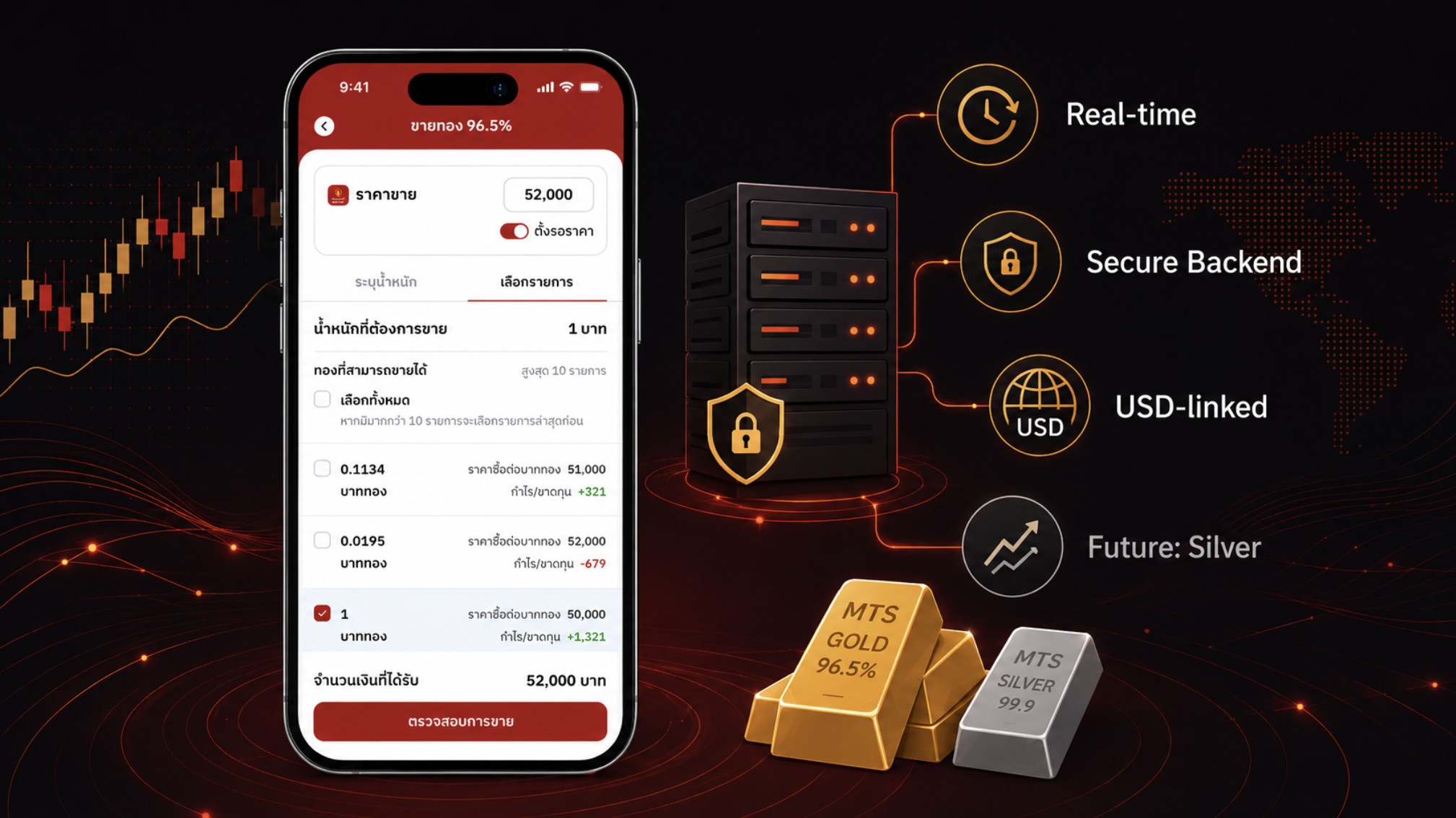
MTS Gold isn’t just another gold shop. It’s an investment Platform that must handle highly complex financial transactions — gold trading, USD-linked assets, and eventually Silver — all of which are products whose prices change continuously with global markets. A system that supports this kind of business needs more than a “nice-looking App.” It needs a Backend that’s solid, Real-time, and scalable.
MTS Gold’s challenges — which mirror what many Thai FinTech companies are facing — fall into three main areas:
Transaction Integrity — Every trade must execute without error. The price locked in must match the price actually executed. In an asset market where prices fluctuate constantly, even small discrepancies can cause real financial harm and erode customer trust.
Multi-Asset Architecture — A system built for gold alone can’t easily support a new product like USD or Silver. Adding each new asset type becomes a Rebuild instead of an extension.
UX That Keeps Pace — Modern users won’t accept slow systems or outdated UX, no matter how trustworthy the business. In a market with multiple competitors, the user experience is often the deciding factor in whether a customer stays or leaves.
Case Study 1: Assessing the Existing Backend and Building the Gold Trading Platform
MTS Gold already had a Backend system in operation. But as Thailand’s online gold trading market accelerated, the question wasn’t whether to start from scratch — it was whether the existing Backend was ready to support the next stage of business growth, and what investment was needed to make the Platform scale sustainably.
Muze came in starting with an assessment of the existing Backend — evaluating what was suitable for extending, what needed to be added, and what needed to be redesigned. That analysis became the foundation for a development plan, executed by a full team covering System Analyst, Dev Manager, Senior and Junior Developers, and QA — to bring the Platform to Go-live readiness.
Business ROI: This was an Enterprise-level investment covering a Full-team throughout Development plus a Warranty Period post-Go-live. MTS Gold received a Gold Trading Application built for stable, sustainable growth. The Cost of Downtime — or losing customers to competitors because of system failures or poor UX — is extremely high in investment markets where Switching Cost is very low.
Case Study 2: Expanding the Portfolio Into USD-Linked Trading
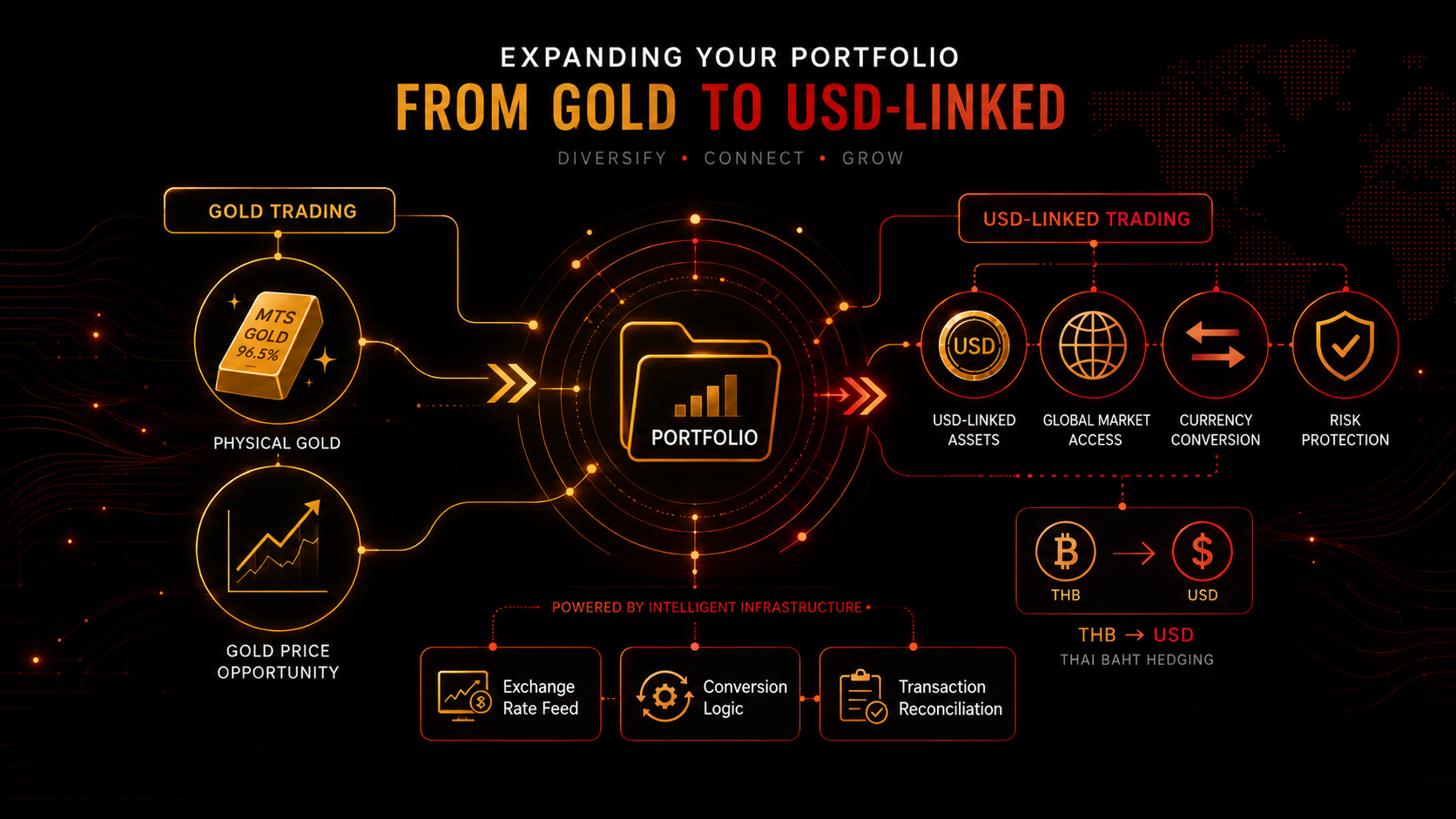
After the Gold Trading App was performing well, MTS Gold identified a new opportunity: customers who wanted to Hedge against baht depreciation by holding USD-linked assets — behavior that was growing noticeably as the baht weakened.
But enabling USD-linked trading wasn’t just about adding a small Feature. It meant building a new financial product on a Backend that needed to handle Exchange Rate Feeds, Conversion Logic, and Transaction Reconciliation — all fundamentally different from Gold Trading.
Muze started by assessing the existing system — checking whether the two critical components required for a USD product were already in place:
- USD Trading carries higher Regulatory Complexity than gold — evaluating whether the AML/KYC layer, Transaction Limits, and Reporting Requirements were already present and adequate
- API Integration with external Rate Feeds — evaluating whether Fallback mechanisms and Latency were sufficient to keep the price shown in the app from lagging behind the real market — in financial services, even a few seconds of price discrepancy creates problems
Case Study 3: Silver Trading and the Platform Thinking Payoff
Alongside the USD Trading App, MTS Gold decided to launch Silver Trading as a third product. Silver is an asset related to gold but with different price behavior, attracting a different customer segment — particularly Entry-level investors because the price per unit is significantly lower.
This is the most interesting part from a business perspective.
By the time MTS Gold reached Silver Trading, they could Leverage the Architecture already built across the Gold and USD projects directly. Starting Silver with a Sprint 0 for Design followed by a Development Phase cost significantly less than building from scratch because:
- Reusable Backend Components — Authentication, User Management, and Transaction Logging systems could be shared across products
- Faster Time-to-Market — A team that already understood the Codebase moved faster than onboarding a new team
- Reduced QA Scope — Integrations already Tested in Gold and USD didn’t need to be fully re-tested
This is the hidden ROI of investing in Backend correctly from the first project: the Cost of the second and third projects drops significantly, and Time-to-Market shortens with each one. In a competitive market like FinTech, the speed at which you can launch new products is a direct Competitive Advantage.
Key Takeaways: When the Next Business Opportunity Arrives, Is Your Backend Ready?
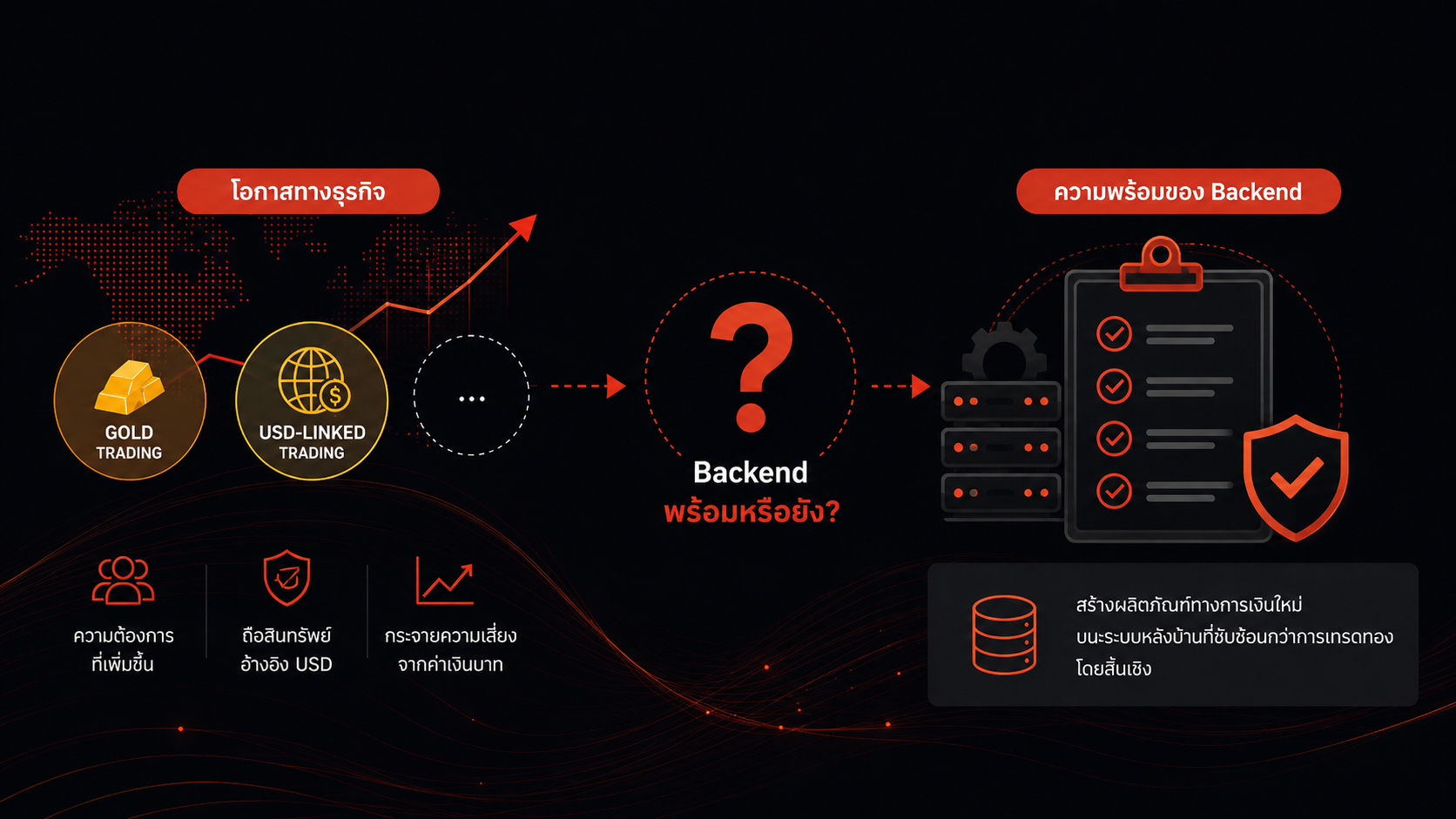
From these 3 projects, Muze has identified 5 signals that a Thai FinTech company’s Backend is “not ready” for growth:
- Signal 1: Every new product requires building from scratch — If adding a new product always means starting a new Architecture from zero, the Backend was built as a Point Solution for individual problems, not as a Platform designed to grow.
- Signal 2: Real-time pricing causes system instability — FinTech businesses dealing in assets need to support Price Feeds that update every few seconds. If the system can’t handle this Load, that’s an Architecture problem — not a Performance Tuning problem.
- Signal 3: New integrations break existing functionality — A well-designed system maintains Backward Compatibility. If every Feature addition triggers a full Regression Test, Technical Debt has already grown too high.
- Signal 4: No complete Audit Trail — In Financial Services, every Transaction needs a Log that can be fully Reconstructed. Without this, the business faces a Compliance risk that may carry significant cost in the future.
- Signal 5: Cost to Change exceeds Cost to Build — When fixing a Bug or adding a Feature costs more than building a new system, that’s a clear signal it’s time to Rebuild.
Conclusion: Investing in Backend Is Investing in Business Velocity
Thai FinTech is growing fast — but how fast that growth can move depends entirely on how ready the Backend is.
MTS Gold’s decision to invest in a solid Gold Trading App from the start made expanding into USD and Silver faster and cheaper per unit than if they’d built each product from scratch. That’s the real ROI of Backend Investment — not just “a system that works,” but a Platform that lets the business scale faster with every product that follows.
For organizations asking “Should we invest in rebuilding our current system?” the right question is: “If we don’t invest now, what Business Opportunity will we lose over the next 12–18 months?”
If your organization is evaluating whether its Backend is ready for the next phase of growth, the Muze team is happy to listen and work through the right approach together — one that fits your Business Context and Technical constraints from the start.