
As Generative AI became part of everyday work, many organizations chose to hold back, issuing policies that ban external AI tools or blocking access from the company network, to make sure important data wouldn’t leak out at a time when there were no clear guidelines yet.
That decision always has good reasons behind it. But data from a number of recent surveys is starting to point in the same direction: AI use at work hasn’t gone down because of the bans; it has moved somewhere the organization can’t see. So the question organizations face is gradually shifting from “should we use AI?” to “how do we use AI as safely and as productively as possible?”
Why Banning Is the Starting Point Many Organizations Choose
Banning AI doesn’t come from failing to see the value of the technology. It usually comes from a sense of responsibility for the organization’s data. When AI tools first spread, many organizations didn’t clearly know where the data employees typed in would be stored, how it would be used, or whether it complied with Thailand’s Personal Data Protection Act (PDPA) or industry-specific regulations.
For organizations that hold large amounts of customer data, such as financial institutions, insurers, or other heavily regulated businesses, pausing until there’s a clear framework is a reasonable choice, and it gives the organization time to study the risks carefully.
However, a ban is a measure suited to the early stage. As time goes on and AI becomes part of almost every tool people work with, the same measure can start producing results different from what was intended.
The Numbers Show AI Use Doesn’t Stop Because of a Ban
Microsoft and LinkedIn’s 2024 Work Trend Index, which surveyed 31,000 workers across 31 countries, found that 75% of knowledge workers already use AI at work, and of those, 78% bring their own AI tools rather than waiting for their organization to provide them.
When bans come into the picture, things get even clearer. PagerDuty’s 2026 Shadow AI survey of 1,250 office workers in the US, UK, Japan and Australia found that 66% of AI users had used it even though they believed it went against company policy, and 39% chose to use it without telling anyone. Meanwhile, an EisnerAmper survey in the US found that nearly 43% of employees who had used AI said they would or might keep using it even if their organization banned it.
More worrying than the usage itself is the data that goes along with it. The same PagerDuty survey found that 43% of employees had put work communications into public AI tools, 34% had entered customer data, and 31% had entered financial data or confidential documents, which is exactly the kind of data the ban was meant to protect in the first place.

When the Need for AI Doesn’t Disappear with the Ban
These numbers don’t mean employees are deliberately breaking the rules. Most employees use AI because they see it helps them get work done faster: summarizing documents, drafting emails, analyzing data, even building small tools for their own team. When the organization closes the official channels, these needs don’t disappear; they move to personal accounts, mobile phones, or external services the organization doesn’t manage. This phenomenon is called Shadow AI, an extension of the Shadow IT that many organizations are already familiar with.
Deloitte UK’s 2026 GenAI Workforce Survey offers another angle: 31% of GenAI users use it at work without their employer knowing, 22% believe their organization would allow it if it knew, and 17% pay for AI tools out of their own pocket to use for work. The picture isn’t one of employees working against the organization, but of a gap between what employees need and what the organization provides.
The result is a paradox. A ban put in place to reduce risk can leave the organization unable to see where its data is being used, and with no chance to step in and recommend safer ways of using it.
Why Bans Are Harder to Enforce Than They Seem
Even when an organization intends to enforce a ban strictly, the nature of today’s AI makes control through blocking alone increasingly difficult.
- AI is already inside the tools people use AI no longer lives only on chatbot websites. It’s built into browsers, document software, meeting apps and mobile phones, so blocking a few websites covers only a small part of real usage.
- Personal devices are outside the network’s reach Blocking on the company network doesn’t cover personal phones or computers, where employees can copy data out to use within seconds.
- The line around “using AI” isn’t clear Translation, grammar checking and automatic meeting summaries all use AI behind the scenes. When the definition is unclear, each employee interprets the ban differently. PagerDuty’s survey found that 29% of AI users aren’t sure whether their own use is permitted.
- A ban with no alternative makes people find their own way When work still has to be done on deadline and tools that can help are close at hand, a ban that doesn’t come with an approved alternative often ends up pushing usage out of sight.
Invisible Risk Costs More Than You Think
IBM’s 2025 Cost of a Data Breach report is one of the first datasets to put a dollar figure on the impact of Shadow AI. It found that around 20% of organizations in the report had experienced a data breach involving Shadow AI, and that organizations with high levels of Shadow AI saw breach costs that were on average about USD 670,000 higher than organizations with little or none.
The same report found that 63% of breached organizations had no AI Governance policy or were still drafting one, and among those that did have a policy, only 34% regularly audited for unsanctioned AI use. Of the organizations that suffered an incident involving AI systems directly, 97% lacked proper AI access controls.
This data shows that the risk doesn’t come from using AI itself, but from using AI where the organization has no policy, no auditing and no access control, a gap that a ban alone can’t close.
The Cost of Waiting That Doesn’t Show Up in Risk Reports
Beyond risk moving out of sight, not using AI in real work has another cost that’s harder to measure.
- Skills that don’t get developed Using AI effectively is a skill learned by doing: framing the task, checking the output, and knowing which kinds of work are and aren’t suited to AI. The later you start, the wider this skills gap becomes.
- Missed chances to improve how work gets done Much of the repetitive work AI could reduce still takes up the same amount of employees’ time, while other organizations in the same industry may already be putting the time they’ve won back into higher-value work.
- The organization lacks data to make decisions When usage happens outside the system, the organization doesn’t know which kinds of work employees most want AI help with, which makes it hard to decide which tools or processes to invest in next.
- What people expect from work Many employees already use AI in their everyday lives. Working in an environment without these tools can affect both productivity and how people on the team feel.
Banning vs. Governing: What’s the Difference?
Banning and governing share the same goal, which is protecting the organization, but they use different methods and lead to different long-term outcomes.
- Visibility Banning keeps the usage that still happens out of sight, while governing brings usage back into channels the organization can track.
- Data handling Banning relies on everyone complying, while governing can clearly define which types of data may be used with which tools, with systems that help enforce those rules.
- Risk management Banning reduces risk by preventing use, while governing reduces risk by reviewing before anything goes into real use, and re-checking at any time.
- Relationship with employees Banning forces employees who use AI to choose between following the rules and getting their work done on time, while governing lets employees use AI openly and feel comfortable asking when they’re unsure.
- Organizational learning Banning leaves the organization without real experience of AI, while governing gives the organization the chance to learn, adjust its rules, and scale up what works.
Put another way, banning protects the organization on the days it isn’t ready yet, while governing protects the organization on the days it’s ready to move forward.

4 Stages of the Transition from Banning to Governing
AI governance isn’t a binary choice between shutting everything down and opening everything up. Most organizations transition gradually as they become ready, which can be roughly divided into 4 stages.
- Stage 1: Ban to assess the risks The organization pauses usage first, to study how AI tools handle data and which legal requirements must be met. This stage suits a short period rather than a permanent policy.
- Stage 2: Enable organization-approved tools The organization provides AI tools with clear data agreements for employees to use through organizational accounts, along with guidance on which types of data can and can’t be used. Deloitte’s data shows that in financial services, banking and insurance, employees use organization-provided AI tools at a higher rate than the cross-industry average, both tools the organization built itself and external tools it procured.
- Stage 3: Govern by use case and data classification The organization starts separating usage by risk. General work can go ahead immediately, work involving customer or financial data requires approval, and usage is tracked systematically.
- Stage 4: Let employees build tools with AI under one shared standard Employees aren’t just AI users; they can build their own applications or workflows, with every piece of work passing security and data-use review before going live, and the organization able to see what exists and who’s responsible for it.
The stages don’t have to happen across the whole organization at once. Some teams may be at stage 3 while teams handling sensitive data are still at stage 2. What matters is that every stage has a clear framework and a path to move forward when ready.
AI Governance Principles That Let Organizations Open Up AI with Confidence
Good governance doesn’t have to be complicated, but it should fully answer the key questions: who is using what, with what kind of data, and who is responsible.
- Provide the right path before banning the wrong one When employees have organization-approved tools that work well enough, the reasons to turn to external tools shrink too.
- Classify data clearly Define which types of data can be used freely with AI, which require approval first, and which should never leave the organization’s systems at all. Lines that are easy to understand let employees make decisions on their own with confidence.
- Have a checkpoint before going live Applications and workflows built with AI in particular should pass security and data privacy review before being opened up to others.
- Control access appropriately Both users’ permissions and the AI’s own permissions should be limited to what the work requires, so that any mistakes don’t spread to other data or systems.
- See all usage from one place The organization should know which tools are in use, who is responsible for them, and how many people use them, so it can respond quickly when problems arise.
- Pair education with rules, and apply the same rules across the organization Rules work when employees understand the reasoning behind them and see that everyone, at every level, follows them in the same way. PagerDuty’s survey found that 81% of employees feel AI rules are applied differently to executives than to regular employees, so consistency is a key part of credibility.
How to Start Moving from Banning to Governing
The transition doesn’t require opening everything up on a single day. Organizations can expand scope gradually as they become ready.
- Survey the usage that’s already happening Give employees the chance to share what they’re already using AI for, with no retroactive penalties. This tells you where the real needs are and which risks need to be handled first.
- Start with a small group and low-risk work Choose a pilot team that’s ready, and start with work that doesn’t involve sensitive data, such as drafting content, summarizing internal documents, or tools that help the team work.
- Set the rules alongside real usage Use the pilot period to learn which rules actually work and which need adjusting, instead of trying to write a perfect policy from the start.
- Measure both benefits and risks Track how much time AI saves and which security issues come up, to inform decisions about scaling up.
- Scale up when ready Once the rules and supporting systems have proven they work, open things up to other teams and expand into more complex use, such as letting employees build their own applications for use within the organization.
This approach lets the organization keep the same caution it intended from the start, only shifting from stopping everything to moving forward within a framework it can control.
Muze’s Experience with AEGIS
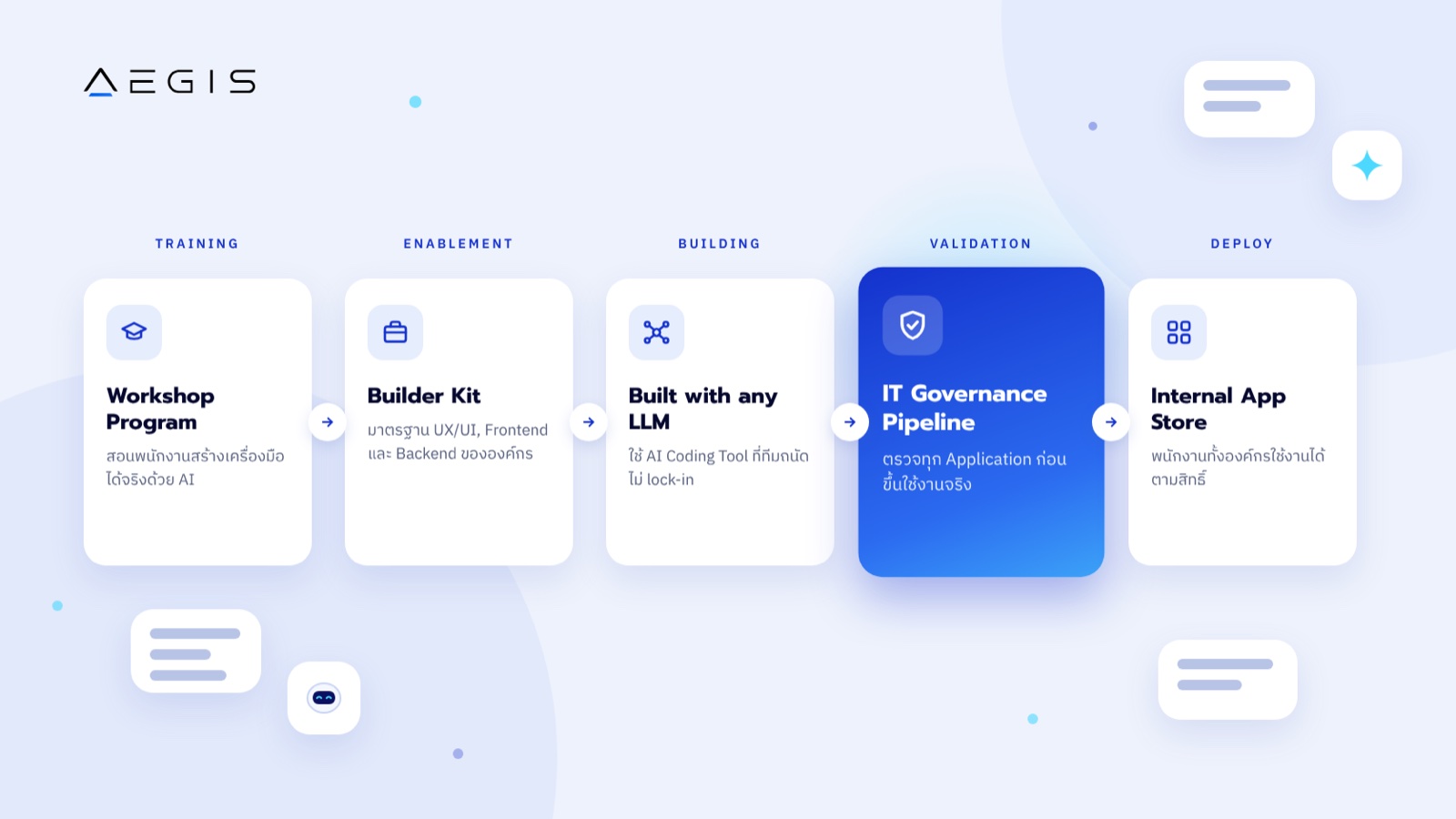
At Muze, we chose to let employees from every function build applications with AI, but with every step held to the same standard. That idea is where AEGIS came from: a platform that helps organizations open up AI more widely without lowering their security standards.
AEGIS puts governance along the entire path: from the Builder Kit that hands the organization’s standards to the AI before building starts, to the Governance Pipeline that checks security, the technology stack and data use before going live, to admin approval before an app is opened to others, all the way to the Internal App Store that lets the organization see every application and its owner from one place.
Within just a few months, Muze’s Internal App Store has more than 150 applications built by employees, while the IT team can still see and look after every single one. That would be hard to achieve if the organization’s only options were banning everything or letting people use AI freely with no framework.
Real Security Starts with Visibility
Banning AI is a decision made with good intentions, and it suits a time when the organization doesn’t yet have the tools or framework to manage it. But now that AI has become part of how work gets done, security may not come from closing the door. It comes from having a door where the organization can see who comes and goes, with rules everyone understands the same way.
Organizations that start putting governance in place today don’t just reduce the risk of Shadow AI. They also open the way for employees to learn and create value with AI, under standards the organization can trust.
If your organization is looking for a way to move from banning AI to governance that is both safe and lets employees create, you can start by getting to know AEGIS or by talking to our team directly.