Many organisations talk about AI the same way. But how they use it is vastly different. For some teams, AI is a “let’s try it” tool. At Muze, it’s a clear process — with defined ownership and measurable outcomes.
We believe that AI which truly works must start with people who know the work — not with the most eloquent prompt.
This isn’t a client case study. It’s our own — the complete rebuild of muze.co.th, using the same framework we apply to every enterprise engagement.
01 — Expertise Before Automation
Before talking about AI tools, what matters more is having the right people frame the problem first.
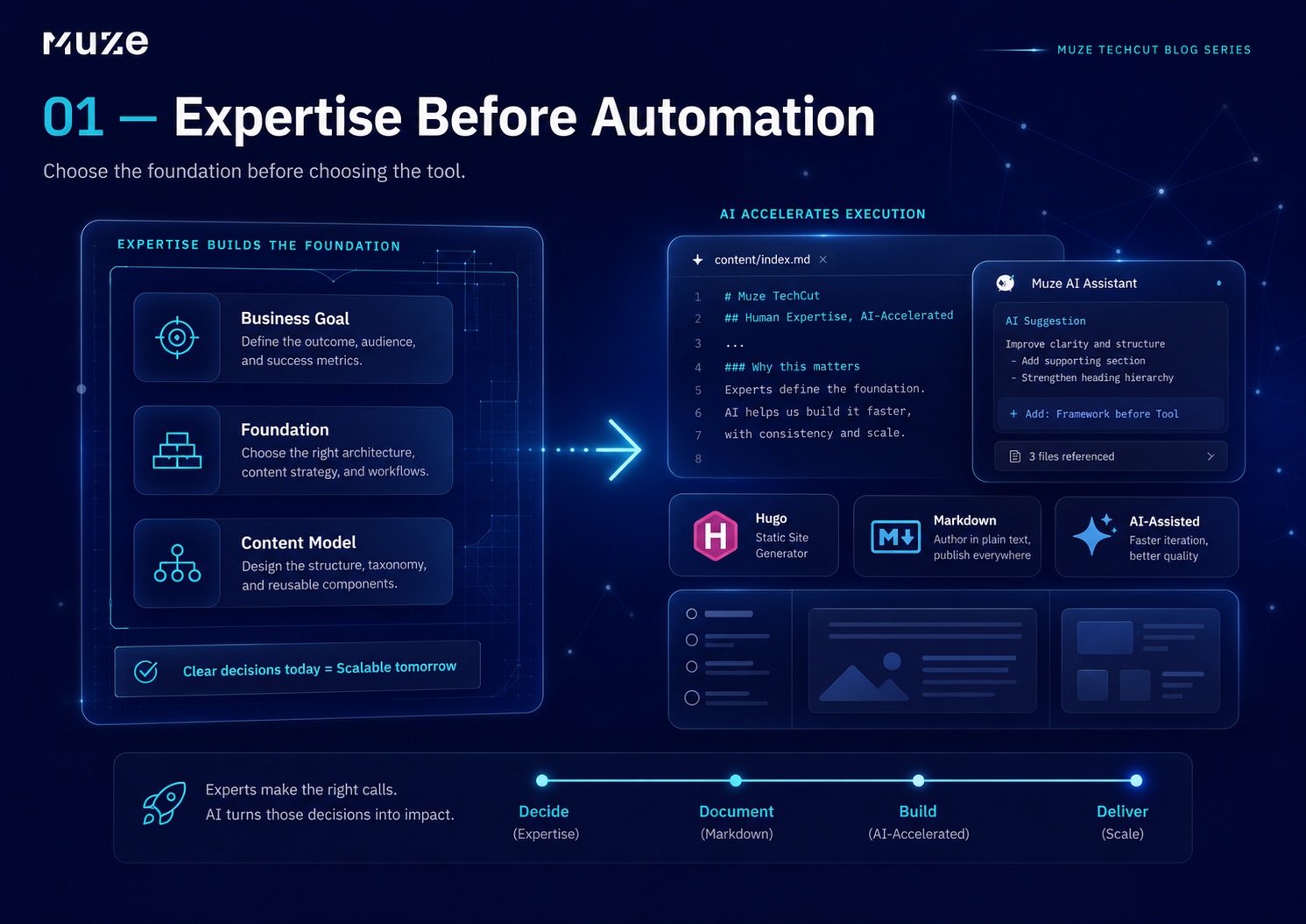
AI doesn’t inherently know what’s right for your business, your customers, or your long-term goals. It can think, write, and propose options at remarkable speed — but if you start with the wrong brief or the wrong foundation, the result may come faster, just in the wrong direction. That’s why Muze calls this principle Expertise Before Automation — let experienced people define the direction first, then bring AI in to accelerate.
Choose the Foundation Before the Tool
Most people think the first step in using AI is finding the best tool. The real first step is choosing the right foundation. Early decisions — what framework to use, how to manage content — may look like technical choices but are actually business decisions, because they determine speed, cost, flexibility, and quality over the long term.
Before Claude Code wrote a single line, Muze’s CTO made the most important decisions first: which framework, and how to manage content.
Hugo, not WordPress: WordPress is a platform with multiple stacked layers — theme, plugin, database, admin panel. Every custom design or animation requires navigating the WordPress API, potentially breaking something along the way. Choosing Hugo meant Claude Code could customise every part directly — HTML structure, CSS animation, even complex JavaScript canvas — without worrying about plugin conflicts.
Think of it like renting a fully furnished office versus building your own. The first gets you in fast but limits how much you can change. The second takes more planning but gives you full control. Hugo is the second.
And if “building your own” used to mean slow, manual work — imagine having a robot ready to build and fix things around the clock, 24/7, without ever sleeping. That’s what Hugo and Claude Code made possible in this project.
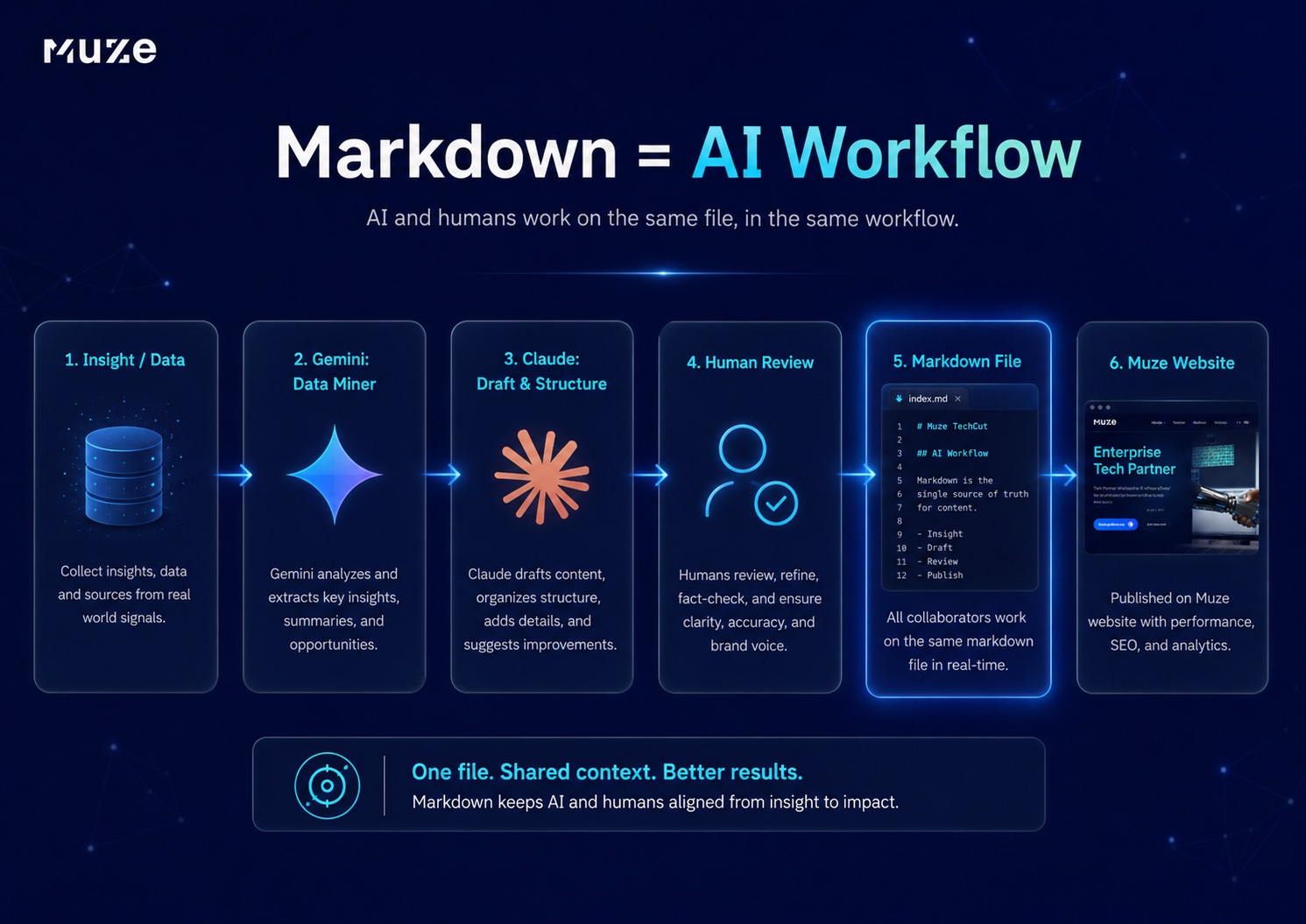
Markdown = The Gateway to a Real AI Workflow: Every TechCut article — including the one you’re reading now — goes through a process where Gemini acts as a data miner, extracting insights from multiple sources. Claude then structures and drafts the content. A human editor reviews and refines.
Markdown is the file format that lets AI and humans work on the same file, with the same tools, in the same workflow — like every department in your organisation agreeing to use the same report template. Whether it’s AI or a human filling it in, anyone can pick it up and continue without translation or explanation.
And if filling out that report form used to take a long time — imagine a helper who completes it 10 times faster than a human, works 24 hours a day, and never fills in the wrong field. That’s what happens in this workflow.
Hugo vs WordPress looks like a technical decision. It’s actually a strategic one — like choosing between having a map and compass versus just walking and hoping you arrive.
A great AI workflow doesn’t start with a great prompt. It starts with designing an environment where AI and humans can genuinely work together.
02 — AI Proposes, We Decide
When organisations start using AI, something common happens: AI generates a lot of options, fast, and many of them look good. The problem is that “looks good” doesn’t mean “right.”
In digital experience work, small details — animation, wording, layout, interaction — all shape how users feel and directly affect brand perception. AI may propose many beautiful options. But people still need to decide which one communicates the brand most accurately and fits the context of that specific page.
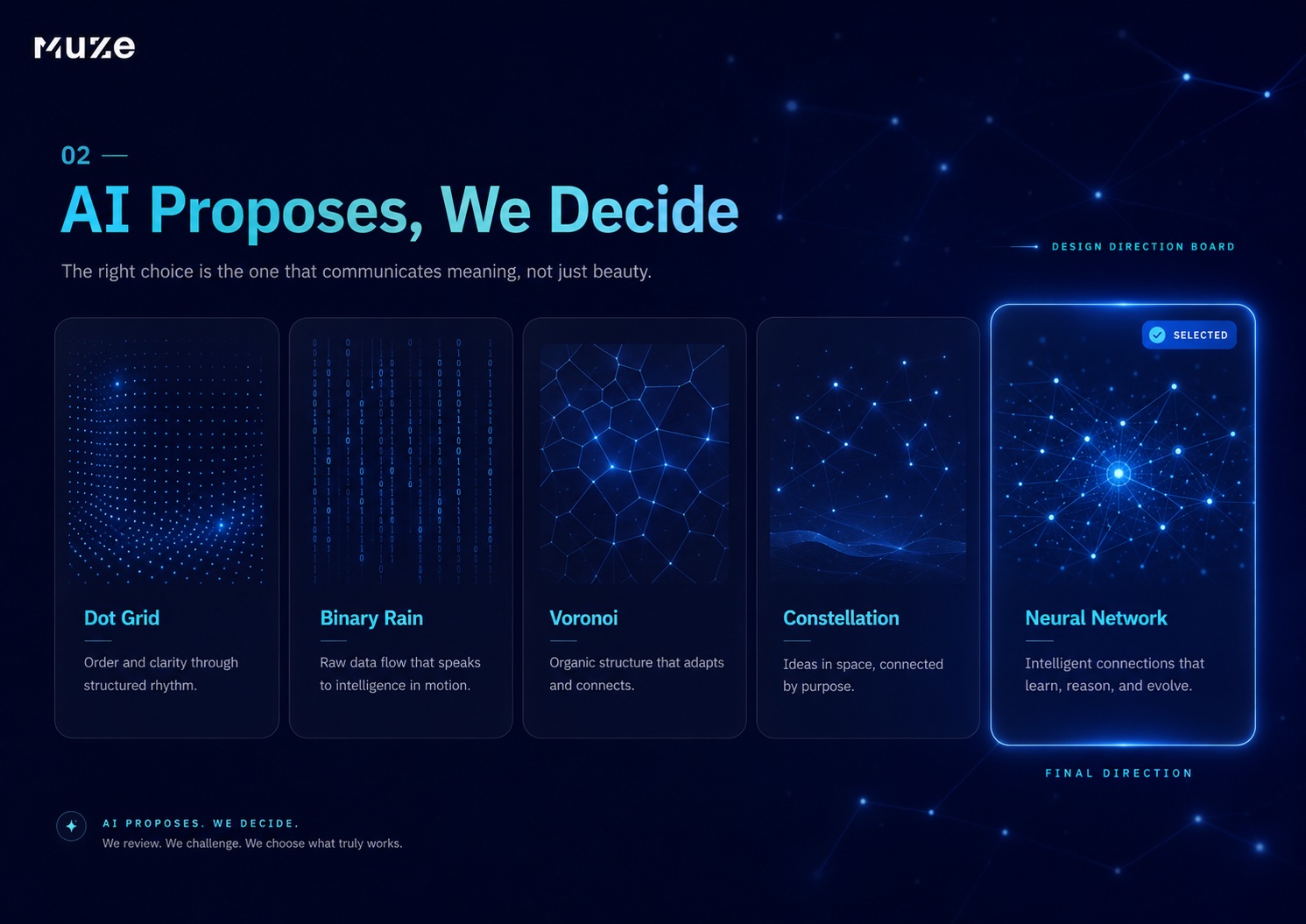
From 5 Concepts to One Question
When designing muze.co.th, we used Claude to explore animation concepts for each section. The brief wasn’t just “make it look good” — it was “make it both beautiful and genuinely communicate the meaning of this section.” Because good design tells a story. It doesn’t just attract the eye.
Claude Code proposed multiple options: dot grid, binary rain, Voronoi cells, constellation, neural network. Each was beautiful in its own way. But the team asked a different question: which animation feels right for this particular section — one that talks about how Muze works with AI, and needs to communicate depth, meaning, and a genuine connection to AI?
The answer was Neural Network.
Why It’s Not Just a Background Effect
A Neural Network — or Multilayer Perceptron — is the foundation of Deep Learning. It’s the structure that underlies Claude, Gemini, and virtually every modern AI model. In simple terms: data enters as input, passes through layers of nodes, gets transformed at each step, and eventually becomes a usable output. Each node represents a neuron. Each signal through a layer represents information being transformed.
Anyone can say “we use AI.” But translating a Multilayer Perceptron into an animation that is both beautiful and communicates meaning accurately — that requires a much deeper level of understanding.
The Process That Actually Happened
AI proposed concepts, parameters, and initial code. But the team decided: which animation was right, what speed and opacity of signals made it feel “deep” rather than “noisy,” and how desktop and mobile should behave differently for the best experience.
Dozens of iterations happened. But every iteration started with a question from the team — not a suggestion from AI.
The result is a section that communicates meaning at depth, with a clean design that doesn’t overwhelm, perfectly aligned with the concept of Human Expertise, AI-Accelerated. For most visitors, it’s a beautiful background animation. For those who know AI — they’ll see the Multilayer Perceptron hiding the entire framework story in a single visual.
For those in the industry who know what they’re looking at — they’ll see immediately that Muze doesn’t just use AI. Muze understands AI deeply enough to design meaning into every detail. And that alone says more than any advertisement could.
03 — Structured Method, Not Guesswork
Getting real results from AI in an organisation isn’t about having everyone try a tool and hoping productivity follows. What matters is knowing what AI should be responsible for — and what humans must own. Without a clear framework, AI gets used in scattered ways. Some use it to write. Some to think. No shared standard for what output is acceptable, what needs review, or who makes the final call.
Most AI adoption failures don’t come from choosing the wrong tool. They come from not being clear about who’s responsible for what.
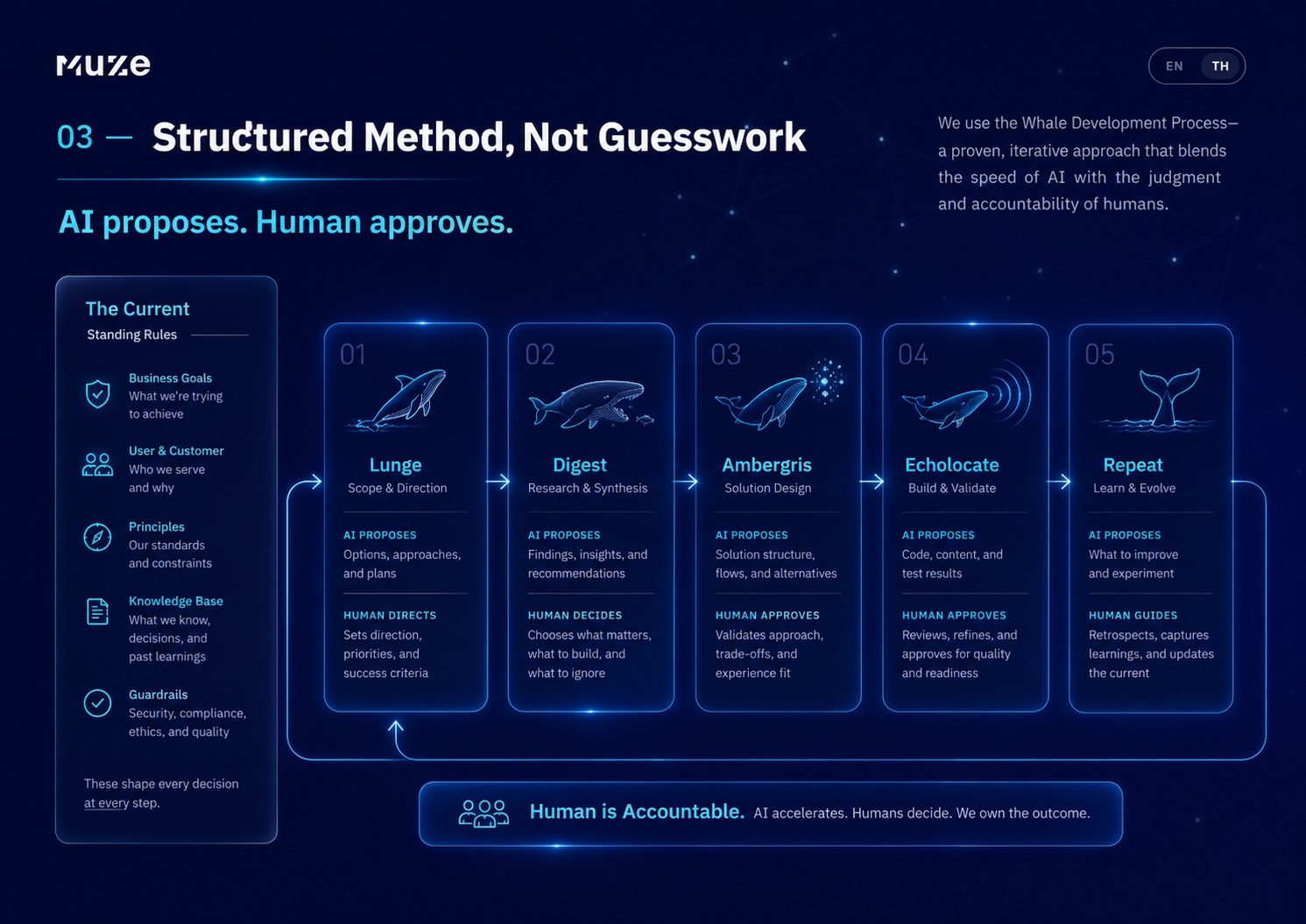
A Clear Division of Responsibility
At Muze, we follow one simple rule: AI generates. Humans judge.
- AI is responsible for: writing code to spec, proposing animation concepts, drafting copy, auditing performance
- Humans are responsible for: setting direction, deciding which proposals fit the brand, reviewing every output before it merges, and saying “this isn’t right” — with an explanation of why
Why Review Matters More Than You Think
Enterprise work doesn’t just need fast output. It needs output that’s trustworthy, verifiable, and genuinely aligned with business objectives.
AI doesn’t know who Muze is. It doesn’t know what a B2B buyer is thinking, or how a section should feel to stay consistent with the brand. But the team does. That’s the difference between output that’s authentically “Muze” and output that’s just “a working website.”
And review doesn’t only mean content or design — it includes system architecture and code structure too.
In this project, the CTO reviewed the codebase and found a single CSS file over 20,000 lines long. AI wasn’t wrong — it did what the context called for. But without someone who understands architecture reviewing it, that problem would have hidden quietly and degraded performance with no one the wiser.
This is what vibe coding typically misses. AI builds things that “work.” That doesn’t mean they’re well designed. AI works from the context you give it. If the context is incomplete, or no one with deep knowledge reviews the output, what you get might look like a building that stands fine on a normal day — but has no central support column. When an earthquake hits, it could come down easily.
The larger the project, the greater that risk compounds.
The Framework Isn’t Just Ours
What we did with muze.co.th is the same process we apply in our own work.
Whether you’re a platform just getting started or a system that needs to handle millions of peak concurrent users — this framework applies:
- Start with experts who know the domain before AI comes in
- Let AI propose. Humans decide.
- Have a clear framework for what’s AI zone and what’s human zone
The website you’re looking at right now isn’t just a portfolio — it’s a proof of concept for a framework we believe in and use every day.
If your organisation is thinking about adopting AI and wants a partner who works by the same principles