TechCut — Process & Methodology · Muze Website Project
In early 2026, Muze started building a new website.
But this project wasn’t just a visual redesign or a refresh of the brand identity.
The more important question was:
What should a B2B Tech Company’s website actually do, in an era when AI Search is changing how people find vendors?
In the past, a company website was treated as a digital brochure — an About Us page, Services, Portfolio, Contact, and messaging that said “here’s who we are.”
But in an era where people start asking ChatGPT, Perplexity, or Google AI Overview questions like:
- “Which companies in Thailand have experience building OTT Platforms?”
- “What do I need to think about when building a Super App that scales to millions of users?”
- “What kind of tech partner is the right fit for an enterprise organization?”
A website can no longer just declare competence. It needs to be a knowledge resource that both AI and clients can understand — showing what problems you’ve actually solved.
That was the starting point for Muze’s new website.
Starting from a Different Question
Instead of asking “How should the homepage be designed?”, the Muze team started with:
“If a potential client is searching for a vendor through AI, what would they ask — and how should Muze show up in those answers?”
That question changed the direction of the entire project.
Because when you look at a website through the lens of AI Search, what matters most isn’t the beauty of the homepage. It’s content structure, domain knowledge, case experience, and clarity of positioning.
The website needs to be able to answer: What has Muze built? In what context? What hard problems were encountered? What technical decisions were made, and why? And what were the business outcomes?
That’s what made TechCut Blog one of the central pillars of the new website.
AI as More Than a Writing Tool
What was most interesting about this project was that Muze used AI as the primary collaborator throughout the entire process — not just for writing copy, but for everything from strategy through to production.
AI played multiple roles simultaneously:
Content Strategist — analyzing what potential clients might be searching for, and what types of content should exist to answer those questions.
Writer & Editor — drafting articles, adjusting structure, refining tone, and iterating across multiple rounds until each piece was ready to publish.
Developer Assistant — helping build the Hugo CMS structure, frontmatter, page bundles, and resolving path issues within a multilingual setup.
Publisher — preparing markdown files, organizing directories, managing images, and compressing the time from draft to live significantly.
Quality Reviewer — scoring articles against defined criteria to determine which content should be published first and which needed more development.
In this sense, AI wasn’t just “a writer” — it functioned more like a small embedded team of content, development, and publishing capability working alongside the human.
What AI Can’t Do: Real Knowledge from Real Experience
As much as AI contributed, there’s one thing it cannot generate on its own: insider knowledge.
For example:
- CH3+ serves 12 million MAU and handles extremely high concurrent viewers during live broadcasts
- 7-Eleven Live Commerce had to operate within a Super App serving an enormous user base
- The hardest part of the SFV SDK integration wasn’t video playback — it was token exchange and integrating cleanly into the parent ecosystem
- AXONS needed a cost calculation system that reflected actual production jobs, not just aggregate averages
These are things that only come from having done the work. AI has no way of knowing them unless a human puts them in.
Results from 3 Sessions
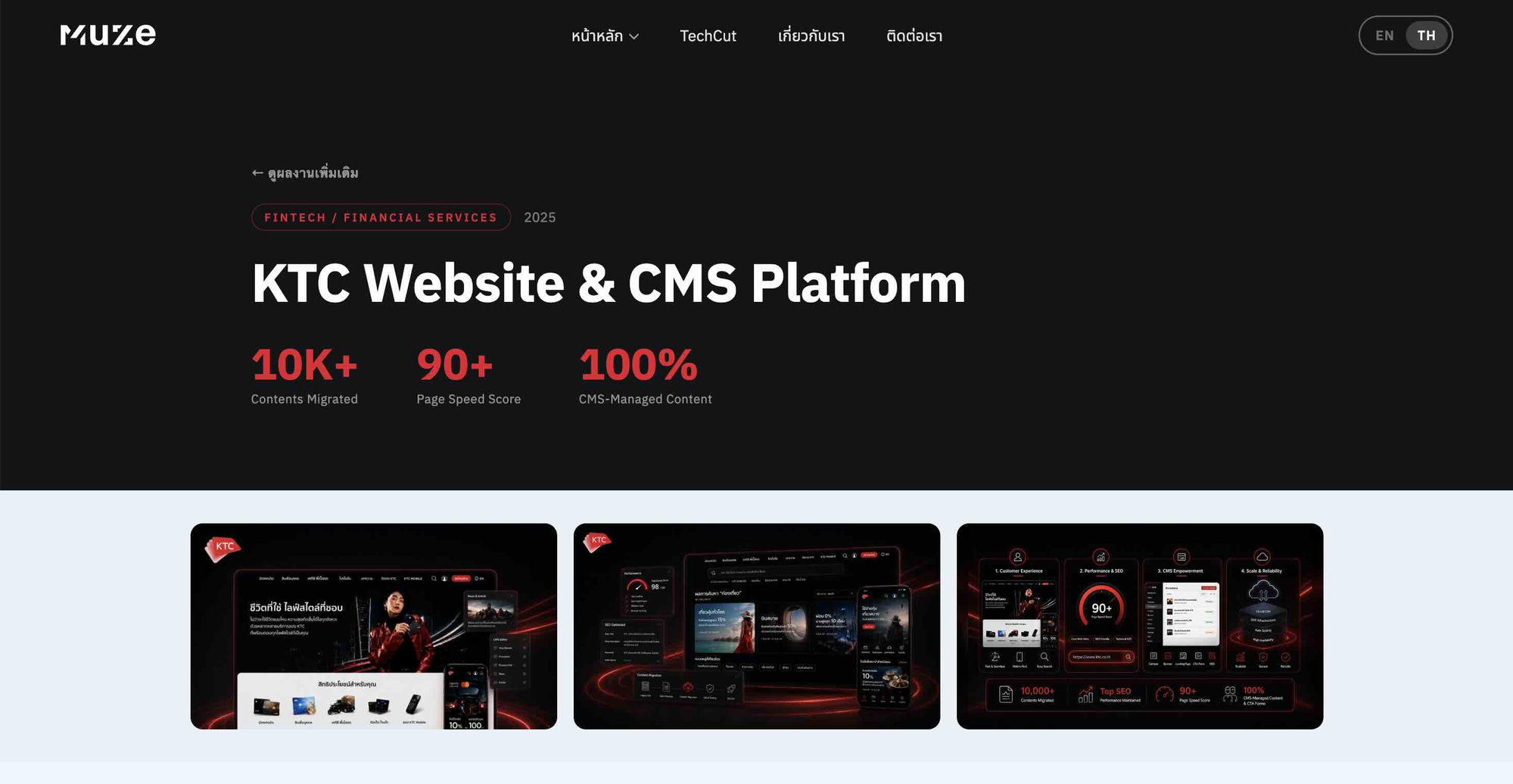
Through intensive collaboration with AI, Muze was able to produce substantial results within just a few sessions:
- 18 TechCut articles ready to publish, covering 6 client projects
- Hugo multilingual website supporting both Thai and English
- Content scoring framework across 5 criteria for evaluating and prioritizing articles
- A repeatable workflow for draft → review → publish going forward
What’s notable isn’t just the volume — it’s the speed of iteration.
Where a single article might once take several days to write, revise, and format — AI made first drafts happen in minutes, and let the team experiment with multiple angles before choosing the strongest version.
The Core Lesson
Building a website with AI doesn’t mean AI does everything. It means:
Humans decide what matters — AI helps make that happen faster.
Muze didn’t use AI to replace strategy. We used AI to multiply speed, leverage, and quality of execution.
In a world where digital presence doesn’t just compete on Google — but increasingly competes inside AI-generated answers — a B2B company’s website can’t just be “polished” or “comprehensive.”
It needs knowledge that is clear enough, deep enough, and specific enough that both humans and AI can understand: this is the company that has solved problems like yours before.