For years, the formula for Thai OTT success was having Local Content that spoke to Thai audiences better than Netflix — Thai dramas, Thai series, variety shows, news. These were the cards local players used to hold their ground against global platform giants. And it worked, at least for a while.
But in 2026, that equation is starting to shift.
Netflix invests more in Thai Originals every year. The gap between “a Local OTT with Thai dramas” and “a Global OTT without them” keeps narrowing. And more than that, in a world where every platform has a massive content library, what determines what users watch isn’t just whether the content exists on your platform — it’s whether the platform presents that content to the right person at the right time.
The difference between OTT platforms that survive and those that don’t no longer lies in Catalog Size.
When Content Is No Longer the Differentiator
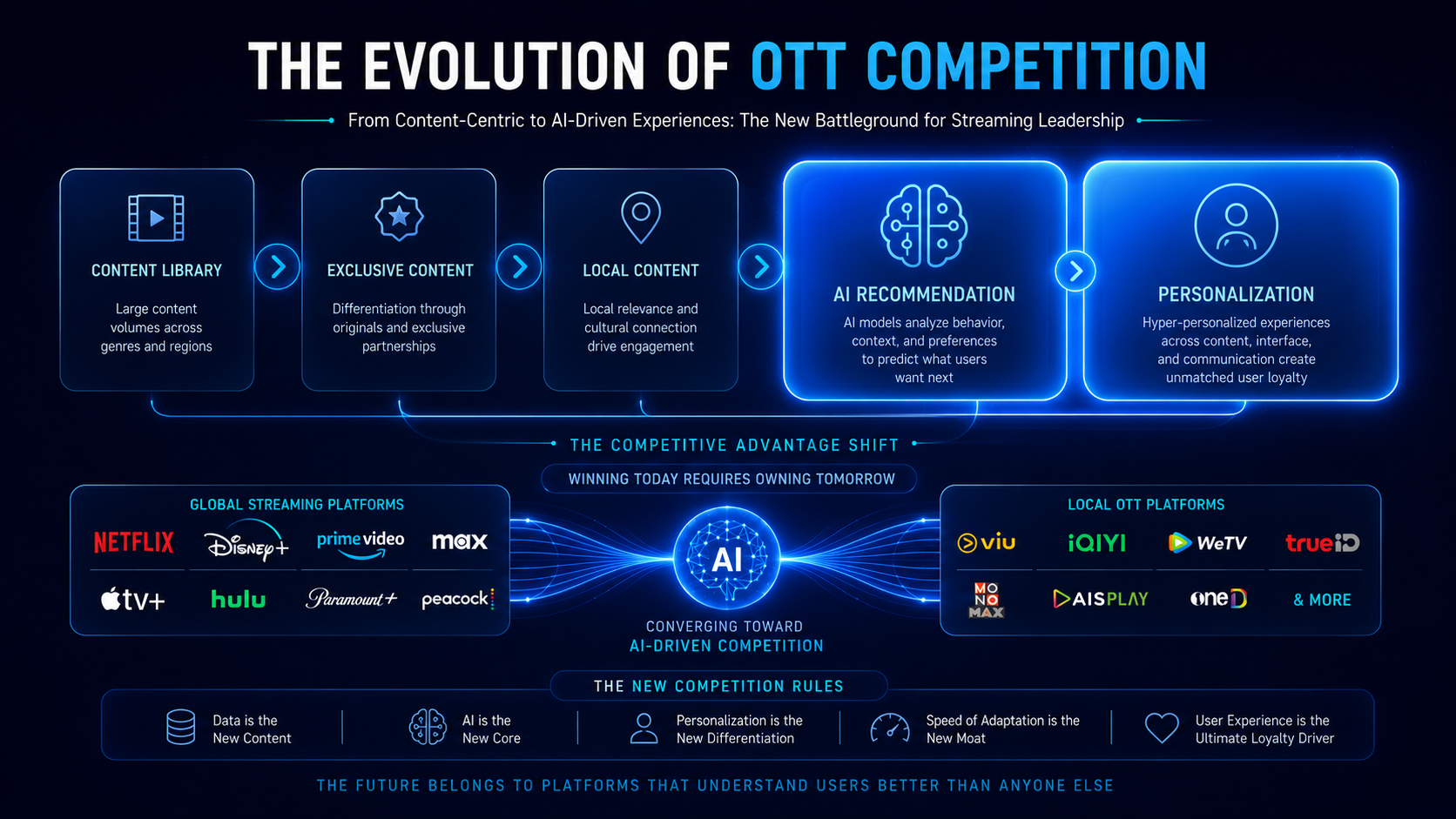
In the past, OTT competition was about the volume of licensed content or Exclusive Content. But today, what users actually see is the Recommendation screen.
No matter how much content exists on the platform, if the system can’t surface what viewers are interested in at the right moment, viewing opportunities drop immediately. And when viewers can’t find what they’re looking for within a few seconds, they leave the platform without watching anything at all — which in the long run means they start questioning whether their monthly Subscription is worth it.
AI Recommendation Is Changing the Rules of the OTT Industry
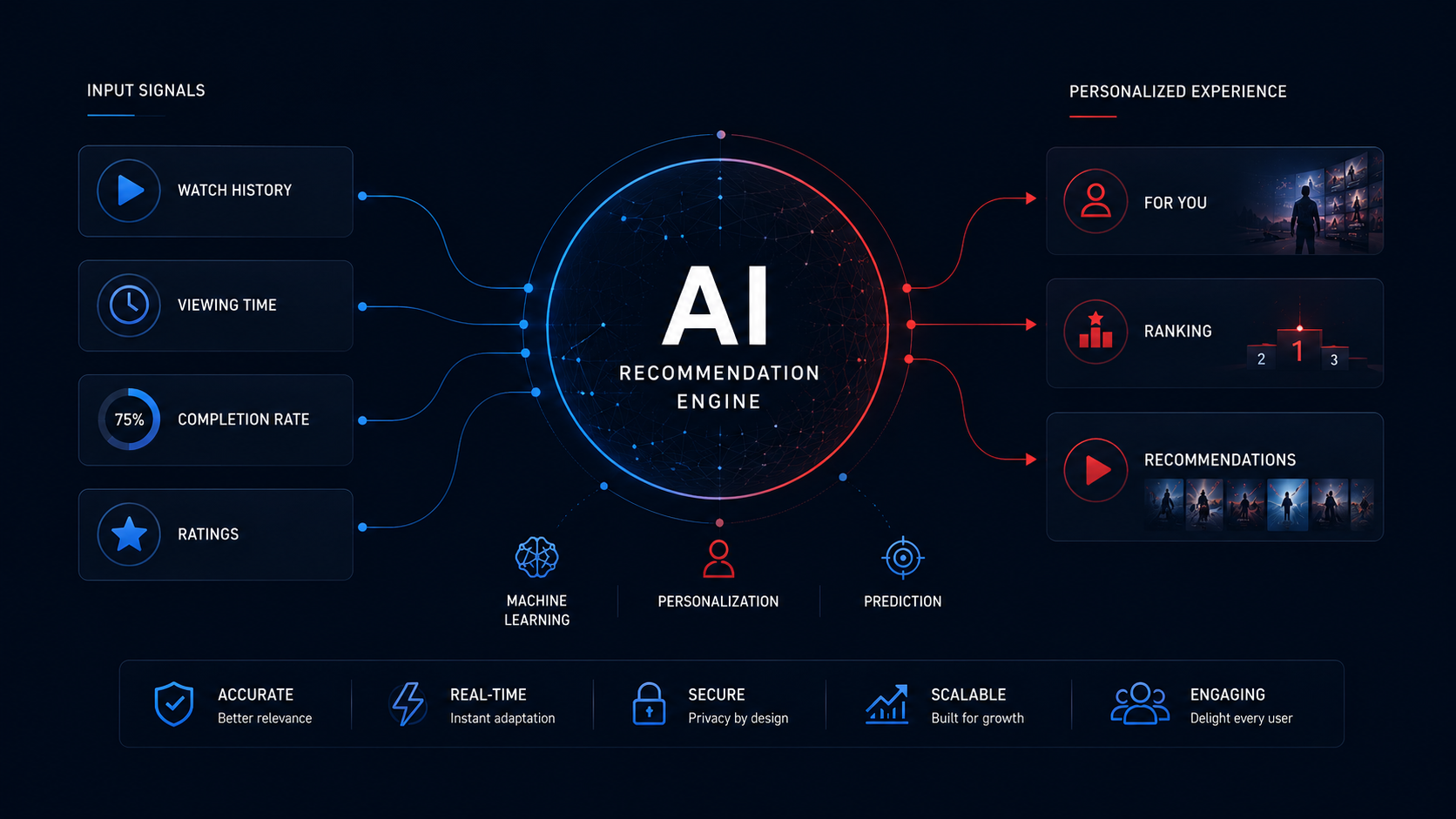
Global platforms invest in Recommendation systems that learn user behavior in Real-time — not just analyzing what users watch, but including when they watch, whether they finish, where they stop, whether they return to watch again, and what type of content they’re likely to be interested in next.
These signals combine to paint a picture of viewers far more detailed than basic Demographics. And the better the system knows its viewers, the longer they stay. For Thai OTT, the key question is no longer “what content do we have?” — it’s “how well do we understand our viewers?”
What makes AI Recommendation fundamentally different from traditional Rule-based Systems is the ability to adapt in Real-time without waiting for weekly Batch Processing. A good system knows that the same user on a Monday morning commute and a Saturday evening at home has completely different Intent — and will surface different content suited to each context. This capability isn’t just a supplementary feature; it’s what determines whether a Platform feels like it “understands” its users. And in a market where consumers have more choices every year, that feeling of being understood is the reason people will renew their Subscription next month.
Case Study: TrueVisions Invested in the Entire Platform, Not Just Content
One of the clearest examples in the Thai market is TrueVisions’ direction throughout 2025. TrueVisions didn’t just invest in buying content licenses — they made the decision to invest in transforming the entire Platform, a business decision that carried significant costs in both time and budget.
The question they had to answer wasn’t just what features to build, but whether the existing platform could support the business direction for the next 5 years. The answer was no. And that was the starting point for a major investment.
TrueVisions chose to work with Muze Innovation as their Strategic Tech Partner to develop TrueVisions NOW — the core OTT application at the center of this entire Platform transformation. Muze’s brief wasn’t just to build a new app, but to design and develop a Platform capable of genuinely supporting TrueVisions’ long-term business direction — spanning Backend architecture through to User Experience across every Device TrueVisions needed to reach.
This investment covered multiple dimensions, including Multi-device Experience supporting more than 10 device types — iOS, Android, multiple Smart TV brands (Samsung Tizen, LG webOS, Hisense VIDAA), Apple TV, and Android TV. What looks like a technical detail carries significant business implications: an OTT that doesn’t fully support all devices has a portion of the market it simply cannot reach.
And more importantly: AI-Powered Recommendation using Google Vertex AI to analyze viewing behavior in Real-time and create a Personalized Home Screen that varies based on each individual’s interests.
Why TrueVisions Chose AI Recommendation as a Strategic Investment
Bringing in Google Vertex AI wasn’t just about adding a feature — it was a strategic decision with clear Business Rationale.
From an ROI perspective, better Recommendation means higher Watch Time per Session, which translates directly to better Subscription Retention. For an OTT Business, reducing Churn Rate by even 1–2% has a significant impact on Revenue over the long term — because OTT is a business where the cost of acquiring new customers is far higher than retaining existing ones. Keeping the people you already have is almost always the investment with the better return.
Additionally, investing in Personalization Infrastructure increases the value of existing content without buying additional licenses. Content that was never being discovered gets served to the right people more often. An existing library becomes an Asset that works more efficiently at no additional cost.
The system is designed to learn from Behavioral Signals across multiple dimensions simultaneously — Watch History, Ratings, Content Completion Rate, and Viewing Patterns — to build Dynamic Shelves that adapt to each user’s interests. This means two people opening the app at the same moment see completely different screens. And the more they use it, the more accurate the system becomes — a Flywheel Effect that makes the Platform smarter automatically over time.
As the Tech Partner responsible for developing TrueVisions NOW, Muze designed the Backend Architecture and Data Pipeline to support Google Vertex AI integration from the ground up — not as a feature bolted on later, but embedded into the app’s structural foundation from the start. This allows the Recommendation Engine to process Behavioral Signals in Real-time across every supported Device without Latency that would compromise the User Experience.
Telco Ecosystem: An Advantage Global Players Cannot Build
Another key Strategic Move was fully integrating the system with the Telco Ecosystem of the True Corporation group.
This decision has clear business logic. TrueVisions doesn’t have to compete for Subscribers against Netflix using Marketing Budget alone — they can reach the existing base of TrueMove H and True Online customers, over 10 million accounts, by bundling OTT into mobile and internet packages.
From a Business Model perspective, this significantly reduces Customer Acquisition Cost (CAC). Instead of convincing people to sign up for a new Subscription from scratch, bundling gives TrueVisions access to users who already have intent through their existing Telco relationship. And once OTT becomes part of a package they’re already paying for, the Barrier to starting drops almost to zero.
Beyond distribution, Telco data adds dimensions that Global Players can never access: Location Patterns, Peak Usage Times, Behavioral Data from other services within the group. This data makes Recommendation smarter without relying only on video viewing data — a dimension that Netflix or Disney+ cannot replicate in the Thai market no matter how much they invest, because it’s not just about technology but about structural relationships with the country’s Infrastructure.
TrueVisions also built a Payment system supporting multiple channels simultaneously — Credit Card, TrueMoney Wallet, and Direct Charge to Bill (DCB) that charges directly through the mobile bill. Lower Payment Friction directly impacts Subscription Conversion Rate, because every Friction point removed from the payment flow is an opportunity that doesn’t turn into cancellations. DCB in particular is a powerful mechanism in a market where Credit Card penetration is still limited.
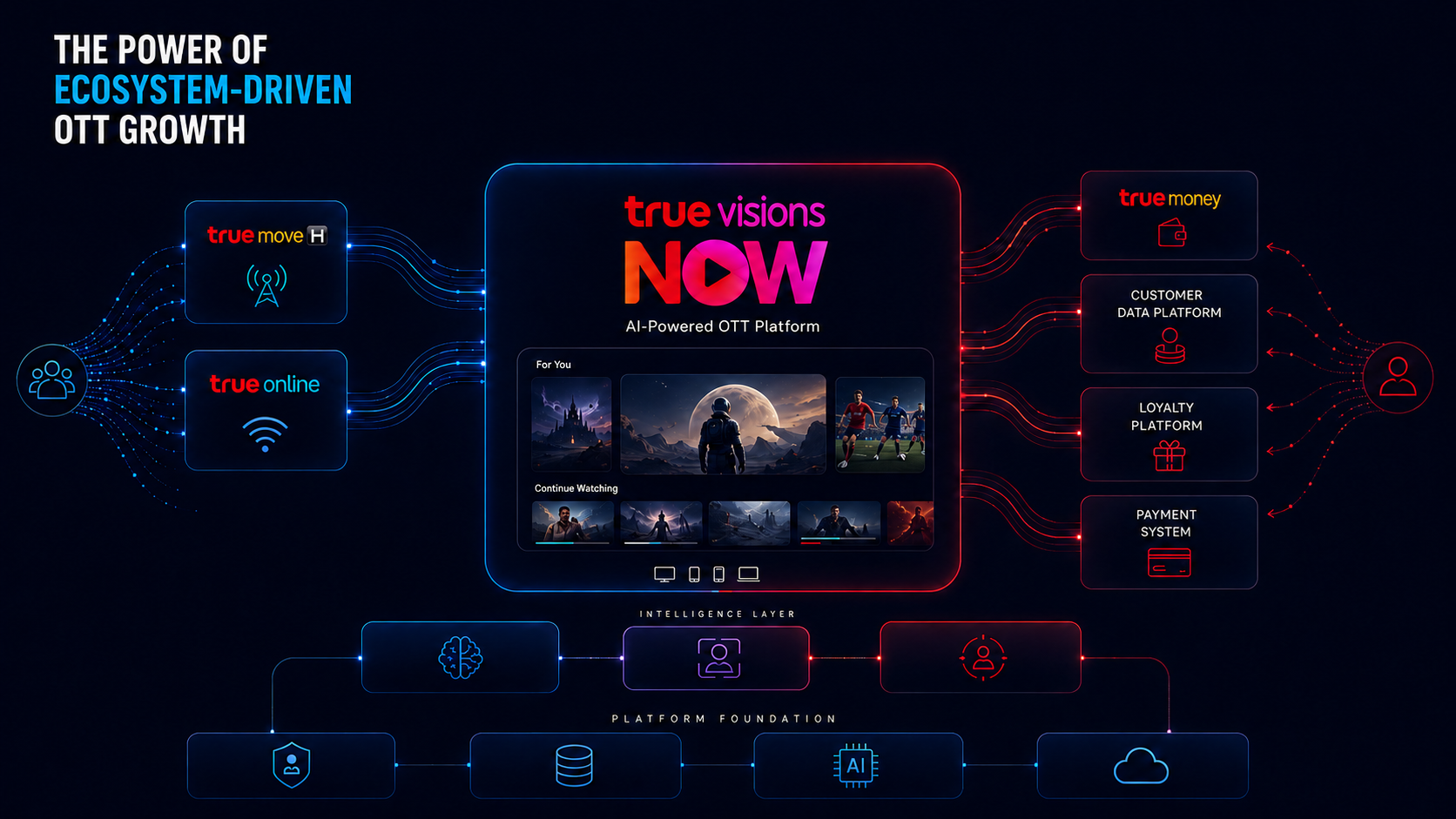
3 Areas Where Thai OTT Still Has an Advantage Over Global Players
1. Telco Bundle Ecosystem: Local OTT with Telco relationships can reach a broader User Base at a lower CAC. Telco data also creates Behavioral Context beyond just video viewing — Location Patterns, Usage Times, and Service Behavior that Global Players cannot access. This advantage isn’t just about Distribution; it’s a Data Moat that grows wider with every use.
2. Niche Community Matters More Than Mass Audience: OTT platforms with a clear Niche — sports, family content, Asian series, or Educational Content — tend to build better Retention than OTTs that try to have everything, because Subscribers stay because the Platform understands them, not because there are many options. Well-executed Niche Platforms consistently show significantly lower Churn Rates than General Platforms.
3. Data Personalization Is a Competitive Moat: Local OTT has the opportunity to collect Contextual Data that Global Players struggle to gather — Regional Content Preferences, Cultural Context, and Behavioral Patterns specific to the Thai market. But this data only has value when there’s a system that can actually use it to create Personalization. Good data without the system to activate it is wasted resource.
The Business Decision: Platform Investment vs Content Investment
Many Thai OTT operators are still wrestling with the same question: should we invest in buying more Content or invest in Platform Technology? It sounds like a Trade-off, but in reality it’s a question of Sequence.
Experience from working with TrueVisions shows that the answer isn’t Either/Or — it’s the order that matters enormously.
Platform Infrastructure must come first. Because if the Platform can’t deliver Content to the right person at the right time, investing in more Content won’t yield its full return. It’s like adding more products to a store where customers can’t find anything — more inventory creates more confusion, not more value.
TrueVisions’ decision to Transform the entire Platform at once — covering AI Personalization, Multi-device Experience, and Flexible Monetization — reflects a Mindset shift toward seeing themselves as a Platform Business rather than a Content Business. It’s not a decision about which series to buy, but about building the infrastructure that makes every existing piece of content work at maximum efficiency.
This Mindset Shift also has implications for how the Management team makes decisions and measures performance. An OTT that sees itself as a Platform Business won’t just ask “how many views did this series get?” — it will ask “did our system help people discover older content in our library?” and “did average Session Length increase after Personalization improved?” Changing the Metric is changing the way the whole organization thinks. And ultimately, it’s what determines where next period’s Budget goes — Content or Technology.
OTT platforms that will survive long-term must ask themselves: are we building a Platform that gets smarter every day, or are we just adding more Content?
Key Takeaway
Local Content Still Matters — But It’s No Longer Enough
In an era where every platform competes with massive content libraries, what determines which OTT survives long-term isn’t who has more Thai series — it’s who understands viewers more deeply, and who can deliver the right content to the right person at the right time more effectively.
Thai OTT that wants to compete must invest in 3 areas simultaneously:
Recommendation Intelligence is the heart of Engagement. A good system doesn’t just suggest “people who watched this also watched that” — it learns from Behavioral Signals in Real-time to create an experience that feels like the Platform truly understands you. That’s something no Catalog size can replace.
Telco Ecosystem Integration is a structural advantage that Global Players cannot build in the Thai market. Access to a Telco User Base along with Behavioral Data that goes beyond just video viewing, and low Payment Friction through DCB — these are Competitive Moats that Netflix doesn’t have and can’t easily buy.
Data Personalization is an Asset that compounds over time. Every time a user opens the app, watches content, stops midway, or returns to watch again, the system is learning and getting smarter. OTT platforms that invest in Personalization Infrastructure today are building a Data Advantage that will widen every day, while competitors who are still waiting are letting that gap grow wider by the moment.
Investing in Platform Technology isn’t a Cost — it’s a Strategic Investment that generates Compounding Returns. The faster you invest, the faster the system gets smarter, the longer viewers stay, the more stable Revenue becomes, and the deeper the Moat you’ve built.
The question every Thai OTT must answer today isn’t “what Content will we buy next year?” — it’s “is our Platform smarter than it was last year? And if not, can we still compete in 3 years?”
If your organization is evaluating how ready your current Platform is — or looking for a clear path to transform your OTT Platform in a way that delivers real results — the Muze team is ready to listen and help identify the right approach for your Business Context and Technical Constraints from the start.