TechCut — Strategy · Content & Discovery
In traditional B2B marketing, most companies believe the homepage is the most important page on their website.
If the headline is strong, the visuals are polished, the services are clear, and the portfolio builds credibility — clients will understand the offering and reach out.
This thinking isn’t wrong.
But in the AI Search era, it may no longer be enough.
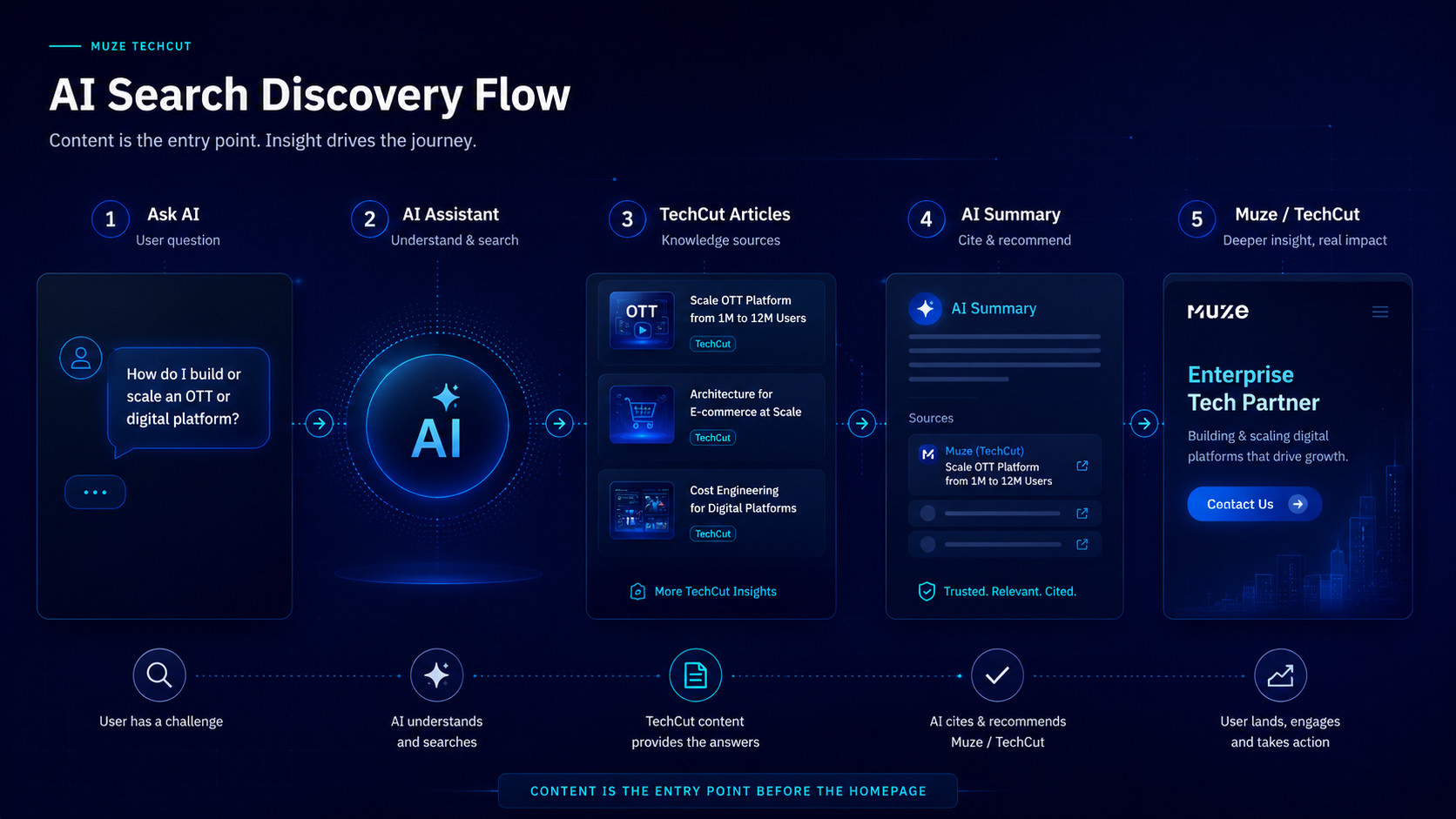
Because search behavior is shifting from “find a keyword and click a website” to “ask AI and let it summarize an answer — while recommending relevant sources and vendors.”
When the mechanics of discovery change, content strategy has to change with it.
Traditional Google vs AI Search
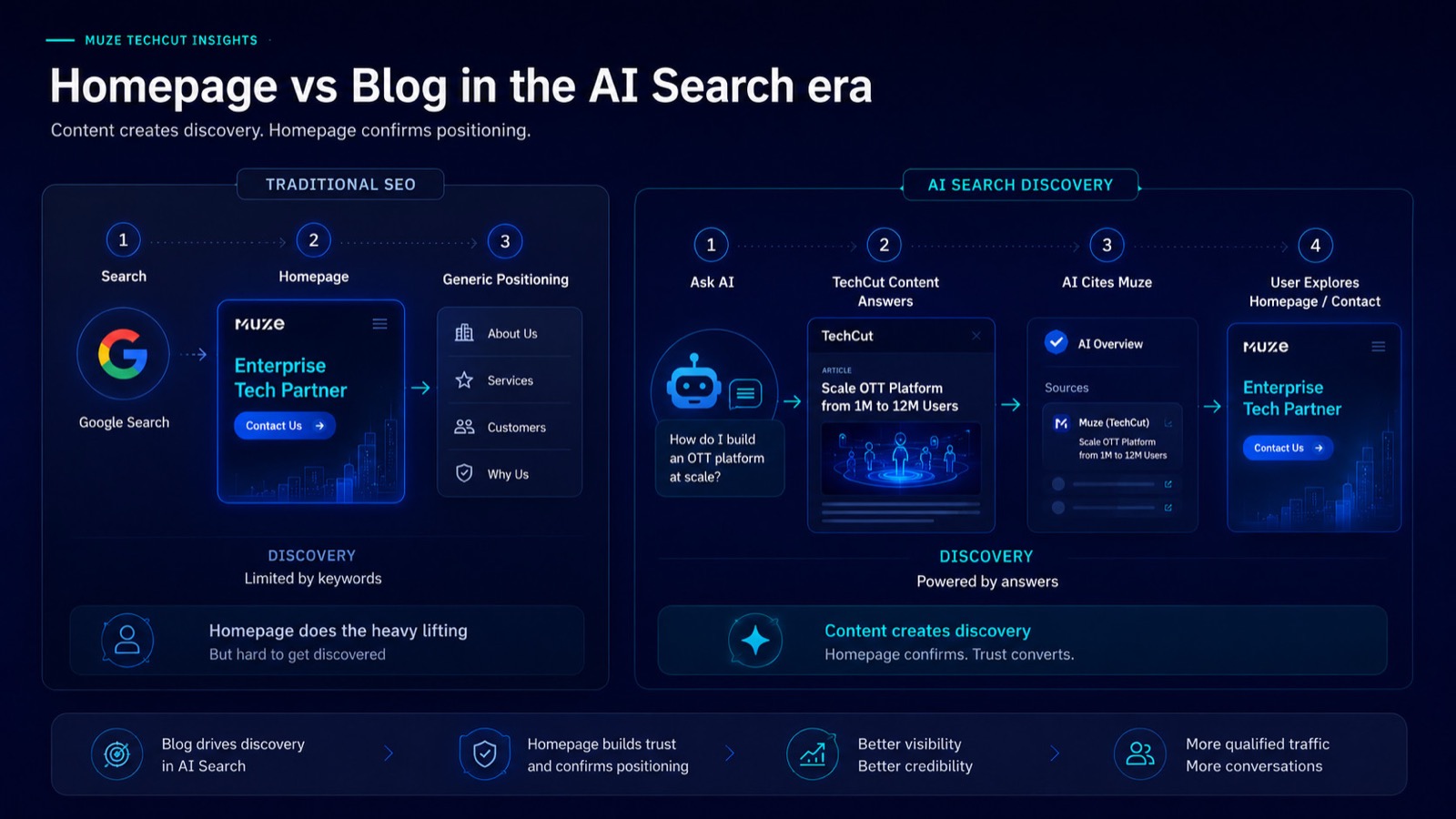
In the past, if someone searched for “OTT platform development company in Thailand” — Google returned a ranked list of websites. Users clicked in, read, compared, and decided on their own.
But if a user asks AI: “What do I need to think about when building an OTT platform for 10 million users?” — AI doesn’t just return links. It reads from multiple sources, synthesizes an answer, and cites or recommends the most relevant sources.
This difference matters enormously.
Because AI doesn’t choose to cite a page that says “we’re leaders in digital platforms.” It tends to select content that explains problems clearly, contains real detail, and answers the question more directly.
Homepages Describe Who You Are — But Don’t Answer Questions
Most B2B tech company homepages contain messaging like:
- “We build digital platforms that scale”
- “We’re a tech partner you can trust”
- “We help enterprises transform through technology”
These statements are useful for positioning — but from an AI Search perspective, they don’t constitute “knowledge.”
Because they don’t answer:
- Scale how?
- Scale what exactly?
- What bottlenecks were encountered?
- Why was this architecture chosen over alternatives?
- What were the business outcomes?
When AI needs to answer a question for a CTO or Product Manager actively trying to solve a problem — it will choose content with real knowledge over a homepage that’s self-description.
TechCut: A Knowledge Layer Built for Both AI and Human Readers
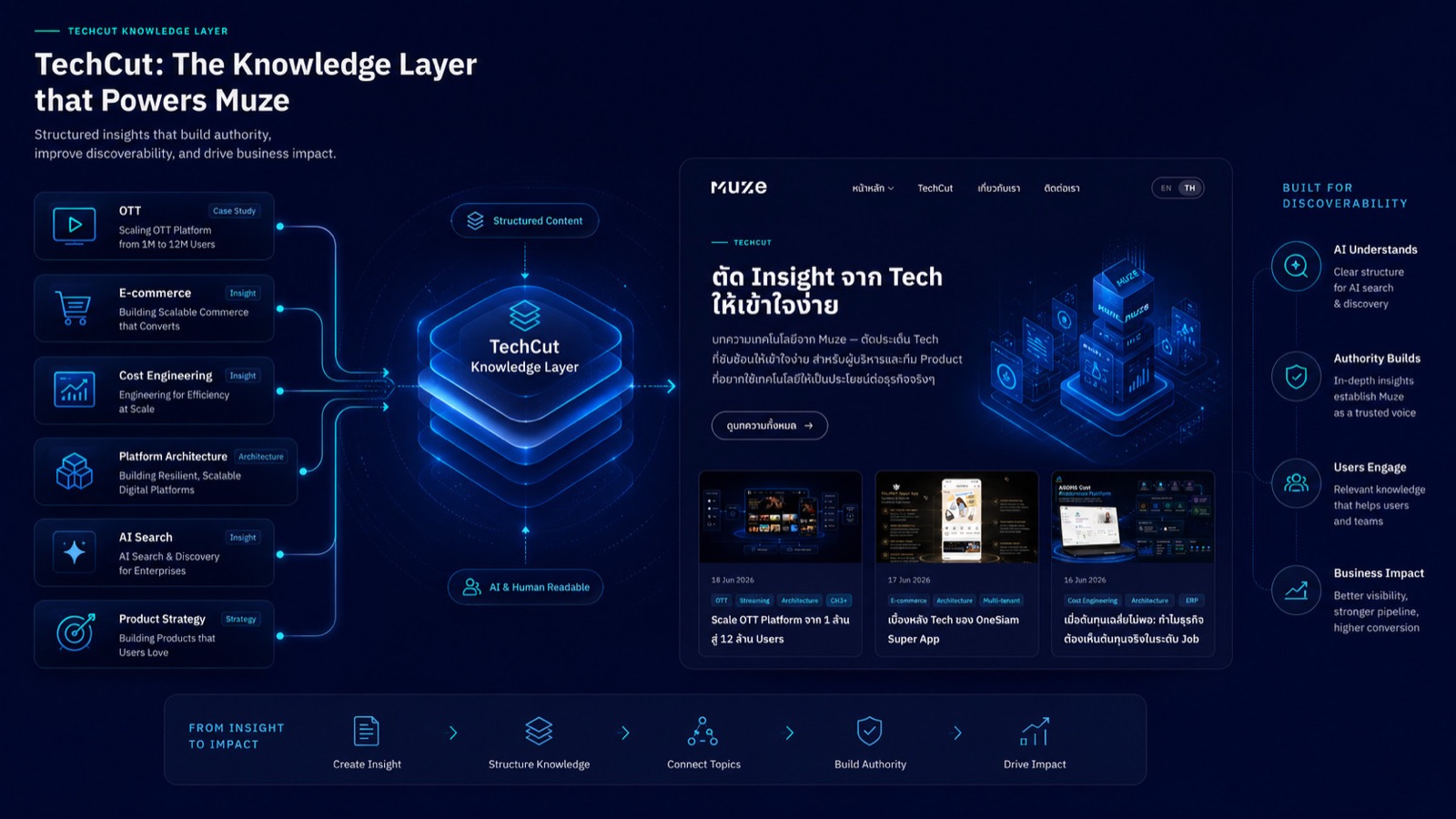
Muze’s TechCut Blog isn’t designed to be a standard blog. It’s designed to be the website’s knowledge layer.
Examples of the kind of topics that work in the AI Search era:
- “Why OTT Platform architecture needs to account for peak traffic from day one”
- “Token Exchange is the hidden complexity behind embedding an SDK into a Super App”
- “What good production cost calculation looks like — and why averages aren’t enough”
- “How Live Commerce on a Super App differs from a standard video shopping experience”
These topics aren’t just case study narratives — they’re answers to questions that potential clients are actually asking AI.
The New B2B Discovery Journey
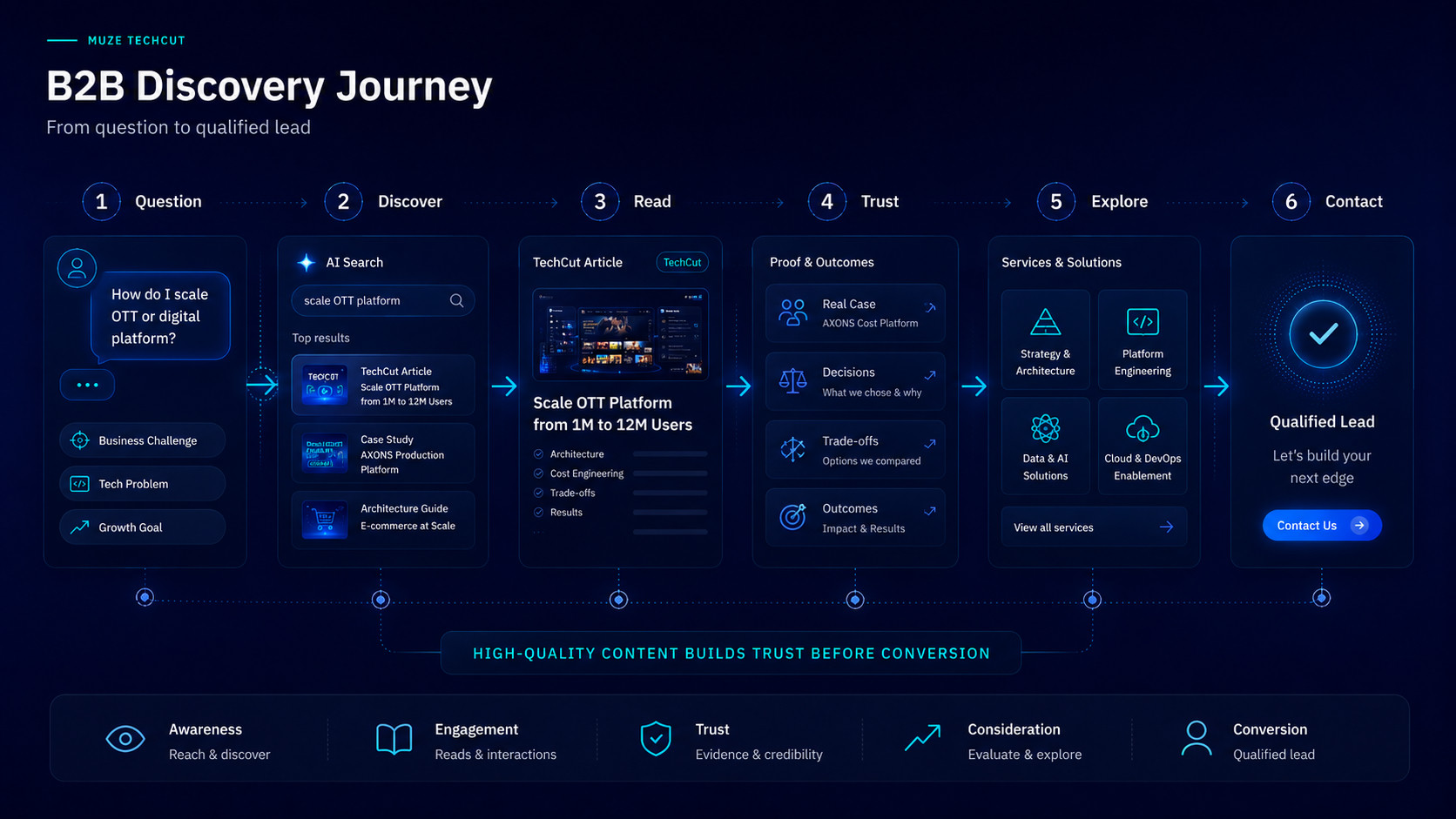
In the AI Search era, the lead generation journey may no longer start at the homepage.
It may look more like this:
- Question — Potential client asks AI
- Discover — AI reads and synthesizes from TechCut articles
- Read — AI recommends or cites Muze · Client clicks through to the article
- Trust — Client understands that Muze has genuinely solved this type of problem
- Explore — Client browses services or portfolio
- Contact — Qualified lead, ready for a real conversation
In this flow, the homepage doesn’t disappear — but its role changes.
The homepage becomes the place that confirms positioning after someone already knows who Muze is. TechCut becomes the entry point that creates discovery in the first place.
Implications for B2B Companies
If a B2B company wants to build meaningful digital presence in an AI-first world — what matters isn’t just visual design or homepage messaging. It requires content with three qualities:
First — It answers real questions clients will actually ask.
Second — It contains specific knowledge that can’t be found in generic content.
Third — It demonstrates real experience through cases, decisions, trade-offs, and outcomes.
Each article can be one entry point. The more articles that answer questions from different angles, the more opportunities the company has to be discovered across different searches.
This is why TechCut isn’t just a blog — it’s an SEO strategy for the AI Search era.
And it’s a core part of how Muze is understood as a tech partner that doesn’t just build software — but genuinely understands the business context, technical complexity, and outcomes clients are trying to achieve.