When organizations talk about Loyalty Programs, the first image that comes to mind is usually a points accumulation system, discount coupons, cashback, or membership rewards.
These approaches can genuinely boost sales, but in many cases businesses find that even as they keep increasing investment in Loyalty Programs, customers remain ready to switch to a brand offering a better deal.
The real question isn’t “should we have a Loyalty Program?” — it’s “is the organization building customer loyalty, or buying loyalty with discounts?”
In an era where customers have more choices than ever, competing on points alone may no longer be enough.
Loyalty Programs Aren’t Failing — But the Goal May Have Been Wrong from the Start
Traditional Loyalty Programs were designed to increase transaction volume. The logic is straightforward: purchase → earn points → redeem rewards → come back and buy again.
This model drives Repeat Purchase well in the short term. But the moment a competitor offers a better deal, customers are ready to switch immediately. What happens is that the Loyalty Program becomes a marketing cost that keeps growing without building any long-term relationship with customers.
Many organizations are therefore shifting their perspective — from “how do we get customers to come back and buy?” to “how do we make customers want to come back on their own?”
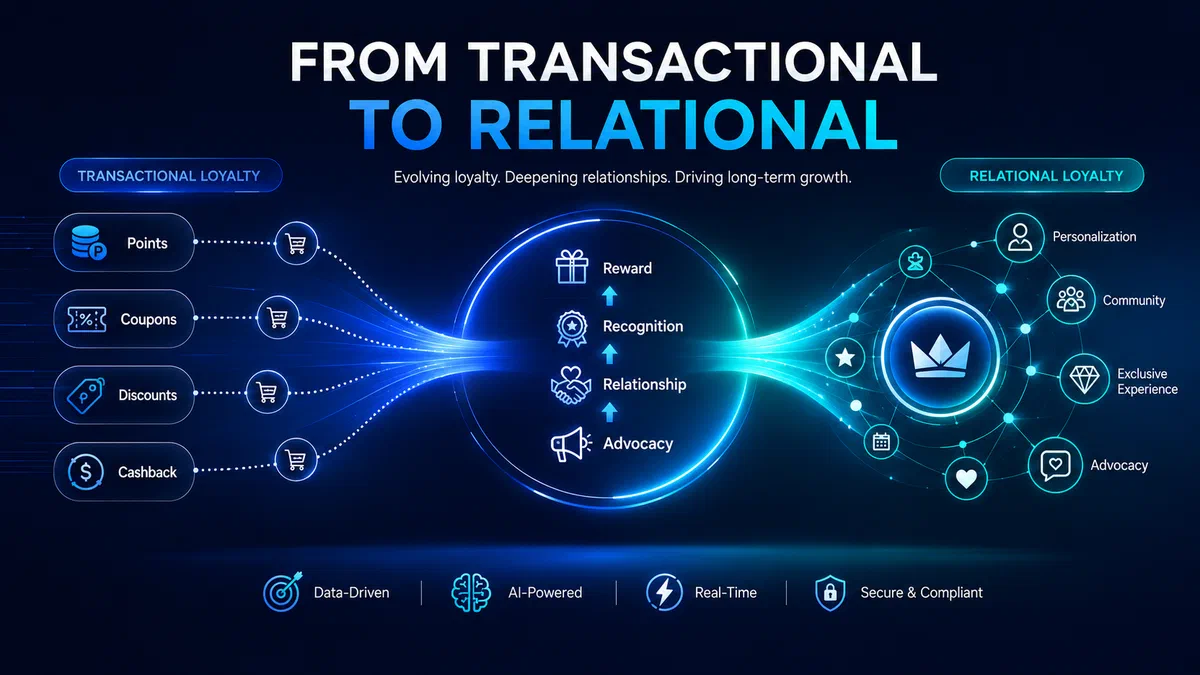
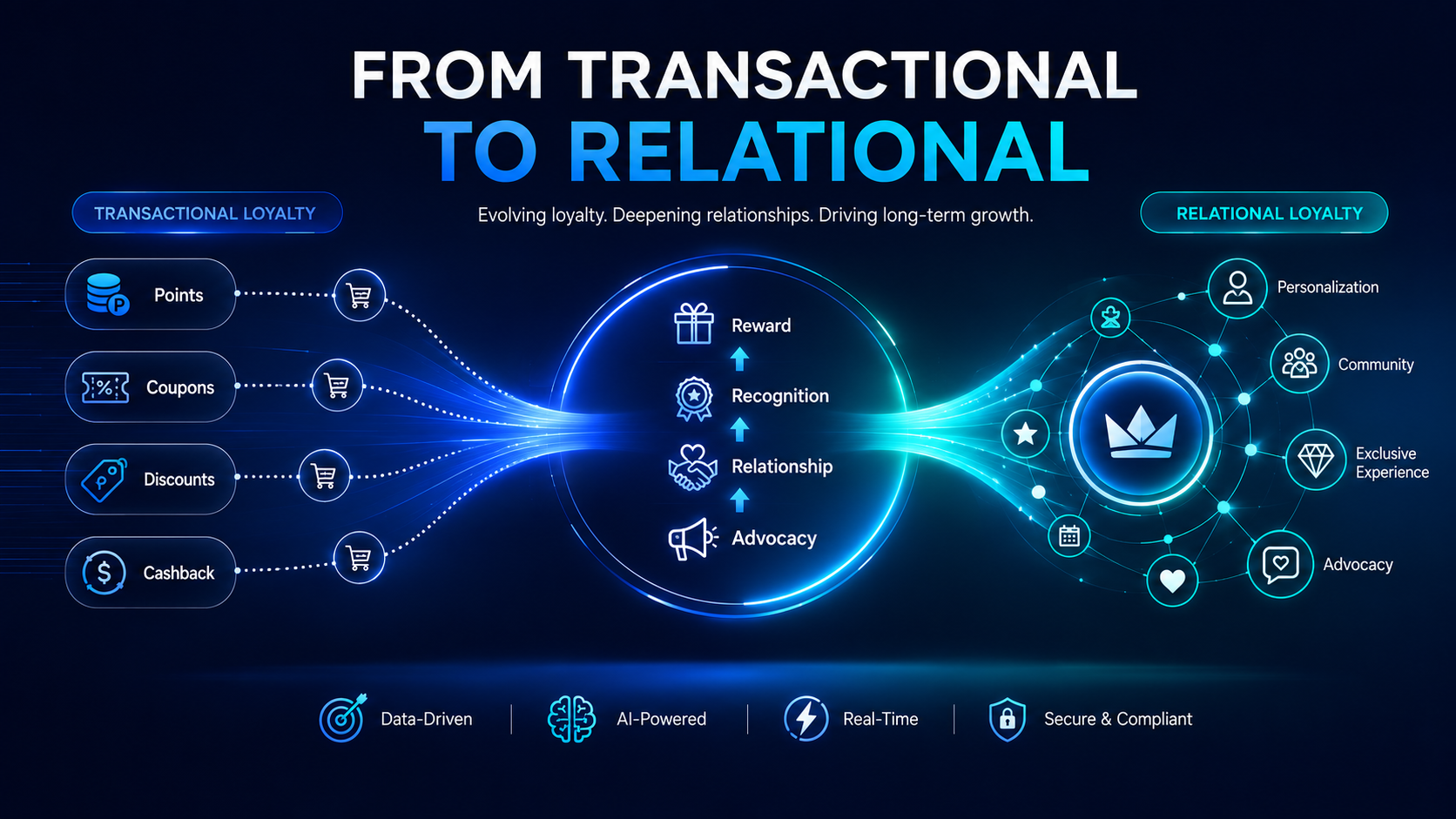
How Transactional and Relational Loyalty Differ
Transactional Loyalty focuses on stimulating purchases through Point Collection, Cashback, Coupons, and Discount Campaigns. The primary goal is to increase sales volume and purchase frequency.
Relational Loyalty focuses on building long-term relationships through Personalized Rewards, Member Experience, Exclusive Privileges, Community Engagement, and Brand Experience. The primary goal is to build an emotional bond between customers and the brand — so customers return not just for points, but for the value the brand delivers.
A Framework for Moving from Transactional to Relational Loyalty
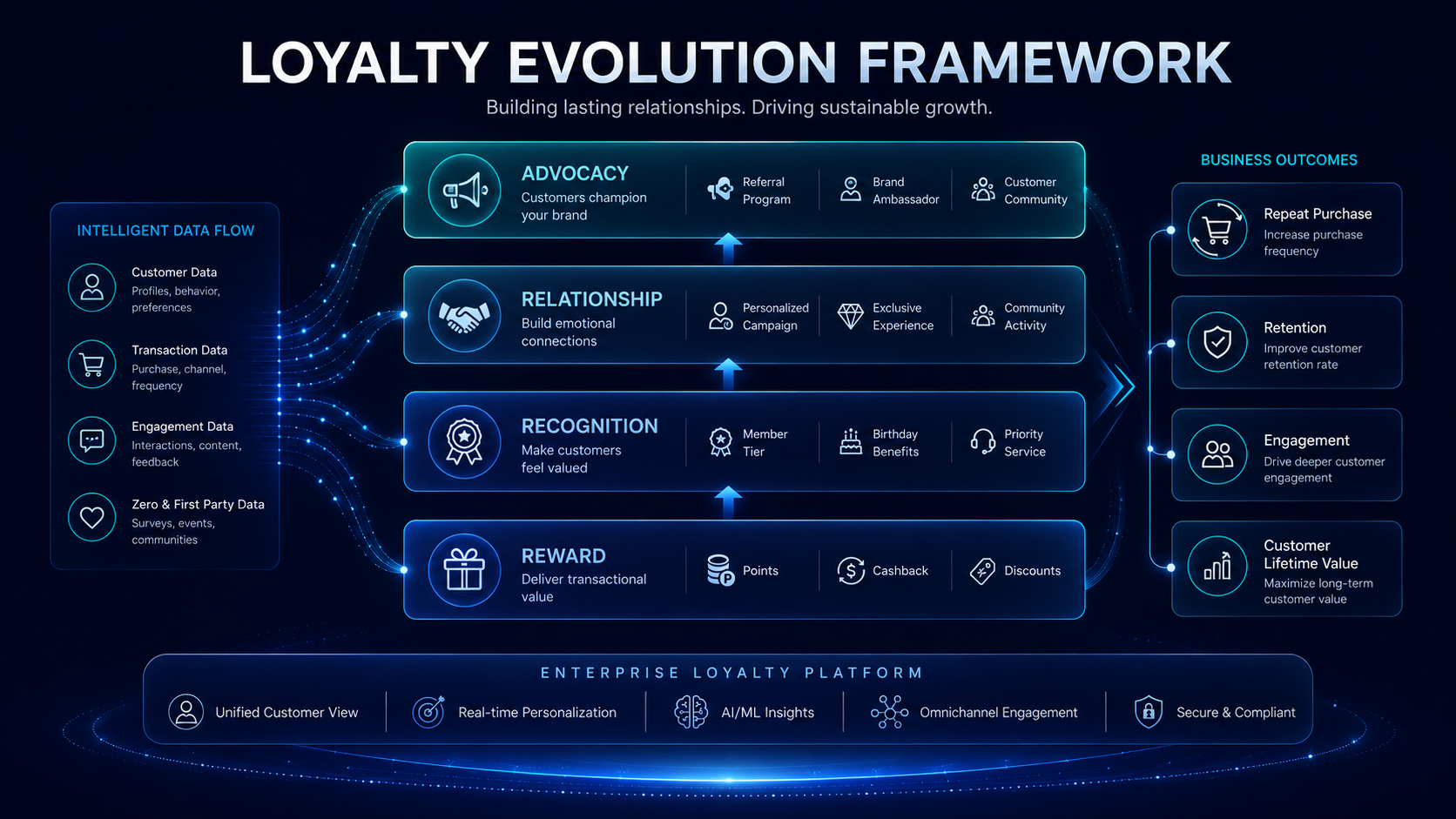
Building sustainable loyalty doesn’t happen overnight — it typically develops in stages.
1. Reward — Create motivation through rewards: points accumulation, discounts, cashback. Goal: Repeat Purchase
2. Recognition — Make customers feel the brand values them: Member Tiers, Birthday Benefits, Priority Service. Goal: Customer Retention
3. Relationship — Create meaningful interactions: Personalized Campaigns, Exclusive Experiences, Community Activities. Goal: Customer Engagement
4. Advocacy — Turn customers into brand advocates: Referral Programs, Ambassador Programs, Customer Communities. Goal: Customer Lifetime Value
Metrics Organizations Should Track Beyond Member Count
One of the most common misconceptions is using total member count as the primary success metric. In reality, that number may not reflect actual business outcomes.
Organizations should track metrics that directly reflect customer behavior: Repeat Purchase Rate, Customer Lifetime Value (CLV), Active Member Rate, Redemption Rate, Referral Rate, and Engagement Rate.
Where Does Technology Fit In?
As Loyalty Programs grow more complex, organizations need to manage member data, accumulated points, privileges, marketing campaigns, and Partner Ecosystems simultaneously across multiple channels.
The challenge isn’t in distributing points — it’s in transforming customer data and behavior into personalized experiences. Modern Loyalty systems therefore need to support Real-time Point Management, Campaign Management, Customer Segmentation, Personalized Experience, and Analytics & Performance Tracking.
Case Study: True Digital Group — When Loyalty Must Scale Across an Enterprise Ecosystem
Business Context and Challenge
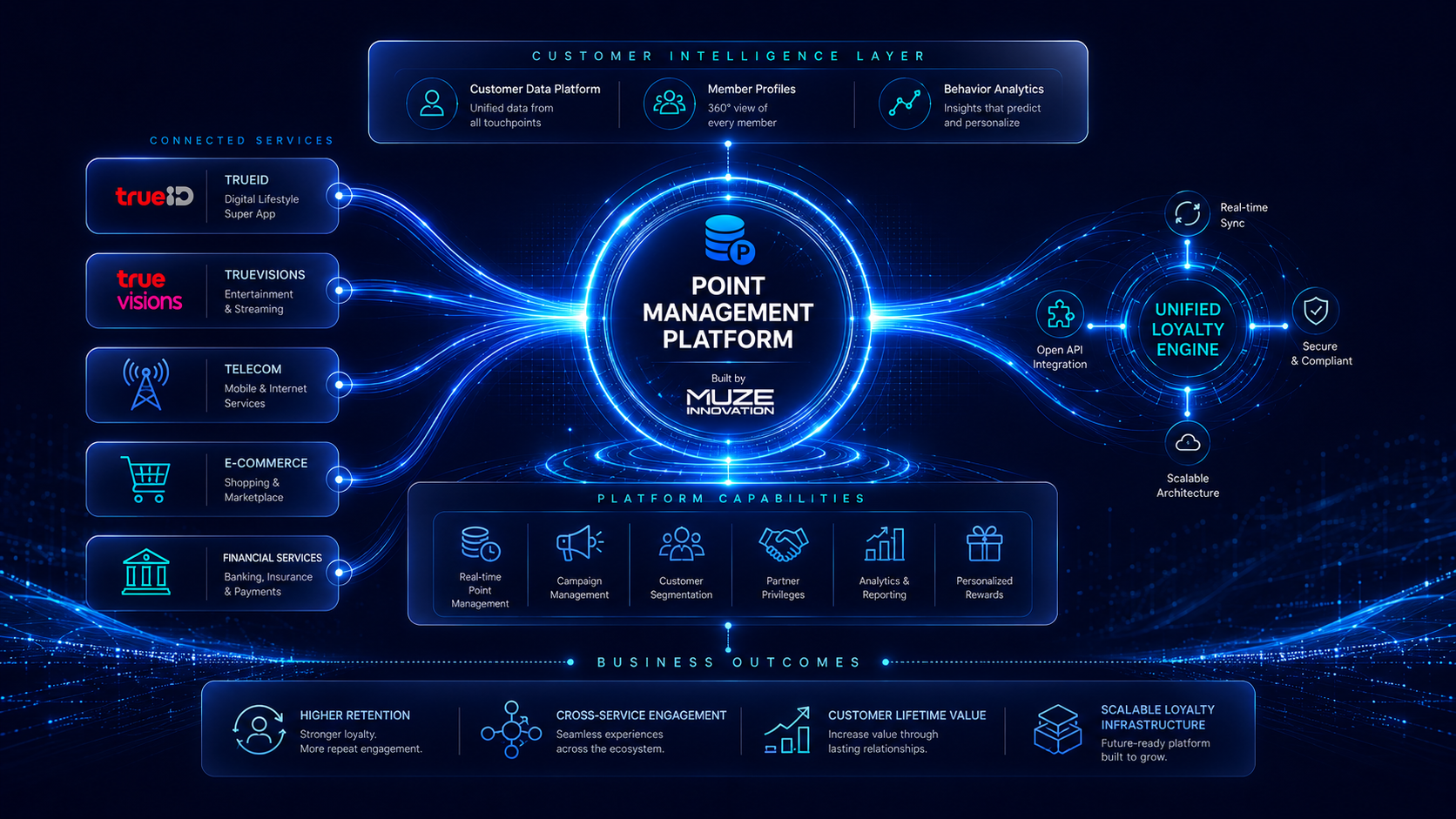
One of Muze’s most significant clients is True Digital Group (TDG), Thailand’s largest digital conglomerate under True Corporation, spanning services from Telecom, OTT, and Digital Content to E-Commerce and Financial Services.
The challenge TDG needed to solve wasn’t a generic points accumulation system — it was a Point Management System capable of supporting an entire Multi-Service Ecosystem, where the same customer could earn and spend points across services. This architecture requires system complexity far beyond what any off-the-shelf solution can provide.
Why Custom Development Over Ready-Made SaaS
Many organizations at TDG’s level ask whether they should “buy” or “build” a Loyalty Platform.
TDG’s decision to develop a Custom Point Management System with Muze came down to several key business considerations.
The first was unique Business Logic — TrueID, TrueVisions, True Leasing, and other services in the group each have different point accumulation rules and privileges. Using an off-the-shelf SaaS means accepting the system’s limitations, which often leads to higher customization costs or forcing the Business Model to conform to the system instead.
The second was Data Ownership and Integration — customer behavioral data is a Strategic Asset for the organization. A Custom system lets TDG integrate with its existing Internal Systems and maintain full data ownership.
The third was Scalability that grows with the business — a purpose-built system can expand its capabilities as needed, without paying License costs that scale with Transaction Volume — a cost that becomes significant as the user base grows.
What Muze Built for the TDG Point Management System
For the TDG Point Management System project, Muze developed a complete End-to-End Point Management Platform using continuous Agile delivery. By mid-2025, the project had reached Sprint 7-8, with additional QA Resources brought in to support Performance Testing — reflecting the comprehensive scope and enterprise-grade quality requirements.
The system covers everything from configurable Point Issuance Rules per service, Real-time Point Deduction on redemption, Campaign Management for conditional bonus point issuance, Partner Privilege Integration to connect with external ecosystems, through to Reporting and Analytics for the Marketing team to measure results.
ROI and Business Value Perspective
Investing in a Custom Point Management System may carry a higher Initial Cost than SaaS in the short term. But for Enterprise-scale organizations with large customer bases and diverse services, ROI calculations require a longer Time Horizon.
The cost savings from not paying per-Transaction License fees and retaining control over the system Roadmap often result in lower Total Cost of Ownership (TCO) over a 3-5 year period. Beyond that, the ability to design a Loyalty Experience that differentiates from competitors is a value that is difficult to quantify but critically important as a Competitive Advantage.
What TDG gained from this project isn’t just software — it’s a Loyalty Strategy Infrastructure that can continue to evolve in line with the business direction.
Insights from TDG: Lessons Any Organization Can Apply
From experience building Point Management Platforms for Enterprise-scale organizations, one recurring challenge stands out: many organizations have vast amounts of customer data but haven’t been able to use it to build long-term customer relationships.
A Point Management System shouldn’t be seen merely as a points accumulation system — it should be the infrastructure that enables an organization to design Loyalty Strategies in many forms: Point Programs, Tier Programs, Campaign-based Rewards, Referral Programs, Partner Privileges, or Personalized Rewards, creating a systematic path from Transactional Loyalty toward Relational Loyalty.
Conclusion: Strong Loyalty Doesn’t Start with Points
In an era where customers have more choices every day, building loyalty through discounts alone may not be a sustainable strategy.
The organizations that retain their customer base long-term aren’t the ones that give out the most points — they’re the ones that can transform every Transaction into a Relationship, backed by systems robust enough to support the growth of those relationships over time.
The True Digital Group case demonstrates that investing in the right Loyalty Infrastructure from the start isn’t just about reducing future costs — it’s about building competitive capability that rivals cannot easily replicate.
Because in the end, customers may come back for the points — but they’ll stay with a brand because of the relationship that brand has built throughout the entire customer journey.