There was a time when a software developer’s ability was measured by how many lines of code they could write.
The faster and the more you wrote, the more effective a developer you were seen as.
But in 2026, that belief is changing.
Now that AI can generate hundreds of lines of code within seconds, the important question is no longer “who can write code faster” — it’s “who can turn a business need into working software faster.”
Ideas like Vibe Coding, AI Coding Assistants, and Intent-driven Development are changing how software teams work around the world, and are becoming a meaningful part of business competition in the age of AI.
Organizations still measuring development teams by old metrics — story points, lines of code shipped per week — may be finding those metrics no longer reflect real competitive capability. As AI takes over more and more of the time spent writing code, what’s harder to measure but matters more is how fast an idea turns into a business outcome.
What Is Vibe Coding?
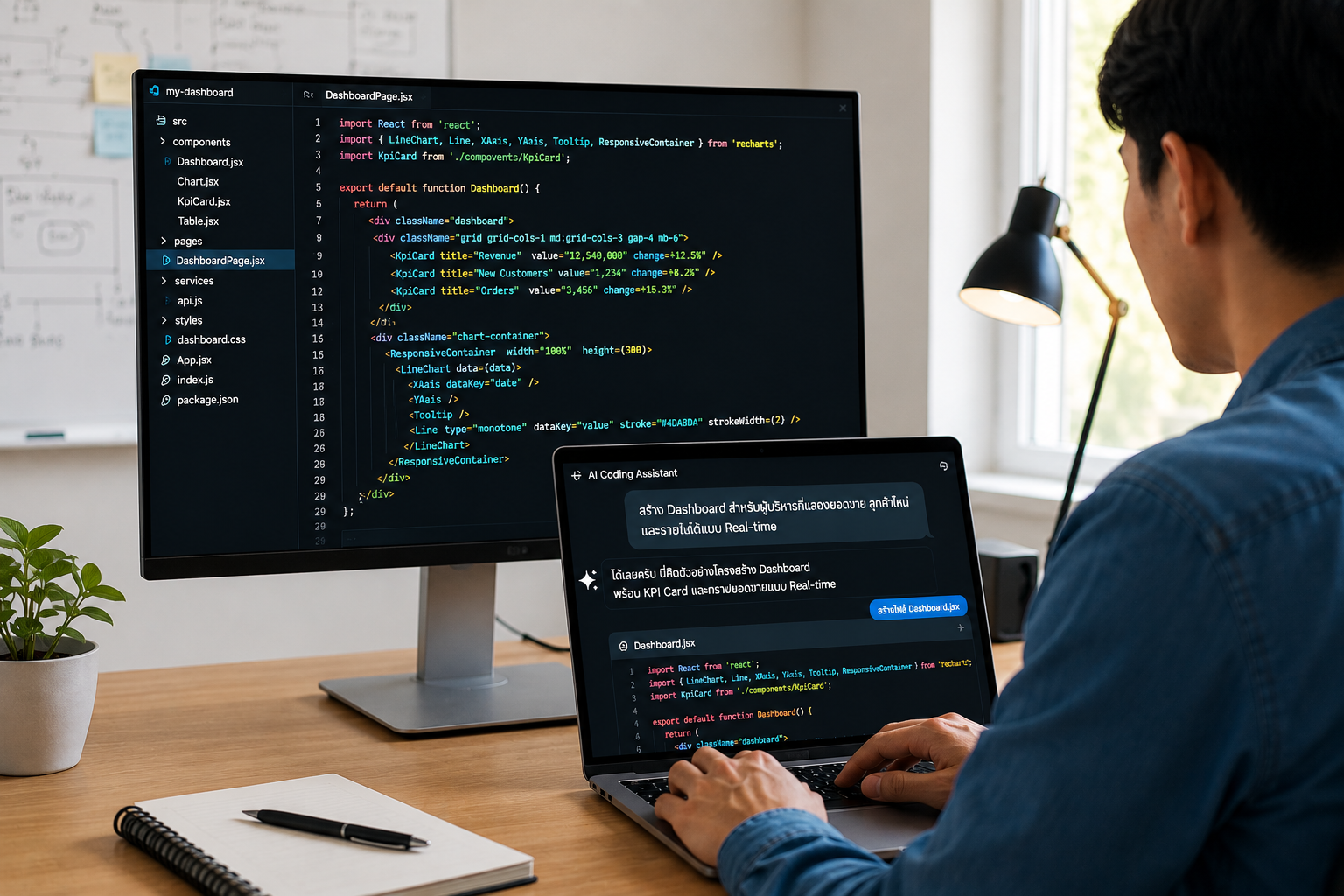
Vibe Coding is an approach to software development that shifts from writing code line by line to describing what you want in plain human language and letting AI generate the code.
Instead of a developer having to start by building the project structure, designing the API, or defining the database schema entirely by hand, they can describe what they need and have AI quickly generate a working draft of the system.
For example: “Build an executive dashboard showing sales, revenue, and new customer count in real time.”
Or: “Build an online booking system for a clinic, with notifications and an admin dashboard.”
AI can help scaffold a basic frontend, backend, or workflow within minutes.
So what’s changing isn’t just the speed of writing code — it’s the developer’s role shifting from “code writer” to “system designer and reviewer.”
The name “Vibe Coding” comes from the idea that a developer can work off the “vibe” — the feel — of what they want, instead of having to specify every line of syntax themselves. It’s similar to describing what you want to a highly skilled colleague and letting them handle the technical details. What’s different this time is that the “colleague” is an AI that works around the clock, with no limit on how many tasks it can take on at once.
AI Coding Assistant: From Autocomplete to Dev Partner
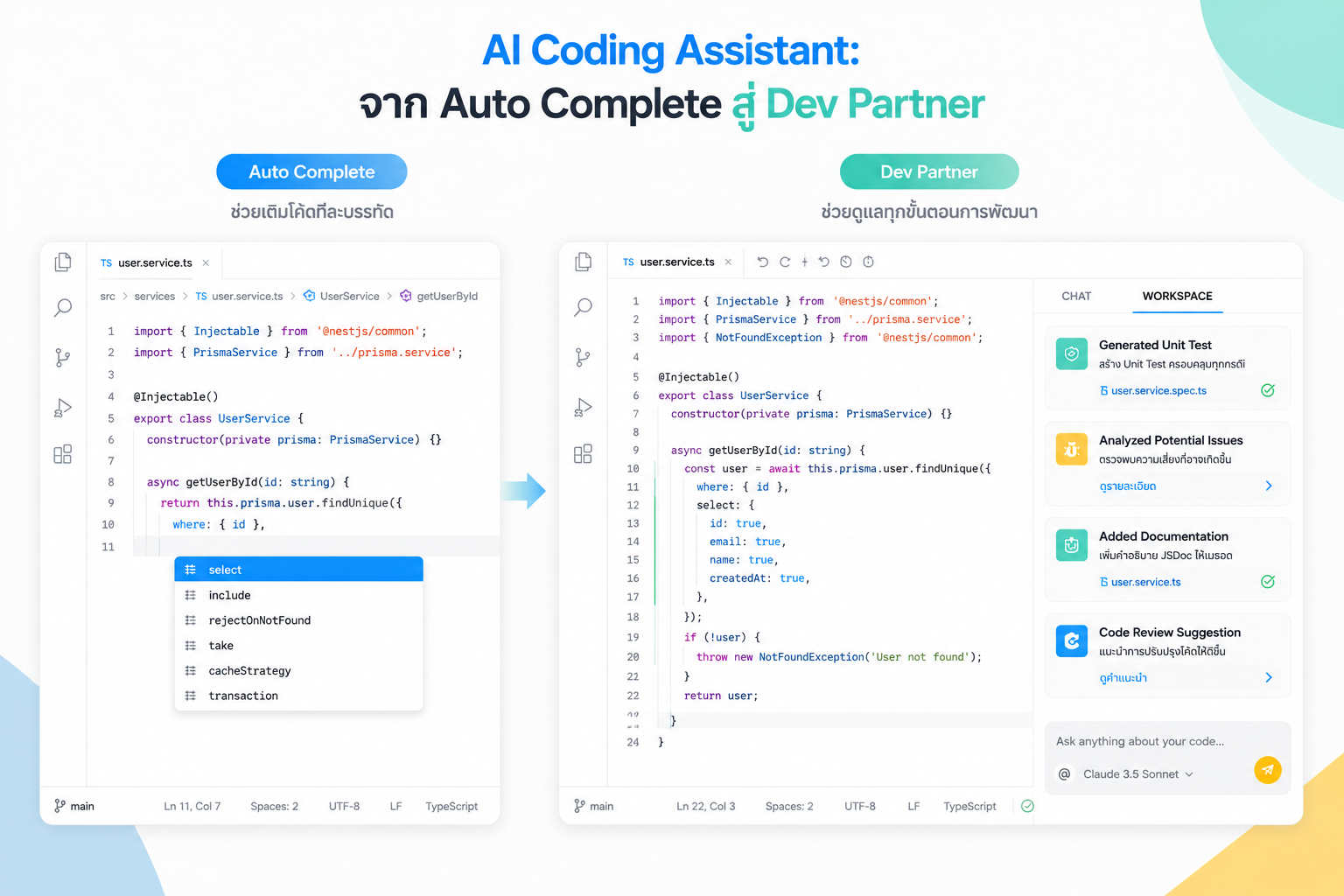
In its early days, the AI coding assistant was seen as just an autocomplete tool that helped fill in code faster.
Today, AI can help with nearly every stage of the software development lifecycle:
- Generating boilerplate code
- Writing unit and integration tests
- Refactoring code for better quality
- Analyzing bugs and error logs
- Generating technical documentation
- Reviewing code quality and risk
- Summarizing pull requests and code reviews
The result: developers spend less time on routine work and more time solving problems that create real business value.
That’s why an AI coding assistant is no longer just a code-writing helper — it’s becoming a dev partner that thinks alongside the team, analyzes, and supports the team’s decisions.
Why Is Development Team Productivity Going Up?
Many people assume the benefit of AI is simply writing code faster.
But in reality, most of a developer’s time isn’t spent typing code.
A large share of it goes to searching for information, understanding existing systems, building test cases, writing documentation, fixing bugs, and reviewing system quality.
When AI can cut time spent on these things, a team can ship new features faster without needing to add more headcount.
That’s why many organizations are bringing AI into their software development process — and seeing a clear improvement in productivity as a result.
What’s more interesting is that the productivity gain isn’t limited to the individual level — it carries through to the team level too. As each developer spends less time on routine work, the time freed up across the team goes toward reviewing each other’s work, designing architecture together, and planning higher-impact business work — activities that are hard to speed up simply by adding more people.
Intent-Driven Development: When the Goal Matters More Than the Code
Another idea emerging alongside Vibe Coding is Intent-driven Development.
In the past, software development usually started with a requirements document that spelled out technical details in depth.
Business Requirement → Design → Code → Test → Deploy
But as AI takes on a bigger role, the starting point of development can shift from a requirement to an intent — a business goal.
For example:
- Increase the checkout page’s conversion rate
- Cut the time it takes to sign up
- Improve internal employee productivity
- Reduce operating costs
AI then helps translate these goals into a system design and an initial draft of the code.
This shifts business and technology closer together, because the conversation no longer starts with the technology — it starts with the business outcome the organization actually wants.
The result: a product manager or business unit owner can help shape a system’s direction from the very start, without waiting for a technical team to translate the requirement first. Decisions move faster, because the distance between the person who understands the business problem and the person actually building the system shrinks dramatically.
Will Developers Be Replaced?
Whenever a new technology arrives, the same question comes up: will AI replace developers?
The answer is no.
What AI replaces is routine work — generating boilerplate code, writing tests, or producing documentation.
What still requires a human:
- Architecture design
- Product thinking
- Business understanding
- Security design
- Governance
- Decision-making
The more capable AI becomes, the more valuable these skills become too.
Future developers may spend less time writing code and more time designing systems, solving business problems, and creating differentiated value for their organization.
An Era Where Both Developers and Non-Tech Employees Can Build Tools
What Vibe Coding changes goes beyond developer speed — it opens the door for people who have never written a line of code to build their own tools too.
Employees in finance, sales, or operations — the people who understand their own day-to-day problems best — can now describe what they need in plain language and let AI build a small tool for them to use, without waiting in line for the IT team the way they used to. This is a meaningful shift, because the ability to “build” is no longer tied to holding the title of developer.
But non-tech employees being able to build tools doesn’t mean developers matter less — it means the value developers bring shifts to a different place.
- Developers still understand architecture, security, and scalability at a level that lets a system reliably support a large number of users.
- Developers can design the shared standard that lets every tool built across the organization — no matter who built it — sit on the same foundation, be auditable, and stay maintainable long term.
- Developers are the ones who know when a problem has gotten too complex for Vibe Coding to handle, and needs to be escalated to a more rigorous design process.
At the same time, non-tech employees don’t have to stop at building a prototype just for themselves to play with. If an organization’s governance is set up properly, with a process that can actually enforce standards, a tool a non-tech employee builds can go into real use at the team or organization level too — no different from a tool a developer built.
In short, the future of software development inside an organization may not be “developers build, or non-tech builds” — it’s “anyone can build, as long as there’s a shared standard to support it.” That shared standard is exactly what turns prototypes coming from every corner of the organization into systems that are genuinely usable, safe, and maintainable long term.
What Kind of Work Is Vibe Coding Suited For?
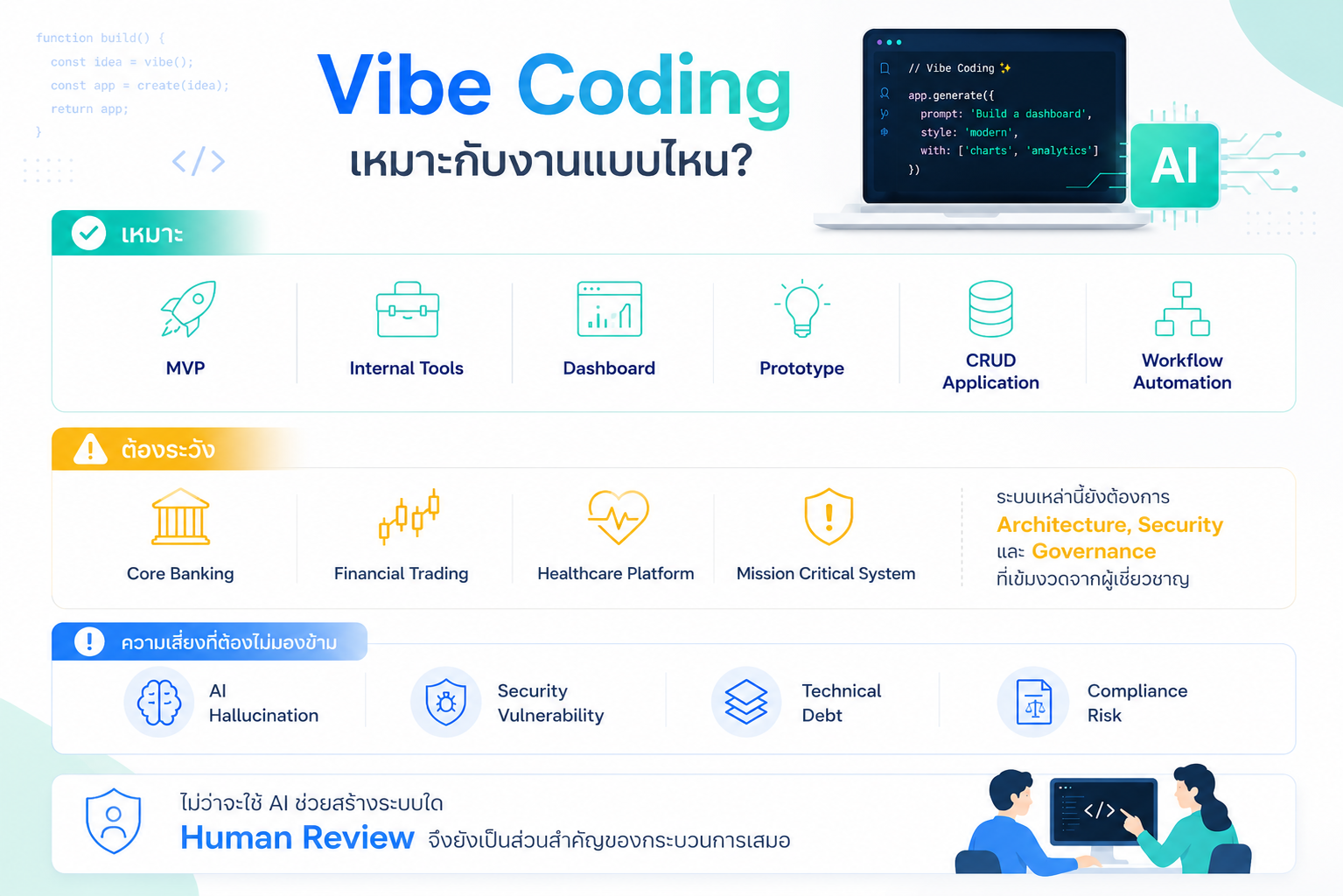
Even though AI is highly capable, that doesn’t mean every system should be built with Vibe Coding.
Work well suited to AI-assisted development includes:
- Startup MVPs
- Internal tools
- Dashboards
- Prototypes
- CRUD applications
- Workflow automation
Meanwhile, highly complex systems or those carrying high business risk — core banking, financial trading, healthcare platforms, or mission-critical systems — still require rigorous architecture, security, and governance from experienced specialists.
A reasonable way to tell the two apart is to look at the cost of failure. If a system going down or having a bug means limited fallout — a dashboard showing data a day late, say — that kind of work suits Vibe Coding well. But if a mistake touches customer money, health data, or the security of a core system, the cost of failure is too high to let a prototype become production without rigorous review.
Risks Organizations Shouldn’t Overlook
Even though AI can dramatically speed up development, there are risks that need to be actively managed — especially as Vibe Coding lets more and more people across the organization build their own tools at the same time.
These risks aren’t hypothetical. They’re patterns Muze has seen repeatedly working with organizations that started letting their teams build tools with AI.
- Built it. But only the builder uses it. — A tool that looks great to the person who built it, but lives only on their own machine. No infrastructure to support it, no access control, no way for the rest of the team to actually use it. A great tool ends up as nothing more than a demo.
- Nobody knows if it’s safe. — A tool that was built without going through a security review. Nobody knows where the data flows, or how the AI handling company information actually works. Leadership won’t approve rolling it out further.
- Training done. Nothing changed. — Employees complete an AI workshop, then go right back to working exactly as before, because there are no right tools, no supporting process, and nowhere for what they built to actually go.
Beyond these process-level risks, there are technical risks that need equal attention:
- AI hallucination
- Security vulnerabilities
- Technical debt
- Compliance risk
That’s why human review remains an essential part of the development process.
AI can help generate code quickly, but responsibility for quality, security, and business impact still rests with the team and the organization. What an organization needs isn’t a ban on using AI to build tools — it’s a shared standard that lets everyone build safely from the start.
Conclusion
Vibe Coding and AI coding assistants don’t mean developers are disappearing from the software development process.
If anything, the developer’s role is being elevated — moving closer to solving business problems.
Going forward, an organization’s advantage may no longer come from how many developers it has, but from how effectively it can pair AI with its development team.
Because once AI can generate code in seconds, the differentiator is no longer writing code — it’s understanding the business problem, designing the right system, and shipping results faster than the competition.
The question that follows: as both developers and non-tech employees build prototypes faster and faster, does your organization have the shared standard in place to take those prototypes into safe, real-world use — instead of leaving them as demos only one person can run?
Looking for a Technology Partner to Build a Digital Platform or Enterprise Software?
At Muze Innovation, we help organizations design and build digital systems that meet real business goals — from MVPs and enterprise platforms to streaming platforms and specialized systems that need flexibility and long-term scalability.
If your organization is in a situation where teams can build prototypes fast with AI, but still lack the standard to take them into safe, organization-wide use, take a look at Muze Innovation’s AI Prototype to Production service — built specifically to close that gap, from a Workshop that teaches employees to build tools, to an Internal App Store that makes those tools usable across the whole organization.