Today, AI can build a working application in a few hours. The user only has to describe what they want in plain language. This way of building software is called vibe coding, and it is turning employees across every function into builders of their own tools.
That speed lets organizations solve problems much closer to where the work actually happens. But there’s another side to it: an application that “works” isn’t necessarily “ready for real use”, especially once those tools start touching customer data, connecting to internal systems, or getting passed around to large numbers of employees.
What Vibe Coding Is, and Why It’s Spreading So Fast Inside Organizations
Vibe coding means building software by letting AI write the code. The user describes what they need, tries the result, and keeps asking the AI to adjust it until the tool does the job, without needing to read or understand every line of code.
For employees who understand the problems in their own work well, this cuts the wait for a development queue from several weeks down to a few hours. Marketing can build a dashboard to track campaigns, HR can build a form for handling requests, and Finance can build a tool for reconciling data, all on their own.
Vibe coding’s strength, though, is that it makes building tools easier. Security, data handling and long-term maintenance still require specialist knowledge, just as before. When the builder can’t see all the details of the code, some risks can stay hidden without anyone noticing.

When an Application “Works” but Isn’t Yet “Safe”
AI is designed to produce code that does what it’s told. If the instructions don’t say anything about security, the AI may take the easiest route to get the system working right away, and that’s often where the most common vulnerabilities begin.
- Credentials and API keys embedded in the code. To connect quickly to a database or an external service, passwords and API keys may be written straight into the code. If that code is shared or published somewhere public, those secrets leak along with it.
- Incomplete authentication and access control. Many quickly built applications let anyone with the link get in, or they have a login but don’t separate what each user should be allowed to see.
- Vulnerabilities hidden in the code. For example, not validating what users type in, which can open the door to SQL injection, or showing error messages that reveal how the system is built.
- Unvetted packages and libraries. AI may pick libraries that are outdated or have known vulnerabilities, or even reference a package name that doesn’t exist, which an attacker can then register to slip malicious code into the system.
These problems usually don’t show up during the trial phase, because the application still runs normally. They become real risks the moment the tool is used with real data or opened up to many users.
The Data Risks an Organization Can’t See
Beyond the code itself, organizations also need to pay attention to where their data goes. While building an application, an employee might test it with customer data, employee data or internal documents in an AI tool the organization hasn’t approved. They don’t mean any harm; they just want the tool to behave as close to real use as possible.
Once the application is built, the next step is usually putting it online through an off-the-shelf hosting service, which takes a few clicks and works straight away with a personal account. These tools are often published with no login at all, so anyone who gets hold of the URL, whether it was forwarded in a chat or indexed by a search engine, can reach the customer data or internal information inside. And because these applications sit outside the structure IT manages, the organization may have no idea any data has leaked until a real problem surfaces.
For organizations in Thailand, this ties directly to the Personal Data Protection Act (PDPA), which requires organizations to handle the collection, use and disclosure of personal data appropriately. Applications built outside the governance process can therefore leave an organization with compliance obligations it doesn’t even know it has.
Shadow IT in the AI Era: When Employees Can Build Their Own Systems
Many organizations are familiar with shadow IT: employees using systems or tools for work that IT doesn’t know exist and doesn’t manage. In the past, that usually meant signing up for outside software on their own. In the age of vibe coding, employees can build new systems themselves, so the number of tools outside IT’s line of sight grows faster than ever.
A tool that starts out for personal use often gets passed along by link until it becomes part of the whole team’s workflow. At that point, the organization may face questions nobody can answer: who owns this application, who’s responsible when it breaks, and who will look after it if the person who built it moves teams or leaves?
Another consequence is duplication. Each team may build tools that do similar things without knowing one already exists, and each one uses whatever technology stack the AI recommended that time. Over the long run, the organization is left maintaining a large number of systems that are all built differently.
Risks to Core Systems and Business Continuity
The risk goes up another level once applications start connecting to the organization’s core systems, such as ERP, CRM or production databases. To make the connection easy, a builder might use an account with far more privileges than the tool needs, which means that if the tool misbehaves, the damage can reach critical data immediately.
There have already been widely reported cases overseas of an AI coding agent deleting a production database, even after the user had told it to stop changing the code. Incidents like this show that once AI is given permission to act, separating experimental environments from production and properly limiting permissions becomes essential.
On top of that, applications built in a hurry often have no testing, backups, audit logs or rollback plan. When something goes wrong, the team may be unable to trace what happened, and restoring the system takes much longer.
Governance Isn’t There to Slow Innovation Down. It Lets Innovation Go Further
Looking at these risks, an organization might feel it has to choose between speed and safety. In reality, well-designed governance gives you both, by setting clear boundaries within which employees can build tools with confidence.
- A shared standard from the very start. Defining the templates, technology stack and data connection methods the organization endorses keeps applications from different teams structurally similar and easy to maintain.
- Centralized identity and access management. Every application uses the organization’s own authentication, and credentials are managed through a central system instead of being embedded in code.
- Review before going live. Automated vulnerability scanning combined with review by the relevant teams makes sure an application meets security and data privacy criteria before anyone else can use it.
- A central place to publish and track applications. The organization knows which tools exist, who owns them and who’s using them, which cuts down on duplicate tools.
- Management across the full lifecycle. From updates and usage monitoring to systematically retiring systems that are no longer used.
AEGIS: Letting Every Team Build Applications Under One Standard
The core idea behind AEGIS by Muze Innovation is to build governance into every stage: before building starts, during review, and after going live. Employees can still build applications with AI just as fast, while the organization keeps oversight at every point.
Governance starts before the first line of code. The Builder Kit gives the AI coding tool employees already use, whether that’s Claude Code or Codex, the organization’s context: UX/UI standards, frontend and backend structure, the organization’s login system, and the list of data connections IT has already approved. The AI builds every application within the same framework from the start, instead of choosing new technologies or connection methods each time.
Every application goes through a Governance Pipeline before going live. The review covers three areas: a Security Check that looks for vulnerabilities before deployment, a Stack Check that confirms the technology is appropriate and maintainable over the long term, and a Data & Privacy Check that confirms data is used according to the organization’s standards.
People still make the final call. Applications are tested in a staging environment first and must be approved by an admin before going live. After deployment, the system is checked again, and it can be rolled back to the previous version immediately if a problem is found.
Clear access rights, from the user level down to the data level. Employees sign in with their company email, roles are split into User, Builder and Admin, and you can define who can see or use which application. Each application has its own separate storage and database, and any request for extra capabilities, such as an AI model or a data connection to another system, needs admin approval every time.
Every application has an owner, and everything is visible from one place. Approved applications are published on an Internal App Store, a central place where employees can find and use tools in an organized way. Every application has a clearly responsible owner, and IT can see the big picture, track usage and AI and infrastructure quotas, and retire unused systems step by step.
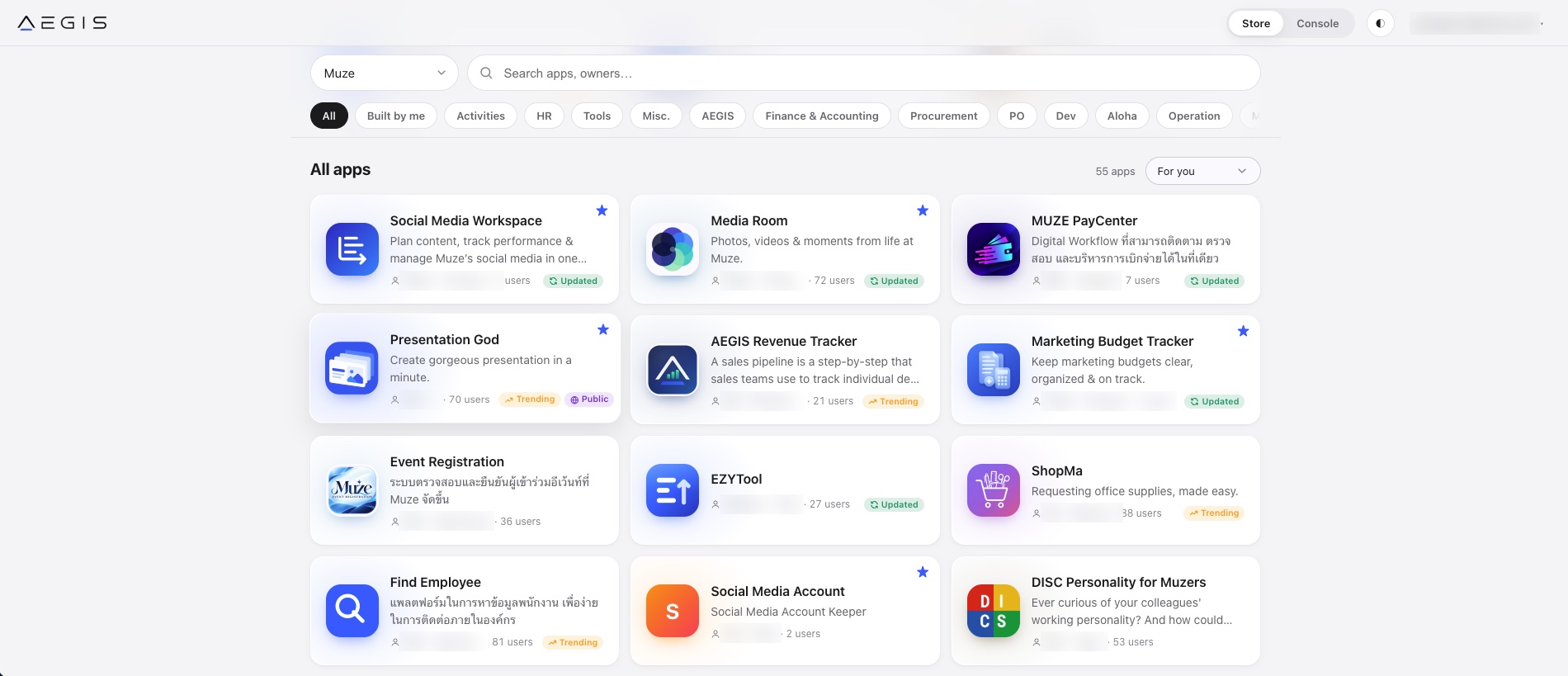
Looking back at all the risks above (vulnerabilities in the code, data exposed to outsiders, tools with no owner and systems with no plan for when things go wrong), each one has a matching control point in AEGIS.
With this approach, employees can still build tools quickly with AI, but every application goes into real use through a process the organization can govern. Speed of building no longer has to come at the cost of risks nobody can see.
AI’s Speed Creates Real Value When the Structure Is There to Support It
Vibe coding lets employees turn their knowledge and experience into tools faster than ever, and that’s an opportunity no organization should overlook.
What turns that opportunity into long-term value is putting a structure in place that keeps every application secure, auditable and clearly owned, from the first day it’s built to the day it goes into real use.
Organizations that start putting governance in place alongside encouraging employees to use AI will be able to grow small team tools into enterprise-grade solutions with far more confidence.