
Whenever someone mentions a website revamp, the image that comes to mind is usually new design, new colors, new fonts, a more modern layout. But from a business perspective, a revamp done purely for aesthetics is an investment that can’t be measured — and rarely delivers worthwhile ROI.
Real projects Muze completed with XSpring Capital and HUGS Insurance demonstrate that a strategically planned website revamp can create business outcomes that are far more tangible and measurable.
Why an Outdated Website Costs More Than You Think
Before discussing how a revamp generates ROI, it’s important to understand that a neglected website carries hidden costs at multiple layers.
Visible costs like hosting, domain fees, and maintenance are manageable. But the costs that are most often overlooked are what an outdated website silently causes the business to lose — sales opportunities disappearing because of slow load times, a brand image that no longer matches the organization’s actual level, or a marketing team that has to wait on developers every time they need to update content.
Case 1: XSpring Capital — When the Website Is the First Impression of a Fintech Business
XSpring Capital, a Financial Technology and Capital Market company, had a clear brief: the existing website wasn’t communicating the organization’s positioning at the level the business had grown to.
In financial services and capital markets, the credibility of the first digital touchpoint that investors or partners encounter carries significant weight. The previous website couldn’t handle increased traffic levels and wasn’t designed to support content that needed frequent updates — a pain point directly impacting the team’s operational efficiency.
Muze led the XSpring Revamp Website project in 2026, with a team comprising a Dev Manager, Sr. Developer, Frontend Developers, and a QA Engineer. Delivery was structured as incremental — customers could see progress and validate at every 2 Sprints.
Why this approach makes business sense
Breaking work into Sprints with payment milestones every 2 Sprints isn’t just project management — it’s about aligning risk between the client and the partner. Clients pay against real deliverables rather than paying everything upfront and waiting. The development team, in turn, has the incentive to deliver against each Sprint’s commitments, reducing the risk of delays or scope creep that plague traditional website projects.
Case 2: HUGS Insurance — Revamp to Support Business Growth
HUGS Insurance is another project that reflects a different dimension of what a revamp can accomplish.
In insurance, a website isn’t just an online brochure — it’s where customers decide, compare plans, and in many cases, begin their entire customer journey. The challenge for HUGS Insurance was building a digital experience capable of supporting long-term business growth, not simply updating the design.
The HUGS Insurance Revamp Website project began in 2026 with a team that included DevOps from day one — signaling that the requirements weren’t just frontend-level, but involved Performance, Infrastructure, and Scalability that needed careful architectural design.
The key business insight is that insurance companies today compete on Speed-to-Market. Enabling non-technical teams to update content themselves via CMS — without waiting for developers — reduces time-to-publish from days to hours. For businesses that need to update promotions, announce plan changes, or adjust messaging based on market conditions continuously, this value is clearly measurable in reduced Operational Cost.
ROI That’s Actually Measurable — Not Just Pretty Numbers
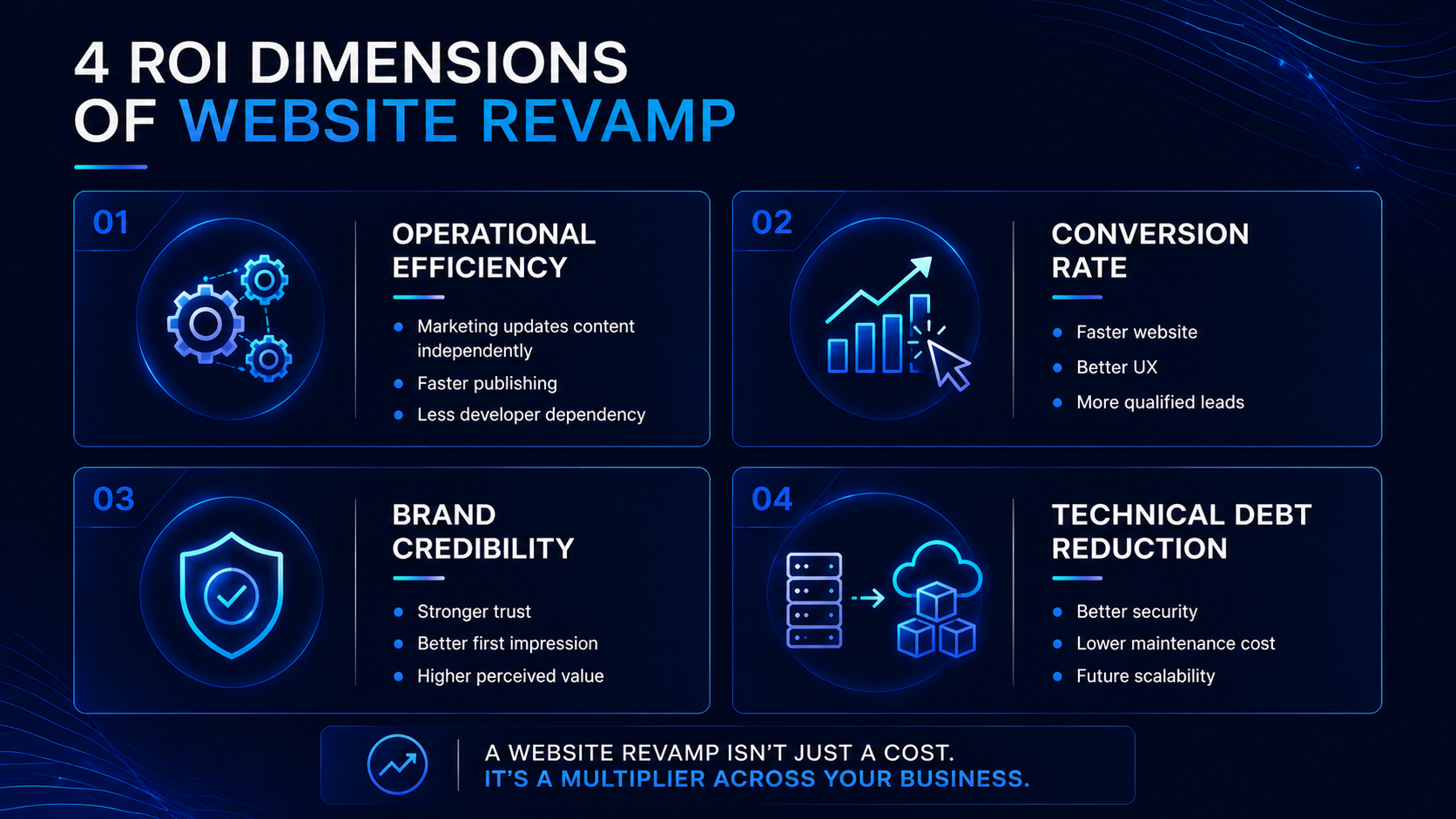
When you look beyond the surface of “the website looks better,” the real ROI of a website revamp comes from multiple dimensions simultaneously.
Operational Efficiency — A marketing team that can update content themselves via CMS returns bandwidth to the development team, who can focus on higher-value work. In business terms, this is a Cost Center Reallocation, not just task reduction.
Conversion Improvement — A website that loads fast, works seamlessly across all devices, and has clear CTAs directly impacts Conversion Rate. Even improving Bounce Rate by 10-15% in a high-traffic business can translate to meaningfully increased revenue.
Brand Equity — Particularly in financial services and insurance, the credibility communicated through Digital Presence influences customer and investor decisions. The relationship between Website Quality and Perceived Credibility produces real Business Outcome, even if it’s hard to capture in a single metric.
Technical Debt Reduction — An outdated website running on a legacy framework carries Hidden Costs in Security Vulnerabilities, Performance Bottlenecks, and Integration Limitations. A revamp structured to support future growth is an investment that reduces Maintenance Cost over the long term.
How to Choose a Website Revamp That Delivers Real ROI
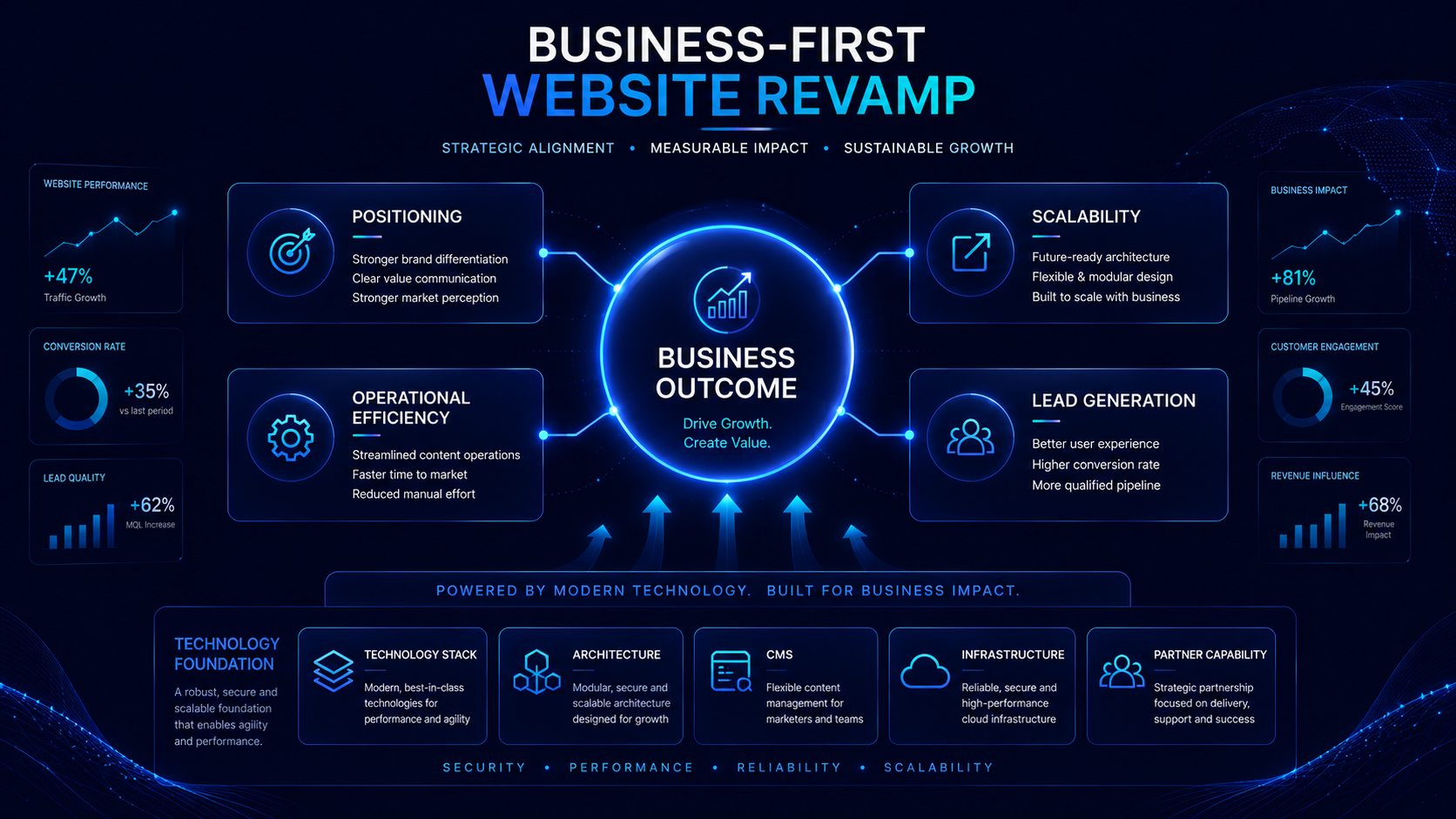
Lessons from both projects highlight an important pattern.
Start by defining Business Outcomes, not Feature Lists — XSpring’s brief wasn’t “we want a better-looking website.” It was “a website that communicates our Positioning at the level our Business has reached and can handle increased Traffic.” When Business Outcomes are clear, Technology Stack and Architecture choices follow the Outcome — not the current trend.
Choose a partner who understands both sides — A successful revamp requires a team that understands both the client’s Business Context and has the Technical Depth to design systems that support growth. Not just a team that delivers to spec.
Measure success with Business Metrics, not Design Awards — Conversion Rate, Bounce Rate, Content Update Frequency, Developer Bandwidth recovered — these are the indicators that tell you whether the new website is actually working for the business.
A website is the first Digital Touchpoint that too many organizations undervalue. A revamp designed with a business-first mindset from the start isn’t just about looking better — it’s about building an Asset that works for the business 24 hours a day, with ROI that can actually be measured.